LeMill is one of my favourite tools to create online material. It's so simple and easy to use. What I like a lot is that they always follow their time, like here I'm testing how the embedding of my content happens in another platform.
Here is one "Collection" that I've created called "hansin kamaa" = stuff from Hans. It includes two different pieces of content. Apart from exporting the content as a zip-file, I can now also just embed it somewhere, for example in my blog. Pretty neat - and useful!
Testing something else here:
Showing posts with label leMIll. Show all posts
Showing posts with label leMIll. Show all posts
Monday, June 15, 2009


Wednesday, November 14, 2007
Tagging in different e-learning environments
In the last days we've had a few discussions about tagging in e-learning environments. My environment, where the tagging takes place, is a portal for learning resources.
Today I came across this nice graph that displays "power law of participation". Now, haven't looked at the scientific background of it yet, so no comments on that. Anyway, it kinda rang the bell with what I'm doing when looking into levels of user engagement on the portal.
According to this graph, adding things to favourites (e.g. bookmarking) and tagging them represents a pretty low threshold to participate in the activities of that given community.

I'm also looking at leMill environment, which on the other hand, demands a pretty hight level of user engagement, as it is about collaborative authoring of digital learning resources. About a year down with users, there is somewhat little collaborative authoring that actually takes place, Hans told me yesterday.
Maybe tagging in some way could help the participant to take the first steps? well, they can already tag and favourite things in LeMill, so maybe the issue is rather to see if similar levels of engagement appear in that community.
So, along with that, I am interested in looking at the tags in LeMill from the same point of view that I'm doing for tags in our learning resources portal. The difference is that our case is clearly what is called broad folksonomies, whereas leMill should be a rather classical narrow folksonomy. Or is it? Maybe once we start looking at those tags as a triple {user, resource, (tags)} with a timestamp on them, it appears that participants first start by bookmarking and tagging resources from other users, before the user takes a step to create her own resources and finally collaboratively work on other's resources.
Update:
So, some data to back-up was found:

Social Technographics®
Mapping Participation In Activities Forms The Foundation Of A Social Strategy
by Charlene Li
http://www.forrester.com/Research/Document/Excerpt/0,7211,42057,00.html
Today I came across this nice graph that displays "power law of participation". Now, haven't looked at the scientific background of it yet, so no comments on that. Anyway, it kinda rang the bell with what I'm doing when looking into levels of user engagement on the portal.
According to this graph, adding things to favourites (e.g. bookmarking) and tagging them represents a pretty low threshold to participate in the activities of that given community.
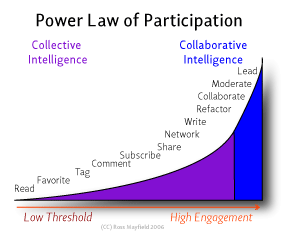
I'm also looking at leMill environment, which on the other hand, demands a pretty hight level of user engagement, as it is about collaborative authoring of digital learning resources. About a year down with users, there is somewhat little collaborative authoring that actually takes place, Hans told me yesterday.
Maybe tagging in some way could help the participant to take the first steps? well, they can already tag and favourite things in LeMill, so maybe the issue is rather to see if similar levels of engagement appear in that community.
So, along with that, I am interested in looking at the tags in LeMill from the same point of view that I'm doing for tags in our learning resources portal. The difference is that our case is clearly what is called broad folksonomies, whereas leMill should be a rather classical narrow folksonomy. Or is it? Maybe once we start looking at those tags as a triple {user, resource, (tags)} with a timestamp on them, it appears that participants first start by bookmarking and tagging resources from other users, before the user takes a step to create her own resources and finally collaboratively work on other's resources.
Update:
So, some data to back-up was found:

Social Technographics®
Mapping Participation In Activities Forms The Foundation Of A Social Strategy
by Charlene Li
http://www.forrester.com/Research/Document/Excerpt/0,7211,42057,00.html
| This is a document excerpt EXECUTIVE SUMMARY |
| Many companies approach Social Computing as a list of technologies to be deployed as needed — a blog here, a podcast there — to achieve a marketing goal. But a more coherent approach is to start with your target audience and determine what kind of relationship you want to build with them, based on what they are ready for. Forrester categorizes Social Computing behaviors into a ladder with six levels of participation; we use the term Social Technographics® to describe a population according to its participation in these levels. Brands, Web sites, and any other companies pursuing social technologies should analyze their customers' Social Technographics first and then create a social strategy based on this profile. |
Subscribe to:
Posts (Atom)
