Showing posts with label papers. Show all posts

Saturday, September 26, 2009

Impact of ICT use on educational performance

The question the top-dog politicians nowadays ask is the impact of ICT on educational performance. Especially in the school sector, this has been the trendy question since a few years, when the policy makers realised that they want to see some return on their investment (i.e. all the hardware put in schools). My favourite EUN report on recent research is The ICT Impact Report (01/2007).

This week at the OECD's New Millennium Learner conference South-Koreans presented another interesting study towards this direction. Prof. Heo's presentation is available here, check the pages from 20 onwards for the results. The study included 10% of the 10th graders in South-Korea (1071 students, random sampling). The design of the study looked at the use of ICT
  • Place: in-school and out-of-school use of ICT
  • Purpose: learning vs. entertainment use of ICT
  • Context: individual use vs. social use of ICT
Educational performance was divided into:
  • Cognitive domain
  • Affective domain
  • Socio-cultural domain
Significant impact was found on educational performance with:
  • Out-of school ICT use
  • ICT use for learning
  • ICT use in individual context
Note, in-school use did not yield any significant impact :/ More interestingly, out-of-school use of ICT for learning purposes had a positive correlation (r=0.520, p= 0.00) with cognitive domain of educational performance, which shows good news for informal context of learning.

Tuesday, September 01, 2009

Best Paper Award in ICWL'09

The paper that I presented in ICWL'09, Are tags from Mars and descriptors from Venus? A study on the ecology of educational resource metadata, was awarded the Best Paper Award. That was pretty dam cool! The picture below shows how psyched I was to pick up the award at the gala dinner. You'll find the paper from here and a news release from here.

The picture is by Kevin Chen from RWTH, Aachen.

Ok, this is an inside joke: I've named the pic "la vengeance se mange très-bien froide", for those who know the story, you guessed that the timing of this award could not have been better! Thanks for the co-authors and the jury :)

Tuesday, June 30, 2009

Study on contexts in tracking usage and attention metadata in multilingual Technology Enhanced Learning

Just submitted the final version of the paper to a workshop on Exploitation of Usage and Attention Metadata (EUAM 09). Here is a one-pager about it and the link to the paper.

Study on contexts in tracking usage and attention metadata in multilingual Technology Enhanced Learning

“Context” is widely accepted to be important for correctly interpreting user input and for improving predictive and possibly also diagnostic models. But what is context, and how can it be measured? By measuring we mean to operationalise the construct and data gathering to provide values for the desired variables.

In this study, we consider the intersection of the areas of digital learning resource repositories, digital libraries and social tagging systems where users from a variety of countries use technology enhanced learning (TEL) offerings in a variety of languages. We consider usage and attention metadata as an example of the wider notion of context adapting the definition of context as “any information that can be used to characterise the situation of entities” [Dey01]. We give an overview of dimensions of context that are relevant in TEL, specifically arguing that context comprises the usage situation and environment as well as persistent and transient properties of the user. Therefore, distinguishing between the macro-context and the micro-context of TEL is useful.

TEL and the analysis of the data it generates take place in different types of educational settings which we call the macro-context of TEL. We use the term micro-context to denote the context that is relevant for interpreting a specific user input and for designing adequate system responses and other output. The micro-context is subdivided into user models, material/environment models, interaction models, and background knowledge, showing that usage and attention metadata are of different types and play different roles for learning about context.

We then concentrate on teachers using learning-resource repositories as an important use-case example of TEL and focus on language and country as context variables. We describe different ways in which these variables are operationalised, and we outline ways in which TEL use such context information to improve the use and reuse of repositories by supporting users in a multilingual and multicultural context. A key theme of our article is the central role that social tagging can play in this process: on the one hand, tags describe usage, attention, and other aspects of context, on the other, they can help to exploit context data towards making repositories more useful, and thus enhance the reuse.

Riina Vuorikari 1,2, Bettina Berendt3
1 European Schoolnet, Brussels, Belgium,
2 OUNL, Heerlen, Netherlands,
3 KU Leuven, Belgium

Thursday, June 25, 2009

My tag paper nominated for best paper award 2009

I'm pretty exited that one of my papers for ICWL 09 was among the 5 best paper nominees. For a some time now I've been wondering what does it take to write a paper that arises above the general mass of papers. Well, now I have a bit better idea :)

What does it take? Reading tons of research papers, write a few (un)successful ones to practice, a good inspiring topic, some research work with ppl who are truly interested in what they are doing, and voila!

I also like how Celstec, OUNL (where I study), picked it up for their news feed. I think that over all, they have a pretty neat way to recognise what's going on and make others aware of it too. A modest person as I am, I would never make any fuss about it.... right.. ;)

Monday, June 22, 2009

Wiley calls it “dirty secret” of OER

Just picked up a fresh PhD study by S. M. Duncan from USU, a student of D.Wiley's. The study is called Patterns of Learning Object Reuse in the Connexions Repository. The punch line is that there is very little reuse of LOs among the repository studied.

What new? Similar findings have been discovered here in Europe (end elsewhere) for a while now. Ochoa (2008), for example, found in his PhD dissertation that reuse in general remains low, about 20%, across all sizes of collections. This was interesting not only for how low the reuse is (20%, common!), but also because since forever folks have been saying that resources with smaller granularity are more reusable, as they lack context, etc (insert here the infamous graph of "modular content hierarchy", the most used LO). Well, according to Ochoa (2008), this was not the case.

I also looked at the reuse on 2 different platforms: LeMill and Calibrate from European Schoolnet. My twist was to study the cross-boundary use and reuse, i.e. teachers reusing learning resources that are in a language other than their mother tongue and originate from different countries than they do. I used the same reuse definition as Ochoa (2008), which basically is the same as in Duncan's study.

The finding was that the general reuse was around 20%, but NOT across all collections. For example, in LeMill, "Multimedia material" was used more often, but in Calibrate, the smaller granularity was seldom added to Collections. The cross-boundary reuse was notably less (37% to 55% of it). Moreover, in some of the collections only around 10% of resources were ever added to a collections, which makes you really think hard about the efficiency of this all..

Anyway, the good news in Duncan's study is this:

There was a common author in 3,722 module uses, while there were only 1,013 module uses where there was no common author. This means that modules were included in collections 3.67 times more often when there was at least one person in common with both the module and the collection.p.32


So if people know each other, they are more likely to reuse material from each other! This shows that social is important when we are talking about the use and reuse of learning resources! This is similar to what I am saying in my PhD thesis, which hopefully will come out one day soon. My twist of course is that tags can make those social connections between people, and by taking advantage of these underlying social connections, we can make the learning resource discovery much better - and hopefully also more useful for teachers.

Vuorikari, R., Koper, R. Evidence of cross-boundary use and reuse of digital educational resources. Link to a revised version of the paper, not reviewed yet!

Monday, May 04, 2009

Link structure and anchor text

I read that Brin & Page (1998) paper again. A few guidelines to keep in mind:
..our notion of "relevant" to only include the very best documents since there may be tens of thousands of slightly relevant documents. This very high precision is important even at the expense of recall (the total number of relevant documents the system is able to return).


Two features to produce high quality precision:
  • Link structure is used to create objective measure of its citation importance that corresponds well with people’s subjective idea of importance. Well, it's that simple..

  • Anchor text:
    ..anchors often provide more accurate descriptions of web pages than the pages themselves. Second, anchors may exist for documents which cannot be indexed by a text-based search engine, such as images, programs,..
The point about the anchor text is so interesting, I wonder how well does it apply to tags? I bet really well..

I also found this interesting: "it has location information for all hits and so it makes extensive use of proximity in search"

Differences Between the Web and Well Controlled Collections
  • extreme variation internal to the documents: documents differ internally in their language (both human and programming), vocabulary (email addresses, links, zip codes, phone numbers, product numbers), type or format (text, HTML, PDF, images, sounds), and may even be machine generated (log files or out putfrom a database).
  • external meta information as information that can be inferred about a document, but is not contained within it. Examples of external meta information include things like reputation of the source, update frequency, quality, popularity or usage, and citations. Not only are the possible sources of external meta information varied, but the things that are being measuredvary many orders of magnitude as well.


http://www.scribd.com/doc/3208417/The-Anatomy-of-a-LargeScale-Hypertextual-Web-Search-Engine

Friday, February 27, 2009

Are tags from Mars and descriptors from Venus?

A study on the ecology of educational resource metadata.

I just finished a paper on the tag evaluations that we did in the MELT project. We had lots of fun with the name of the paper :) the main question being which one, tags or descriptors, should be from Venus...?

Anyway, we were able to show that not all the tags are as far from the Thesaurus descriptors as Mars is from Venus. We had different perspectives for evaluations: end-users, expert indexers and repository owners. For me the most interesting thing that came up was that 11% of end-user generated tags are actually terms that we can find in our multilingual Thesaurus! I assume teachers are "better taggers" than average, usually there is lots of talk about the gap between end-users' language and the one deployed by experts.

Abstract. pdf. In this study, over a period of six months, we gathered empirical data from more than 200 users on a learning resource portal with a social bookmarking and tagging feature. Our aim was to look at the tags from different stakeholders’ points of view; end-users, librarians/expert indexers and repository owners. We first look how users tag resources, and then conduct an evaluation with indexers to understand how they perceive the value of tags as descriptors. We then present a case study from a repository owner’s point of view. Lastly, we study users’ clickstream when searching resources. We find that, even though end-users and expert evaluators apply very different strategies when adding metadata, (end-users have a rather synthetic approach whereas expert indexers an analytical one) there is an overlap in the information in tags and the official descriptors, this overlap is even up to 51%, creating an ecology of metadata.

Keywords: Learning resource metadata, tags, folksonomy, clickstream,
thesaurus, evaluation.


Wednesday, January 07, 2009

Out Now: Special Issue on Social Information Retrieval for Technology Enhanced Learning

I am glad to announce the Special Issue on Social Information Retrieval for Technology Enhanced Learning (SIRTEL) which just came out today in Journal of Digital Information (JoDI) Vol 10, No 2 (2009)!

I co-editored it with Erik Duval and Nikos Manouselis. The following stuff's in it, enjoy!

Special Issue on Social Information Retrieval for Technology Enhanced Learning HTML
Erik Duval, Riina Vuorikari, Nikos Manouselis

Articles

Identifying the Goal, User model and Conditions of Recommender Systems for Formal and Informal Learning Abstract PDF
Hendrik Drachsler, Hans G. K. Hummel, Rob Koper
The Pedagogical Value of Papers: a Collaborative-Filtering based Paper Recommender Abstract PDF
Tiffany Y Tang, Gordon McCalla
Lost in social space: Information retrieval issues in Web 1.5 Abstract HTML
Jon Dron, Terry Anderson
Exploratory Analysis of the Main Characteristics of Tags and Tagging of Educational Resources in a Multi-lingual Context Abstract HTML
Riina Vuorikari, Xavier Ochoa
Visualising Social Bookmarks Abstract PDF
Joris Klerkx, Erik Duval


A Special thank to people who participated in the PC:
  • Alexander Felfernig, University of Klagenfurt, Germany
  • Brandon Muramatsu, Utah State University, USA
  • David Massar, European Schoolnet, Be
  • Hendrik Drachsler, Open University of the Netherlands, The Netherlands
  • Jon Dron, Athabasca University, Canada
  • Marc Spaniol, Max-Planck-Institute for Informatics, Germany
  • Martin Wolpers, Fraunhofer, Germany
  • Miguel-Angel Sicilia, University of Alcala, Spain
  • Nikos Manouselis, Greek Research & Technology Network, Greece
  • Rick D. Hangartner, MyStrands, USA
  • Salvador Sanchez, University of Alcala, Spain
  • Xavier Ochoa, Escuela Superior Politécnica del Litoral, Ecuador
  • Yiwei Cao, RWTH Aachen University, Germany

Monday, December 22, 2008

Share early: Paper on Evidence of cross-boundary use and reuse of digital educational resources

I finally sent off my paper to a journal. Exiting. The first comment was to cut it shorter by about 2500 words, even before they started reviewing it. Outch, I think I managed to do it, I have a copy of it here:

Vuorikari, R., Koper, R. (submitted). Evidence of cross-boundary use and reuse of digital educational resources. pdf
ABSTRACT: In this study we conducted an investigation on the server-end log-files of teachers’ Collections of educational resources in a number of content platforms. Our goal was to find empirical evidence from the field that teachers use and reuse learning resources that are in a language other than their mother tongue and originate from different countries than they do. We call these cross-boundary learning resources. We compared the cross-boundary reuse of educational resources to the general reuse figure of 20%, and find that it was either equal to or less than the general reuse. We further studied the coverage, the overlap and the pick-up rate of these resources, and propose steps that could improve the probability of discovery, use and reuse of cross-boundary resources.

I actually have a new academic homepage too, check it out http://elgg.ou.nl/rvu

Friday, December 19, 2008

Learning resources landscape

Learning resources come in all colours and shapes, that is for sure. They also come from all kinds of different places; repositories, portals, the web.... For a recent presentation and paper, I created this diagram to better depict the learning resources landscape. As I later had to remove this part from the paper to save place, I post it here.


Teachers use a plethora of ways to discover educational content online. Harvey et al. (2006) report on search strategies of 4500 US faculty members where Google-like searches are by far the most prominent (81%), second most important being own personal Collections of resources and also “portals” that provide links to disciplinary topics (55%). In our user group comprised of 45 language and science teachers in K-12 education, such diversity of strategies was also discovered: one third use national and regional educational repositories as their primary source of educational content, 28% use search engines, 21% said they create their own content, 7% use content from schoolbook publishers and 12% reported all of the above (Vuorikari, 2008a).

These search strategies also give an indication of the different types of resources that teachers use. Figure 1 illustrates a number of different sources of content that teachers use. First of all, on the horizontal axis we distinguish between platforms that have institutional support and the ones that are rather teachers’ community driven sources. On the vertical axis we distinguish between teacher-generated content and “other sources”. The latter encompasses a large number of providers from educational portals and repositories, schoolbook publishers to educational and non-educational sites created by a number of private and public stakeholders. This “other sources” category is essentially as large as a teacher’s pedagogical imagination is in taking advantage of the resources on the Internet.

This diagram allows us to draw a landscape for educational resources. In the upper left corner of the diagram, there are examples of institutional Learning Object Repositories (LOR), such as the ones managed by Educational Authorities (e.g. Learning Resource Exchange for schools and members of EdReNe) and other repositories that make educational content available. On the lower left corner we place initiatives like MIT OCW which is an institutional repository that makes available teacher-generated content. The lower right corner represents teacher-generated content in a community-driven environment (e.g., LeMill), whereas the upper right hand corner represents content that is found on the Internet from various sources and saved in community-driven environments like delicious.com. None of these boundaries are fixed and there are many in-between-models (e.g., LOR with both user-generated content and institutional ones). Our data sets for this study, which are presented in Table 1, cover a wide area of Figure 1. For learning resources we use Wiley’s (2002) definition of learning object as “any digital resources that can be reused to support learning”, as they vary greatly in granularity and other qualities.

Our evidence finding focuses on teachers in K-12 education in a European multilingual context. In the Europe Union area, where 497 million people (Eurostats) live from diverse ethnic, cultural and linguistic backgrounds, multilinguality has an important role (Council of Europe, 2007). There are 23 EU official languages, 3 alphabets, and some 60 other languages are part of the EU heritage and spoken in specific regions or by specific groups (COM, 2008). Multilinguality can be defined as a situation where several languages are spoken within a certain geographical area, as well as the ability of a person to master multiple languages. 56% of EU citizens say that they are able to hold a conversation in one language apart from their mother tongue, and 28% in at least two languages. English remains the most widely spoken foreign language throughout Europe (38%), second and third place is French (14%) and German (14%), whereas 6% have foreign language expertise in Spanish and Russian respectively. Over two-third say that they language lessons at school was the way they have learned foreign languages (COM, 2006).

..................

Harley, D., Henke, J., Lawrence, S., Miller, I., Perciali, I., and Nasatir, D. (2006). Use and Users of Digital Resources: A Focus on Undergraduate Education in the Humanities and Social Sciences. Available from
http://cshe.berkeley.edu/research/digitalresourcestudy/report/digitalresourcestudy_final_report.pdf

Vuorikari, R. (2008a). A case study on teachers' use of social tagging tools to create collections of resources - and how to consolidate them. In Wild, F., Kalz, M., Palmer, M (Eds) Proceedings of the First International Workshop on Mashup Personal Learning Environments. Available from http://sunsite.informatik.rwth-aachen.de/Publications/CEUR-WS/Vol-388/vuorikari.pdf

Wiley, D. (2002). The Instructional Use of Learning Objects. Online at: http://reusability.org/read

COM(2006). Europeans and their languages. Special Eurobarometer, European Commission.

COM(2008). 566 final. Multilingualism: an asset for Europe and a shared commitment, European Commission.

Council of Europe (2007). Un cardre Européen commun de référence pour les langues : apprendre, enseigner, évaluer. Division des Politiques Linguistiques, Strasbourg: France.

Monday, August 25, 2008

Notes on Margaryan, Littlejohn and Activity Theory as a framework

Margaryan and Littlejohn (2007, 2008) analysed the mismatches in the perception of repository curators and users. One of the issues really hit home for me:

The curators focus on repository centric factors, while users spotlight a wide range of contextual factors.
They explain this as following: Repositories are frequently introduced to users as sandalone tools. Users, however, see them only as one component within an entire activity system. They recommend that curators and users have to think through the ways in which individual components inter-relate.

This is what I actually realised this summer when we were at the summer school with MELT teachers. At the point where our system failed to work, teachers did not loose too much time but started checking their delicious accounts and bookmarking some interesting learning resources there that had been introduced earlier during the day. That moment, somehow, was an awakening moment for me. I realised that what I've been hassling about for so long, our dear repository, the one and only, is not really one and only source of information for them. Just one among many others that we are not even interested about.

Hence the little idea of integrating users delicous tags and bookmarks on the MELT portal. A logical place for them would be at the Favourites' section: here, on the first tap, are my bookmarks from MELT, and over here on the second tap, are my bookmarks from delicious too. Cool,ugh, inter-relating the services that teachers use. Also, since by default all my Favourites in MELT are publicly available to other users, so would my delicious bookmarks be.

The whole idea goes much further to integrating these using APML to create a profiling tag cloud from my tags from both places. The workshop paper is found here, I still need to work on it a bit.

Other interesting things about the papers:

The study was build using the Activity Theory from Engström 1987 as a theoretical framework. It also might be interesting for me, as I am missing one. Margaryan and Littlejohn (2007, 2008) claim that it offers a holistic framework that allows to study LORs and communities as a single system, rather than as a loose set of instruments, subject, objects and outcomes. It provides an analytic lens to understand the complex relationships wihin each system.

Activity Theory as such belongs to the family of socio-cultural approaches to learning (e.g. Vygotsky), situated learning theoris (Lave) and communities of practice approaches to learning (Wenger, there he is again..). The paper explains that the common denominator for socio-cultural theories is the importance of social and cultural contexts in learning.

From that perspective Activity Theory might make a nice match. One thing why I first was skeptical about it was that Margaryan and Littlejohn in (2007) say this theory offers a method of analysing the development of LORs as participatory environment where knowledge is co-constructed rather than "exchanged" or "consumed". I am not sure whether LORs really were developed in thinking of co-construction of knowledge, at least not before we mixed in the social tagging stuff. From that point, then, it becomes interesting, maybe.

In Margaryan and Littlejohn (2008) authors also talk about how social co-creation of knowledge is facilitated through the use of tools, either concepetual or physical. A dialogue can be such a conceptual tool, but so can email or blogs. Also tags, I guess, can subscribe to that.
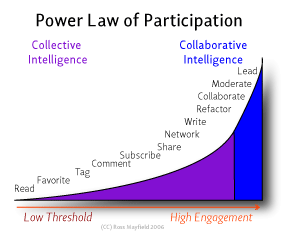
Another thought that came out from reading the 2008 journal paper was that it also talked about Leontiev (1981) and analysing an activity from 3 different levels. The first level related to the overall motive for engaging with an activity. The second level relates to the actions that constitute an activity that are governed by (short-term) goals. The third level of activity related to the operations necessary for carrying out the actions. This made me think of "levels of participation" like in this ladder (or the long tail one). What they also try to depict is that there are different levels of participation, they are differently motivated, and maybe when talking about learning, we can also observe similar levels as pointed out by Leontiev (1981).

A few ideas for the evidence finding paper:
  • The dimensions of repositories and communities can be used to describe the datasets that I will use
Start for the evidence paper: Assume that repositories and learning resources get rid of technical, socio-cultural and pedagogical barriers for usage (references from the JISC report on Learning Communities and Repositories from CD-LOR project), does the re-use across the national and linguistic borders happen? If evidence is found, how much and where?

Engestroem, Y. (1987). Learning by expanding: An activity theoretical approach to developmental rsearch. Helsinki: Orienta-Konsultit Oy. Retrieved August 25, 2008, from
http://lchc.ucsd.edu/MCA/Paper/Engestrom/expanding/toc.htm

Margaryan, A., & Littlejohn, A. (2008). Repositories and communities at cross-purposes: Issues in sharing and reuse of digital learning resources. Journal of Computer Assisted Learning (JCAL), 24(4), 333-347.

Margaryan, A., Littlejohn, A. (2007) Communities at cross-purposes: Contradictions in the views of stakeholders of learning object repository systems. Proceedings ascilite, Singapore 2007.

Wednesday, November 07, 2007

notes on "Context, (e)Learning, and Knowledge Discovery for Web User Modeling: Common Research Themes and Challenges"

"Context, (e)Learning, and Knowledge Discovery for Web User Modeling: Common Research Themes and Challenges" by B.Berendt

This paper is about context and how to define it or how it is defined differently. The following is related to "Context in Web usage mining and eLearning"

2.1 Context as data and as metadata

"In order to evaluate whether intended and actual usage coincide or not, and in order to obtain a more fine-grained picture of actual usage, it is of course interesting to measure aspects of actual usage. "

- This is also one thing that we are interested to find out in MELT, and partly also in my PhD. As we have very little access to "actual use" we try to infer this type of information from usage logs. E.g. We have a teacher who has said in his profile that he teachers students from 12 to 13 year olds. If he bookmarks LOs that have intended audience of 14-18, we can maybe infer that this LO can also be used for younger students. Especially, if we start seeing this taking place a lot, we might want to update the LOM on intended audience: instead of 14-18 we could say 12-18.

- My interest is also to see if tags can give us any hints of this.


2.2 Context and model parts

"context representations can form and/or enrich (a) user models, (b) material/environment models, or (c) interaction models."

- EUN uses a) in one search to rank resources, but we are still only implementing it and we don't know how users react to it. That is related to my own PhD, as are how different search methods are used. In general, we do way too little with user modeling (I guess bigger issues are still more imminent)


2.3 Context: parameters of the (inter)action

- For my PhD I'm looking into user logs to create "levels of user interaction", e.g. what does it mean if a user views a page vs. makes a bookmark on it. We want to use this as an input for a recommendation system, for example.

- I'm also interested in the type of search that the user has chosen and its relation to the search task that the user has at hand.

- Tags were mentioned in this context, that is also a huge part of what I am looking. There are different questions around them, one most interesting related to search is how they can be used for discovering resources.

Need to look into these papers:

- B. Berendt, G. Stumme, and A. Hotho. Usage mining for and on the semantic web. In H. Kargupta, A. Joshi, K. Sivakumar, and Y. Yesha, editors, Data Mining: Next Generation Challenges and Future Directions, pages 461–480. AAAI/MIT Press, 2004.

- Claus-Peter Klas, Hanne Albrechtsen, Norbert Fuhr, Preben Hansen, Sarantos Kapidakis, L aszl o Kov acs, Sascha Kriewel, Andr as Micsik, Christos Papatheodorou, Giannis Tsakonas, and Elin Jacob. A logging scheme for comparative digital library evaluation. In Julio Gonzalo, Costantino Thanos, M. Felisa Verdejo, and Rafael C. Carrasco, editors, ECDL, volume 4172 of Lecture Notes in Computer Science, pages 267–278. Springer, 2006.

- Totally agree with his observation, not the method: Tanimoto [53] emphasizes that may be difficult to conclude, from a mere clicking event, that there was indeed attention paid to (specific) content of the requested page.


2.4 Context: background knowledge

Tags, tags, tags. multiple views.


2.5 Context: Activity structure
" This metadatum can provide important information about a visitor’s intention or expectation (e.g., whether they followed a prescribed link from a course page, or whether they found a material by actively searching with a very detailed search phrase)."

For me this is important, I guess using terms from this paper, I'm interested in user's intentions and expectations and finding out the ways the users choose to access or discover resources in our portal. I'm also interested in seeing whether one method is more useful to a given task, e.g. if people like browsing to find inspirational material and some other method (social information retrieval vs. information retrieval) for another task. If we know what kind of method is useful for a given task, I think we can help our users a lot.

2.6 example

An example is given using the three aspects of context; activity structure, parameters of the (inter)action and background knowledge. The type of analysis allows answering questions like: which search options are popular and are there differences between users? Which content areas were frequented, and how did people navigate between then; did they go back to the search options, or did they use the inter-content links? Did certain content areas become hugs for navigation and thus served to organise the domain and the presentation of the domain? On the other hand, questions like; were there differences between users with high verbal and users with high visuo-spatial competencies; did certain textual or pictoral material become hub?

These are also questions that I am looking at in lre portal and am getting a good idea of them. However, I have not been able to link them with the task at hand yet, which is something that I'm interested in.

Tuesday, October 16, 2007

New acquitance: Semiotic Dynamics

Pretty exiting, I came across this new area of Semiotic Dynamics, which is described as "a new field that studies how semiotic relations can originate, spread, and evolve over time in populations, by combining recent advances in linguistics and cognitive science with methodological and theoretical tools from complex systems and computer science." One topic of this study field is folksonomies, which draw my attention. The stuff can look like this.

Everyone nowadays repeat the same mantra of web 2.0, but somehow this project managed to say things sets it apart:

..users are no longer limited to consuming or creating online content, they also provide the semantic scaffolding holding together such content, thus taking on an active role in shaping the architecture of online information. The collaborative character underlying many Web 2.0 applications puts them in the spotlight of complex systems science,..

"Semantic scaffolding holding together .. content", that's a pretty awesome way to put it!

The paper "Vocabulary growth in collaborative tagging systems" investigates the temporal evolution of a tagging vocabulary size (of delicious) both on a
  • global level (the number of distinct tags in the entire system) and
  • local level (the growth of the number of distinct tags used in the context of a given resource or user).
It asks questions like how does the number of tags grow?; what is the rate of invention of new tags? is the asymptotic number of tags finite (uugh, a nice way to say it)? etc...

The paper finds out that the growth behaviours are remarkably regular throughout the entire history of the system with power-law behaviours with exponent smaller than one (non of that "fat head and long thing tail"!) and across very different resources being bookmarked.

Moreover, they find that there are some intrinsic characteristics of the system which do not depend strongly on the size of the dataset, like that the average number of tags is about 3.4 (local level). If I get it all right, they conclude on this that on the local scale (resource or user) "all curves tend to lie along a "universal" growth curve with an exponent close to 2/3".

The authors of this paper also highlight that the tools and concepts from complex system science may prove valuable for understanding the structure and dynamics of folksonomies.

Some interesting papers towards this direction: http://www.furl.net/members/vuorikari/semiotic_dynamics

Saturday, September 29, 2007

Notes on Smart Indicators on Learning Interactions

Smart Indicators on Learning Interactions by Clahn et al. (2007) discusses how indicators can be used to help learners, or groups of learners, to organise, orientate and navigate through learning environments by providing contextual information that is relevant for performing learning tasks. Indicators are part of the interaction between a learner and a system (social or technical).

Indicator system is defined as a system that informs a user on a status, on past activities or on events that have occurred in a context; and helps the user to orientate, orgaise or navigate in that context without recommending specific actions.

So, it is not:
  • a feedback system (analyse user interactions to inform learners on thier performance on a task and to guide the learners though it) or
  • a recommender system (analyses interactions in order to recommend suitable follow-up activities),
  • instead it provides information about past actions or the current state of the learning process.
  • Moreover, smart indicator systems adapt their approach of information aggregation and indication according to a learner's situation and context.

The paper draws heavily on the notion of social navigation, interaction history and footprints, and offers a good review of this literature (ToRead).

The paper offers an architecture of smart indicators, where different layers are defined to support user modeling (first two) and helping the system to adapt to better decision making process (last two). Four layers:
  • sensor layer
  • semantic layer
  • control layer, where a strategy defines the conditions according to learner's context
  • indicator layer, presents aggregated information to the learner.

This approach of smart indicators adapts the strategies on the control layer (as opposed to semantic layer) to meet the changing needs of a learner.

SENSOR AND SEMANTIC LAYER

The paper further presents the information aggregates of sensor and semantic layers. The idea is to classify and organise the user's engagement (interaction foot prints) with the system, e.g. contributions, tagging activities. In the sensor layer, there is a division between "learner interaction" and "contextual sensors", e.g. location tracker, tagging activities (in my case this is considered direct) and contributions of peer-learners.

I am doing the same with my research data, and I call it the "user engagement" following the Yahoo!'s idea on STAR-metadata (kind of attentional and explicit metadata about users actions).

I tried to apply the classes of Chlan's prototype to my research data (learning repositories) that I collect using our CAM framework. Our focus being somewhat different, it did not really work out that well. The attempt below, though:

Direct: accessing resources through browsing, tag cloud, search result list, other user's favourites (implicit interest)
  • user views metadata
  • user views tags
  • user views resource ("entry selection sensor")
  • (timestamp on everything)

Direct: higher level interaction with a resource (explicit interest)
  • user adds a resource to favourites and tags it ("entry contribution sensor", "tag selection sensor", "tagging sensor" or"tag tracing sensor", hard to say in my case)
  • user rates the resource ("entry contribution sensor")
  • user comments on the resource ("entry contribution sensor")
  • shares resource with network ("entry contribution sensor")
  • (timestamp on everything)

Contextual sensors could be (here I'm blending them with user information):
  • context of a project within which the user access resources
  • the information about the country and school from where the user is from

SEMANTIC LAYER

The semantic layer users the information from Sensor layer and transforms it into meaningful information by using an "activity aggregator". This calculates the activity for a given period of time for an individual learner or the whole community according to different ratings that each activity has (beginners have different way of counting activity from power-users).

CONTROL LAYER

In this prototype the control layer defines how the indicators adapt to the learner behaviour. There are two elemental strategies:
  • motivate learners to participate to the community activity
  • raise awareness on the personal interest profile and stimulate reflection on the learning process
Moreover, a third level control strategy uses the activity aggregator as well as the interest aggregator.

INDICATOR LAYER

This layer embeds the indicators into the user interface of the community system. The prototype is being tested by a group of PhD students now.

Glahn, Christian, Specht, Marcus, Koper, Rob (2007) Smart Indicators on Learning Interactions
http://hdl.handle.net/1820/941

Monday, May 21, 2007

Interpersonal networks in finding information

A hugely interesting study on patterns on information seeking about culture. I wonder how much this would match with what teachers do? Are they also inclined first to turn to their interpersonal ties, e.g. human network of colleagues, friends and families, to find information, before turning to the Internet, text book publishers, educational portals and such?


When searching for information about culture, the participants in this study look first to their families and social networks, specialized governmental and non-governmental organizations (such as Heritage Canada or the Danny Grossman Dance Company), and published and broadcast sources (Toronto Globe and Mail; People magazine; CBC radio and TV). It is only after they have a recommendation or suggestion—from their interpersonal ties or from elsewhere—that they turn to the Web for information. Then, they usually seek specific information, such as upcoming performances by a favorite band, book reviews, or hotel prices for a summer vacation. This suggests that for many people, the Web tends to satisfy curiosity rather than inspire it.

Yep, seems like supporting social information retrieval thorough Web is like a killer-ap!

Kayahara, J., and Wellman, B. (2007). Searching for culture—high and low. Journal of Computer-Mediated Communication, 12(3), article 4. http://jcmc.indiana.edu/vol12/issue3/kayahara.html

Monday, May 07, 2007

Workshop on Social Information Retrieval in Technology-Enhanced Learning (SIRTEL07)

Good news! The workshop proposal for EC-TEL 07 was accepted, so I will be co-organising my first workshop on social information retrieval techniques in support of learning and teaching later this September.

The tag line will be "We use people to find content, we use content to find people" by Morville. On the other hand, maybe it should be "We use digital traces to find people, and we leave digital traces to be found"..

Two main focuses: Recommender systems and Social navigation

The list of topics will be LONG, but I put it in here as an appetiser:

  • Defining the scope, purpose and objects of social information retrieval in TEL
  • Recommender systems and collaborative filtering in educational settings
  • Novel ways of generating input information for recommenders in the area of learning and teaching
  • Ranking of search results to support individualised learning needs
  • Folksonomies, tagging and other collaboration-based information retrieval systems
  • Social navigation processes and metaphors for searching information related to teaching and learning
  • Analysing social interactions in learning communities and social networks on the Web to facilitate information sharing and retrieval
  • Approaches to TEL metadata that reflect social ties and collaborative experiences in the field of education
  • Interoperability of SIR systems for TEL
  • Integrating SIR services in existing learning management systems
  • Visualisation techniques to support social navigation in learning and teaching
  • Semantic annotation and tagging for social information retrieval purposes
  • Evaluating the performance of SIR systems in educational applications
  • Measuring the effectiveness of SIR systems in supporting learning and teaching
  • Evaluation the user satisfaction with SIR systems in supporting learning and teaching

The idea is that as this is the first European workshop on the topic, we will try to scout out who are there to work on this topic and set the ground for better future collaboration . Of course we wish to run the workshop again, not as a pre-workshop , but really as a part of the main show.

Voila, more info to come shortly and the website for the call!

Thursday, April 19, 2007

D.Watts on Social influence and popular songs

This study is pretty interesting: there were 14,000 participants who were asked to listen and rate songs by bands they had never heard of. The point was to study the social influence, i.e. how seeing cues from other people, like Top10 downloads, no of downloads, etc. would influence on people's choice.

The set-up of this study is pretty neat, the participants were sliced into eight parallel “worlds” so that participants could see the prior downloads of people only in their own world. Everyone started from the same line, zero downloads — but because the "worlds" were kept separate, they subsequently evolved independently of one another.
What we found....In all the social-influence worlds, the most popular songs were much more popular (and the least popular songs were less popular) than in the independent condition. At the same time, however, the particular songs that became hits were different in different worlds, just as cumulative-advantage theory would predict. Introducing social influence into human decision making, in other words, didn’t just make the hits bigger; it also made them more unpredictable.

Our experimental design has three advantages over both theoretical models and observational studies. (i) The popularity of a song in the independent condition (measured by market share or market rank) provides a natural measure of the song's quality, capturing both its innate characteristics and the existing preferences of the participant population. (ii) By comparing outcomes in the independent and social influence conditions, we can directly observe the effects of social influence both at the individual and collective level. (iii) We can explicitly create multiple, parallel histories, each of which can evolve independently. By studying a range of possible outcomes rather than just one, we can measure inherent unpredictability: the extent to which two worlds with identical songs, identical initial conditions, and indistinguishable populations generate different outcomes. In the presence of inherent unpredictability, no measure of quality can precisely predict success in any particular realization of the process.

This makes me want to test and set up experiments, too. In the project that I'm part of, and where I will get my data, we are planning some experiences on the input part of the tags to see how social influence in terms of seeing other users' tags when inserting own ones, will effect on the nature of tags, their number, their convergence, etc.

But, on the retrieval side of things this would be very interesting too! To have two different interfaces to see the search result list, where on the one there would be all the social cues for social influence (no of downloads, no of bookmarks, others' tags), and on the other one there would be nothing. The experiment would test whether the users, in this case teachers, would be viewing the metadata of similar resources and what would they actually download, bookmark and rate, if they did any.

Well, actually the latter is the situation as it is now. So maybe I can just compare the data from this year and the year after, when we actually start implementing the social navigation part.


Link:
In NYTimes

Science 10 February 2006:
Vol. 311. no. 5762, pp. 854 - 856
DOI: 10.1126/science.1121066
http://www.sciencemag.org/cgi/content/full/311/5762/854

Supporting material:
http://www.sciencemag.org/cgi/content/full/311/5762/854/DC1

Wednesday, April 11, 2007

Social Navigation as seen a decade ago

I'm always fascinated when I find "old" papers that still resonate today. Well, I'm not talking about the manuscripts from the Library of Alexandria, but I just came across a paper on "Design Principles for Social Navigation Tools", written in 1998. The principals still seem rather relevant!

That makes me think; what was social navigation about a decade ago and how differently we perceive it today, after all, there was no social bookmarking nor tags out there, like we know them today.

Defining different flavours of social navigation

Social navigation can happen in many different forms... One may distinguish between direct and indirect social navigation [Dieberger, 1998, Svensson, 1998]. In direct social navigation, we talk directly to other users. In indirect social navigation, we can see the traces of where people have gone through the space, as for example in the Footprints system [Wexelblat and Maes, 1998].

In my context of use, direct social navigation could be seen to happen through networks of friends and colleagues, that the users of a social tagging system have established. Or, it can also be sort of "ask the expert", or ask your colleague type of thing. Direct social navigation could most likely take place in sharing pedagogical practices, for example.

Indirect social navigation, on the other hand, would be like following other users collections of bookmarks, browsing them through " xx other user have this in their collection" or through common tags, for example in the personal or common tag cloud.

Furthermore, social navigation may be intended or unintended by the advice-giver.. distinction can be made for when the advice-giver is one particular person, known to us, or when it is just a group of anonymous users that have happened to navigate through the same space as us. In-between these two extremes, we may have groups of users that are similar to the navigator in terms of interests, profession, knowledge or task. The advice-giver may also be an agent [Foner, 1993]1.

The idea of having intended or unintended advice-giver is intriguing, many times in collaborative environments for learning, we are very occupied in setting up advisors whose intend it to give advices. But in the real world, people are somewhat shy asking a specific "advisor" for hints or help, peers seem to work better, or many people look for "traces" for that purpose. So, it seem to me that it is very important to design a lot of unintended advice-givers to help social navigation in learning and teaching contexts, they can be anonymous crowds, agents, traces, annotations, hints of task orientation, shared interests, or what ever we can think of.

I wonder if this table makes sense like it is now: (I'm not talking about blanc spaces...)


Unintended advice-giverIntended advice-giver
Indirect social navigationTag cloud guiding the navigationA recommendation (person, agent,recommender,..)
Direct social navigationBookmarks from network of friends to navigateA friend, expert, peer gives advice or recommendation


The 6 design principles

The principles according to Forsberg et al. (1998) are Integration, Trust, Presence, Privacy, Appropriateness and Personalisation. The examples are pretty hilarious, really like from 10 years ago, but nevertheless, the principles stand like they should!

Integration:
It is emphasised that social navigation should be part of everyday tools to make best use of it. This is what we see nowadays a lot, more and more things are integrated in our workflow, for example the browser with all the add-ons and blug-ins has become a central tool.

To make the best use of social bookmarking, it is of utmost importance to make the process easy and part of what one was doing right at that moment. The delicious-bookmarklet added in the browser toolbar is a good example, it is so easy to use that you hardly even have to stop what you are doing at that moment to bookmark. Thus, you leave more traces for others, besides arranging your own information space.

The idea of Attention Metadata is another one, if you use Slogger to generate Attention Metadata on what all you do on your web-browser, you don't even have to think of doing it.

Presence:
This refers to how do you make the presence of others shown to users, how do they know that someone has been here before. Annotations (tags, comments, evaluations, opinions, ratings...) are a perfect way to do that (Kilroy was here!), you know that someone passed through that space.

Or showing how many other users are online at the moment, think of how much fun is it to log into Skype at 1am and see that despite the quietness of your work room, some other people are out there still slaving away.

Trust:
In order to take a note of someone else's doings, it helps if you know whether you can trust them, are they a reliable source, do they like the same things as you do, etc. When reading film critics, one quickly picks up the critic who is like-minded, and disregards the other one who always seem to have too much of a mainstream thinking. Similarly, to trust the source for online social navigation can become crucial, if there are many ways to go forward.

Appropriateness:
In some situations one design choice is more appropriate than the other one, for example indirect social navigation can be suitable for finding inspiring information, whereas you might rather turn to someone to talk to when you have a specific question at hand. This is in my opinion related to finding a means that fits the purpose of the information seeking task at hand, something that I've been mulling around a lot and is related to the Human-Computer Interaction framework.

Privacy:
This concerns the issues of making users aware of the traces that they leave, data that is logged and used for personalising their searches, etc. This is also related to some codes-of-conducts that some systems have. Very important for things like Attention Metadata, Google personalized, etc.

Personalising Navigation:
"Social navigation provides excellent opportunities for tailoring navigational advice to individual user's task, knowledge or abilities". How I see this, it is related again to the information seeking tasks, interests, etc.


Forsberg, Mattias and Höök, Kristina and Svensson, Martin (1998) Design Principals of Social Navigation. In: 4th ERCIM Workshop on User Interfaces for All, Stockholm, Sweden.

@InProceedings{sicsprint95,
author = {Mattias Forsberg and Kristina Höök and Martin Svensson},
year = {1998},
title = {Design Principals of Social Navigation},
address = {Stockholm, Sweden},
url = {http://eprints.sics.se/95/01/designprincip.pdf},
booktitle = {Proceedings of 4th ERCIM Workshop on User Interfaces for All}

Wednesday, January 17, 2007

Notes on Combining Social- and Information-based Approaches for Personalised Recommendation on Sequencing Learning Activities

This paper, Combining Social- and Information-based Approaches for Personalised Recommendation on Sequencing Learning Activities, cames from OUNL and is related to a bigger schema of works that those guys are carrying out on competencies. Thus, the context is very related to lifelong learning, namely to higher ed and vocational training.

The aim of the paper is to describe a domain model for "way finding". By the term "way finding" is meant "selecting and sequencing learning activities". The raison d'etre is:
Learners' problems in way finding will decrease the efficiency of education provision (the ration of output to input) and increase the cost. The local context for this paper is Dutch Open University student who lacks adequate information on study possibilities at an early stage of study, and problems in getting a good overview of the number and best sequence to study modules.

The paper describes a personalised recommender system (PRS) model that combines social-based (i.e. completion data from other learners) and information-based (i.e. metadata from learner profiles and learning activities) data to recommend the best next learning activity. The system is currently under development, a limited implementation is running using learner profile metadata.

Note about learning activities; OUNL has been very active in developing IMS Learning Design. They (Tattersall et al. (in press)) have previously proposed IMS-LD as a candidate to model learning paths. Moreover, they argues that its selection and sequencing constructs appear suitable for learning activities (units-of-learning) as well as for higher levels of granularity (e.g. competence development programmes). Interesting. At one point of time one could look how IMS-LD information could be generated in attention metadata (CAM).

So, the idea of PRS approach is a hybrid recommender that uses
  • a) information from other learners and their completion of tasks (completion is understood like rating) in a collaborative filtering manner (in text called social-based approach), and
  • b) information from students profile and c) metadata about the resource in the spirit of a content-based system (in text called information based approach).

Authors also argue that it is not enough to find the most efficient learning paths (like the shortest route in GPS), but to explore which paths are most attractive or suitable (like routes suited for biking), thus personalisation needed (individualised needs, interest, preferences or circumstances).

Other key concepts are:
  • learner's start position in a given domain (prior learning history)
  • aimed competence profile for that domain
  • learning path towards that competence
To develop a PRS the authors identify the following pieces, that the paper defines:
  • uniform and meaningful description of formal and informal learning paths
  • learning activities that are addressable and meaningfully described
  • uniform learner profiles that define needs and preferences
  • uniform competence description that defines proficiency levels
  • a learning path processing engine
  • an engine recording completion of activities
  • information matching techniques to enable personalised recommendation

Related work

I will later post on my blog some excerpts from my own literature review in the field of learning to show other recommender ideas based on the same hybrid approach, as in this paper they mention that this approach has hardly been applied in learning. There was only a reference to Herlocker et al. (2004).

In the related work section it is mentioned that education field imposes some specific demands for recommender. Main differences sited between recommenders for books are the degree of voluntariness (learning is many times required to obtain some goals) and the possibility to establish an explicit completion (as most learning activities are to be assessed for successful completion). Hmm..I do agree with the statement, but had come up with different reasons myself. Goes to show, I guess, how the initial requirements for a recommender system differ from what I'm working on.

An interesting outcome is cited from Janssen et al. (in press): learners were offered a recommendation "most successful learner continued with Y after having completed X". I call this an "Amazon-like" recommendation (other people interested in this book also bought x, y, z) based on clustering behaviour. There were no personal characteristics taken into account in this study. They found out that this type of recommendation enhanced effectiveness in completion of the set of learning activities, but did not increase efficiency, the time it took to complete them.

Authors also acknowledge the problem of insufficient data that can be derived from existing log files, the same that my colleagues are working on with the view on capturing attention metadata (CAM).


Discussion

Authors state:
"From a self-organising point of view it would be ideal if way finding would emerge as a result of (in)direct interactions between members of the learning network, without being dependent of formalised descriptions in domain and user models."

I so agree: instead of investing time in describing all the information regarding the learner, his/hers existing and required competences; the resource; and the curriculum with goals and skills required, would be more interesting to tap onto existing knowledge from the masses and their previous experiences, the decisions they took to find the next suitable step, etc.

The authors also discuss the complimentary approach of controlled vocabularies or ontologies combined with annotations such as social tagging and rating, just in the same direction as we are doing in MELT (we talk about adding metadata a priori and a posterior) and what I'm interested in looking into.

Related to my work

The difference in what I'm looking into now and what this paper describes is, first of all, the context. I'm interested in a repository that is used mostly by K-12 teachers and learners (sometimes). The repository is not linked to formal learning requirements related to a curriculum, because it is used on the European level, where there are many curricula depending on a country or a local policy. However, each teacher who comes to that repository has his/hers own information seeking tasks, that I've talked about previously. Sometimes those tasks are related to covering a piece of a local curriculum, whereas some other times it is to find a piece of resource to support some generic learning goal, or find inspirational material, or something else.

Secondly, in my context of work sequencing learning resources is not the goal, rather just finding resources that fit to the search criteria and the task at hand. So I'm not so into this sequencing, however, I like the idea of playlists and using this type of expert knowledge of putting items together for learning purposes (the use of Case-based Reasoning like Claudio explore here).

Imagine if teachers could generate playlists of LOs as easily as I do playlists in iTunes (I'm NOT talking about automatically generating them, but hands-on deejaying). Then, those lists could be used as rules for generating new ones. In that case, we would not need LOM to know which item in a repository is described as "introductory item" or "motivational item" to start the lesson, or which one is good for "explaining a rule", but we could detect that information form playlists generated by teachers who knows through her domain knowledge that after this piece I put x,y and x. Let's see.

To check out from the paper:
- Koper (2005)
- Janssen et al. (in press) about the test
- Sicilia (2005) about ontologies to express competencies
- Van Setten, 2005 social-based approaches
- McCalla (2004), pragmatics-based paradigm of tagging learning activities with learner information

Wednesday, October 25, 2006

Information seeking, teachers and what a digital repository could offer?

In context of digital learning repositories we often times offer users a few ways to search learning resources without thinking much of why and for what purpose they would be using the repository.

Too many times repositories are developed with a glorious idea "if we build it, they will come". But to start with, do we really ask teachers whether they need a repository for digital learning resources?

Building a repository or a federation of them without asking this "raison d'être" is like creating a product to sell without a need or demand for it. That happens often, without doubt, but with the difference that there is a big marketing budget to create the need. Thus, teachers are stuck with bad looking search interfaces that hide potentially interesting technology without any needs and desires to use it.


To backtrack a bit, one should look at what teachers are doing in their work and how they are doing it. Ok, they teach, right. They have a goal, usually laid out in a curriculum, that they are set out to fulfill. They might have different requirements for the material to use; in some countries teachers have more freedom on choosing educational material than in others. To facilitate their job, teachers like to use the material that they are comfortable with and know well. They might use ready-made lesson plans by school book publishers or prefer to create their own material from bits and pieces.

Moreover, there are the routines to save time and efforts - information seeking, like learning, is a fundamental and high level cognitive process (Marchionini, 1995). People like to resort to something that they know does the job. Teachers are social animals, too, maybe a few hints from a colleague will settle a teacher for the day's task. Thus, the needs are rather contextualised (the given age, curriculum) and socially supported (accepted and negotiated educational practices, hints from colleague teachers,.. ).

Where does the digital learning material stand in this picture and how do teachers see the need for using a repository to better do their teaching? On the long term we are interested in looking at teachers' tasks in their teaching and see how digital learning resources repositories could better support teachers in their daily quest to make the learners better learners. Two main areas are concerned, namely information seeking and social information retrieval. We will argue that digital repositories should do more to offer social and contextual support for teachers and learners to discover relevant resources from a repository. But this blab is about looking into information seeking and the review on existing literature.


Information seeking, teachers and what a digital repository could offer?

When we think of a teacher preparing for a new lesson, we can think that it is part of larger information seeking behaviour, which is contextually driven, i.e. there is the national or regional curriculum, its topics, goals and learning activities to fulfill. The current information seeking research defines information seeking as a conscious effort to acquire information in response to a need or gap in your knowledge (Case, 2002).

For a teacher there is a diversity of support material available to fulfill the task, some of it being paper-based teaching material, some digital and others might relay on human resources. A teacher might also address a digital learning repository for the purpose of finding suitable digital learning resources. This teacher might already know exactly what he is looking for, a piece of material that he has seen before, or he might look for some motivational piece of information or some assessment material, for example.

However, often times digital repositories are not well prepared to serve different individual tasks that teachers might have at hand when they come to a repository. For that reason, more job-level analyses would be needed to look into individual tasks that teachers are to perform when they are using a learning resources repository. In general, the repositories have very little observation on patterns across tasks and contexts. So we ask, what are those general patterns that we can find across tasks that teachers are set out to perform at a digital repository?

Moreover, information seeking, in some cases, can be a social activity. Wilson (2005), for example claims that more information is communicated by word of mouth than is ever retrieved from databases. Many other researchers in the field of information seeking talk about its social layer. Hargittai & Hinnant (2006), who lay out a social framework for information seeking, argue that an “important factor influencing users’ information-seeking behavior concerns the availability of social support networks to help address users’ needs and interests. People’s information behavior does not happen in isolation of others.“

Thus, when we are looking into teachers information seeking tasks at the learning repository, it becomes important to think of the support for such social networks to tap onto. We can think of these networks in two different ways, as human resources themselves (such as getting in touch with an expert in a given field, etc) or as secondary support to help the teacher to find the suitable resource for the lesson. Or, like Peter Morville (2004) says; We use people to find content. We use content to find people. Information seeking behavior and social network analysis go hand in hand.

Information seeking ranges from forming question to gathering, synthesising and using information. It is usually cyclic and iterative process from seeking to gathering, refining questions, to evaluating and synthesising information to using it. A holistic view of information seeking process comes near to ideas of inquiry learning, both emphasising an iterative question-driven process of finding, managing and evaluating information. (Lallimo, et al. 2004).

Moreover, Kuhlthau (Wilson, 2004) also talks about search process in similar terms as educationalists, introducing the notion of the 'Zone of Intervention', similar to Vygotsky's Zone of Proximal development (Vygotsky, 1978), where the learner, when engaging in collaborative problem-solving with a guidance of an adult or more experienced student, can reach better level than without. Kuhlthau talks about five intervention zones, in some of which the advancement is dependent of collaborating with others, such as the librarian providing the quick reference or someone helping discovering potentially useful information resources.

We should further investigate how these zones of interventions could be supported in a digital learning repository when a teacher is looking for learning resources, or when a learner is there with his own information seeking intention to attain a task. We are interested in looking into supporting users in different ways, by designing better tools and interfaces, but also to build in support from fellow users.

This support could appear in different ways, such as "leaving traces" of information seeking patterns by other users or by creating social connections between users where they did not previously exist. The following can be envisaged: leveraging the previous search histories of other users; tapping into similarities in interest displayed by bookmarking action; looking into subjective relevance judgements such as annotations, tagging and end-user evaluations and ratings. Moverover, the use of existing social networks (such as expressed by using FOAF or FXML) should be supported, but more importantly, also the emerging ones, that could be detected by using social network analysis should be investigated.


---------

Case, D.O. (2002). Looking for informaiton: A Survey of Research on Information Seeking, Needs and Behavior, San Diego: Academic Press.

Hargittai, E. and Hinnant, A. (2006). Toward a Social Framework for Information Seeking. In New Directions in Human Information Behavior by Amanda Spink and Charles Cole.

Järvelin, K., Ingwersen, P. (2004). Information seeking research needs extension towards tasks and technology. Information Research, 10(1) paper 212 [Available at http://InformationR.net/ir/10- 1/paper212.html]

Lallimo, J., Lakkala, M. and Paavola, S. (2004) How to Promote Students' Information Seeking? ERNIST Answers archive, European Schoolnet.

Marchionini, G. (1995). Information Seeking in Electronic Environments, Cambridge, UK: Cambridge University Press.

Morville, P. (2004). Ambient Findability. http://www.digital-web.com/articles/ambient_findability/

Vygotsky, L.S. (1978). Mind and society: The development of higher mental processes. Cambridge, MA: Harvard University Press.


Wilson, T.D. (2004) Review of: Kuhlthau, C.C. Seeking meaning: a process approach to library and information services. 2nd. ed. Westport, CT: Libraries Unlimited, 2004. Information Research, 9(3), review no. R129 [Available at: http://informationr.net/ir/reviews/revs129.html]

Wilson, T.D. (2005). Review of: Ingwersen, P. and Järvelin, K. The turn: integration of information seeking and retrieval in context. Dordrecht, The Netherlands: Springer, 2005. Information Research, 11(1), review no. R189 [Available at: http://informationr.net/ir/reviews/revs189.html]

Links to other things I'm reading about the topic: http://www.furl.net/members/vuorikari/info_seeking