Thursday, May 24, 2007

Massively multiplayer object sharing by R.Sinha

I've followed some stuff from Rashmi Sinha, and I think every once in a while she comes up with good ideas. Like I liked the stuff early on that she did on the recommenders and the focus on user-centric design. Sometimes I just don't like her stuff, it sounds very popularistic and her references are, well, not very academic. But then again, maybe she does not need to be either..

Anyway, this slideshow has cool ingredients. I like the idea of object/artefacts in the center of the social networks, that's why I'm a big fan of social bookmarking, for example. I really don't care that much about connecting to people that I don't know (mySpace) or even using LinkedIn (what's the point, you get a list of people, but no substance..), but when I can connect through items and tags to people's stuff that I find interesting, I find it useful.

In the slideshow Sinha talks about models of 2nd generation networks (the 1st g was only about people):
  • Model 1: Watercooler conversations
    (around objects e.g., Flickr, Yahoo answers)
  • Model 2: Viral sharing (passing on interesting stuff, e.g., YouTube videos)
  • Model 3: Tag-based social sharing (linked by concepts. e.g., del.icio.us)
  • Model 4: Social news creation (rating news stories, e.g., digg, Newsvine)
Then, further on, she talks about Cognitive Diversity, which I also find really important. It's related to the continuum of wisdom of crowds vs. stupidity of mobs. What I got out of the slide 29:
  • Good answers need many perspectives, thus many perspectives are needed otherwise groups become too homogenous, which might have its dangers also (stupidity of mobs, see Digg for that ;). If all the new members are too similar and like-minded, they don't bring anything new to the group (that's why we want serendipity from recommenders!). Diversity reduces groupthink (think of Digg again and how fast not favourable stuff gets buried), groupthink is bad and only way to fight that is diversity.
Moreover, she also talks about the importance of social influence condition and about Watt's study.

Lastly, some design principles:
  • Make system personally useful: For end-user system should have strong personal use; Self-expression (e.g., Newsvine);Social status: Digg
  • Don’t count on altruism: System should thrive on people’s selfishness


Wednesday, May 23, 2007

Vanderwal: Tagging Today & Tommorw

Vanderwal nicely captures the spirit of tagging both for personal use and for the social aspects of it.

Personal      Social

- capture      - share
- hook/copy   - point
- annotate     - collaborate
- refind        - filter
- privacy      - trusted groups


Tagging Today & Tommorw - New Content, on the page 32
http://www.slideshare.net/vanderwal/tagging-today-tommorw

Anyway, the slides are worth taking a look. I'm glad he mentions "i" word - interoperability :)

Social influence on the convergence of tags

I'm a big fan of finding out how the social conditions influences the tags. Well, that is why it is one important aspect of my PhD studies, so we will find out - sooner than later.

In order to design a good tool for social tagging, I did quite a lot of research on our current understanding on this. I also came up with the table below, as I was mulling over what would be the best balance between giving social cues to people while tagging (e.g. showing the tags from other users) and still keeping the tags individual, personal, and specific enough.

See, I think too much of the social condition will make people lazy to come up with their own tags, thus the tag base will become less and less descriptive and consequently it becomes harder to find items tagged with these terms. Chi et al (2007) find that out too, but they do not contribute it to social influence! Just to the size of the community.

I think social cues are important for the uptake of tagging, in the first place, and in the second, they are important in terms of using common vocabularies, e.g. seeing those broad folksonomies to emerge. But too much can be too much! Thus, we are planning an experiment on tagging interfaces, where half of the users see the previous tags (social influence condition) and the other half does not (independent condition). We will study the tags from different aspects, how they converge, their originality and some other...not sure yet.


High convergenceLow convergence
Social influence conditionPrompt tags from other users (1) ; high influence from the community (2), better uptake as users may be more motivated to add tags; (3) maybe all tags become the same.
Use of existing tags becomes a habit, not many new tags are created as the time goes by (4); tags become less and less descriptive and consequently harder to find items.
Independent condition (no guidance)Even without social influence, when many users tag popular items, usually broad folksonomies startemerging (4).Original and intuitive user generated list evolves; however, low convergence of tags (1), lower uptake of tagging (3)

Table 1: Table presents two axes that affect on tagging habits and
convergence

(1) if people see other's tags (e.g. they are proposed, are auto filled when typing, ...) while they are tagging, vocabularies are more likely to converge than if users are working on their own.

(2) Also, users, who view tags by other people before adding their first tag, are more likely to have their tags influenced by other taggers in the community. The community of other users affects a user's personal vocabulary; there is a strong influence on user's first tag, if they have been exposed to others' tags.

(3) There were overwhelmingly more non-taggers in the group that had not seen examples of tags than in the one that had seen them in their tagging interface. As stated above, pre-existing tags affect the future tagging behaviour.

(4) When looking at how the vocabularies evolve while tagging, it was found that about half of the tags used were tags that the user had previously applied; thus, it was concluded that early habit and investment influence tagging behaviour and grows stronger as users apply more tags.
However, the research shows that habit and investment aren't the only factors that contribute to vocabulary evolution.

Well, there was another point, somewhat related to this, that I talked about with a studdy-buddy of mine: what is a good tag? Firstly, it is important to note that tags do have two main functions: one being a PKM element and the other is the sharing.

So, for the first one, any tag is good, if it makes sense to the user.
For the second category, we thought of different metrics; it could be for retrieval purposes or sharing with other people.

For retrieval, for example, a tag that repeats the terms in the title is not very good, especially if the search looks at the title anyway (like in our case we do have LOM already). So one could say that a good tag has some additional information that we do not have in the metadata already. After all, if we talk about social bookmarking of websites or research papers, there is some metadata already available. A tag that is a synonym of the title, however, can be useful for retrieval purposes, if any automated way for understanding synonyms are used (like a thesaurus that knows the relations of different terms).

A good tag could also hint something in the use of that content, for example in digital content, it could be something that would hint how that content could be used.

Chi, E. H. and Mytkowicz, T. Understanding Navigability of Social Tagging Systems. In Proceedings of CHI'07, February, 2007.

Sen, S., Shyong K., L., Cosley, D., et al. (2006). tagging, community, vocabulary, evolution. Proceedings of CSCW 2006. Retrieved from http://www.grouplens.org/papers/pdf/sen-cscw2006.pdf.

Vander Wal, T. (2005). Explaining and Showing Broad and Narrow Folksonomies :: Personal InfoCloud. Blog posting. Retrieved November 13, 2006, from http://www.personalinfocloud.com/2005/02/explaining_and_.html.

Tuesday, May 22, 2007

tag: deserted island

What if you were going to be out of the reach of the Internet, email and phones for 3 weeks, what books would you want to read? Oh, and let's add that you would not be able to pack many books with you, only a few. What would you take with you? Tag it with , please!

I was sure that I can just turn to LibraryThing or del.icio.us to find books that people really, really like, the kinds that they would take with them in case they were to be stranded on a deserted island for 3 weeks. According to my logic, you would tag that book with tag desearted island, desert island or something like that.

To my surprise I found only a few things for books! Some people had done lists of music and films that they would take with them, but I want books. After all, there is my iPod. (hmm..audio books anyone??)

So please help me! Tag a few books that you would take with you on a deserted island using the tag of , and that will help me to my choice.

Oh yeah, and did I mention that I will spend about 3 weeks on a sailing boat in the South Pacific? Apart from sailing, we'll be diving and hanging out in numerous atolls situated between Cooks Island and American Samoa. It'll be with D&D on Confetti. I'm getting pretty exited, I must say :)
Countless travellers' tales, books, plays and films have created a vision of an archetype of heaven in the South Seas -- massed coconut palms, jungle-clad peaks, the boom of combers smashing on the reef, the crimson flamboyant trees and the beat of the drum dance. Amazingly enough it is all true. Word66

That'll be the from June 10 to about July 5. So don't expect me to answer any emails. Try a message in a bottle?

Monday, May 21, 2007

Interpersonal networks in finding information

A hugely interesting study on patterns on information seeking about culture. I wonder how much this would match with what teachers do? Are they also inclined first to turn to their interpersonal ties, e.g. human network of colleagues, friends and families, to find information, before turning to the Internet, text book publishers, educational portals and such?


When searching for information about culture, the participants in this study look first to their families and social networks, specialized governmental and non-governmental organizations (such as Heritage Canada or the Danny Grossman Dance Company), and published and broadcast sources (Toronto Globe and Mail; People magazine; CBC radio and TV). It is only after they have a recommendation or suggestion—from their interpersonal ties or from elsewhere—that they turn to the Web for information. Then, they usually seek specific information, such as upcoming performances by a favorite band, book reviews, or hotel prices for a summer vacation. This suggests that for many people, the Web tends to satisfy curiosity rather than inspire it.

Yep, seems like supporting social information retrieval thorough Web is like a killer-ap!

Kayahara, J., and Wellman, B. (2007). Searching for culture—high and low. Journal of Computer-Mediated Communication, 12(3), article 4. http://jcmc.indiana.edu/vol12/issue3/kayahara.html

Sunday, May 20, 2007

A kid-Ceo designs an educational game

A kid designing a game for other kids, that's not SO new. But this kid designs an educational game for other kids and plans to make a million out of it by middle school, that is in a year's time! This kid is pretty amazing! I have no doubt that he won't do it. After all, he's already in the Wally.


Makes me think if we got it all wrong with all the e-learning things and going digital..

Saturday, May 19, 2007

Are digital bohemians bohemians among digital bohemians?

Yo! The BlogWalkEleven took place yesterday in Amsterdam. Theme: Digital bohemians. It was inspired by some German book on the topic of young people making their ends meet by earning a € here and there while leading a digital, networked and somewhat vagabond lifestyle. Of course, part of it is glamour, some are real addicts to the lifestyle, and the down side is the exploitation of young talents with short term contracts, issues with pension fees and how to live on a shoe string while trying to find a next freelance contract.

The idea of BlogWalk is inspired by concept of Open Scpace. Heard people talking of un-conferences? That's the same idea. no PowerPoints, no formal schedule, everyone contributes and cross-pollinates the conversation.
In Open Space meetings, events and organizations, participants create and manage their own agenda of parallel working sessions around a central theme of strategic importance..

Is digital bohemian a trait of character, a mindset, or a definition of an individual in relation to her/his surroundings?


So, the central theme was Digital Bohemians, which I found somewhat detached from in the first place. Towards the end, I'm sorry to say, but I left with an impression that we did not really "walk the talk".

The fun part of all was that the ~30 people around were all pretty inspiring and fun to talk to. They all had clearly anticipated an event with lots of interaction, so they were eager and ready to ask questions, talk to you about your interests and theirs, and just hang out. The first part of the day was fun, we all hurdled around the "window wiki" with post-its to write down our keywords, lines of thoughts and concerns on the topic. There was some geniousity on those post-its, I'm looking forward for Ton to sum'em up.

We had a lunch and - yeah, finally we physically walked in the city as a group! See, the whole idea of the thing is that you are able to find or initiate a discussion that you are interested in. If not, tant pis, walk on or do something. In this thing it's not up to the organisers to entertain and court you, but yourself! Walking is an excellent exercise for that.

Walking part was fun, but I must say that a sit-down lunch was not my idea of this type of organisation. I love cocktail parties for the part of being excused on the fly to change the group. Once you sit down, the "sofa-magnet" starts sucking you in and it's hard to find an excuse to move about 5 people from the same bench to allow you to change the scene just because you are bored with them.

So, that is exactly what happened in the afternoon. People sat down to start the second session, and nothing moved on from that point onwards. I was sad not to have my laptop with me (not many did, and get this, there was no wifi around! radical!), it's a perfect escape route of boredom and has become somewhat acceptable, too.

Anyway, my 2 €cents on digital bohemians: Are bohemians bohemians among bohemians? Is digital bohemian a trait of character, a mindset or a definition of an individual in relation to her/his surroundings?

I think digital bohemianism can best be defined by the relationship to the surrounding behaviour and conventions of practices. It's easy to point a finger to someone saying, see that one is a digital bohemian, if they do something that most people are not doing or do not want to do, e.g. live their life out of their laptop/PDA, have non conventional ways of getting their bills paid, know how to navigate in different spaces (physical and digital), are networked around the globe, etc.

However, if you have a flock of digital bohemians together, they cease to be bohemians among themselves, as they all pretty much sing the same cord. Of course, still, in the relation to others surrounding them, they would remain digital bohemians.

So, finally, maybe rather than defining and classifying digital bohemians, we should just attach tags to it and allow its folksonomic, non-exclusive base of terms to flourish just like bohemians do. Why tags are great is that they allow clustering "the thing" with many other things too, rather than having it sitting in one place in the catalogue or classification scheme, like we used to know them from library. There, I finally was able to tie it up with folksonomies, I'm getting really good at this :)

Anyway, I was glad to be part of this social experiment of BlogWalkEleven and I'm super glad to have met all these people! Let spaces be open in the future too!

Wednesday, May 16, 2007

Tomorrow BlogWalking in Amsterdam

Pretty exiting, high expectations - how could I describe the anticipation better than that? I've known Sebski for a few years now, and what brought us close in the first place, was the dislike of seminars. Then, back in the day, we were stuck in Turkey.

Sebastian told me about this undefined group of people who would piggyback any conference or other happening to get together and just walk around and talk about things. Things that matter and are important to this group of people who happen and choose to be there at that time. Things that they care about and feel passionate about. Related to networked technologies and such. I took all that in like a little gal (yes, I'm still a little girl) - and felt a bit jealous not never have been part of it.

Well, you live and you learn - tomorrow I'll be wondering around Amsterdam with BlogWalkEleven.

No rules but one - you are responsible for keeping your self interested, no-one else will do it for you. This is so cool. Will most likely let you know more about it - if worth..


http://blogwalk.interdependent.biz/wikka.php?wakka=BlogWalkEleven

Tuesday, May 15, 2007

More semantics to tags - emerging trends in tagging

Sometimes a word is not enough, so many more words are needed to explain what is it that is meant by that word.

That seems to be the case with tags. Uumh, they are ambiguous, did you know that?

First I think it was Technorati, they came up with the concept of WTF .
WTFs are short blurbs that explain the buzz around people, things, or events—why the hot topics are so hot—and you can vote the best ones to the top.

Now I saw it in del.icio.us, you can create a tag description to explain to others what is it that you really mean by your tag (it's really getting from being personal to being public). Very interesting. You now add metadata to your tags (e.g. meta-metadata) to describe the meaning by an author of that tag.

Well, if this trend keeps going, soon we can expect to fill-in all the LOM metadata fields ;) No, seriously, Sir Berners-Lee must be exited about this turn!

Monday, May 14, 2007

Notes on Everything is Miscellaneous interview

A pretty good interview on S.Weinberger's new book Everything is Miscellaneous with a Yahoo! guy Bradley Horowitz. It's actually way too long, he's a verbose guy, for sure, he's elevator pitch in the beginning would need an elevator ride in a skyscraper and back, and that would still not be enough! Some interesting bits to dive in or for fast-forwarding.
  • An interesting discourse over a unit of knowledge; he talks about group knowledge and how, for example, Wikipedia discussion pages or some mailing lists themselves are a unit of knowledge build through discussion, agreement and disagreement, and sometime arguments, too. Non of those individuals would not be able to construct that alone "the knowledge is not in anyone's head, it's literally in the discussion in the mailing list (28mins)
  • It was funny when they talked about Justin TV, how this guy carries a camera 24/7 and records his life. The interviewer comes up with something like what's the point, "you don't get a second life with which to review the first one (about at 31 min). This part is also related to gathering metadata about everything, in MIT they record individual's heartbeat throughout the day, so that you can later check when the heart rate was high, remember the moment and relive it! Dudes, get out!

  • Towards the end the whole thing gets more interesting. In about 45 min they talk about social filtering and Mr. Weinberger is very pro, he argues that it is hard for us to know what we are interested in. He goes "...the serendipity thing: we don't know what we are interested in. There are things that we can predict we are interested in, but largely not. The world is way more interesting than our interests, which is why social filtering is so important." I like that :)

  • Soon after they talk about the definition of discussion (48min) which makes me think of a lunch discussion with Teemu and his group in Medialab on how computer science has banalised terms like dialogue (a pop-up "yes" or "no"), interactive, etc..

  • At the very end (54min) they talk about folksonomies, and he says about how silly it would be to replace a taxonomy with a folksonomy. His argument was that "you don't want just one folksonomy", but many of them so that you can cluster and gather things so that it is relevant to what we care and interested in. That's good too!

Friday, May 11, 2007

1st Workshop on Social Information Retrieval for Technology-Enhanced Learning

I hereby proudly present the call for the first ever workshop on Social Information Retrieval for Technology-Enhanced Learning!

The complete call can be found from here: http://ariadne.cs.kuleuven.be/sirtel

A few words on the raison d'être of this workshop, what are the drivers for it?

Everyone in the field of e-learning has their ears full of talks of Communities of Practice (CoP) and networks of users, but not very often do we see how they actually are leveraged in practical terms. This workshop focuses on one part of the process, namely on retrieval of useful resources, either learning resources or human resources, for that matter. The tag line could be as P.Morville said "We use people to find content. We use content to find people."

Take that a step further and think of using digital traces to find people, and also leaving digital traces so that you can be found by other people. In this workshop we are interested in both; social navigation systems and recommenders for retrieving resources to enhance learning and teaching.

Social information retrieval (SIR) refers to a family of techniques that assist users in obtaining information to meet their information needs by harnessing the knowledge or experience of other users. Examples of SIR techniques include sharing of queries, collaborative filtering, social network analysis, social navigation, social bookmarking and the use of subjective relevance judgements such as tags, annotations, ratings and evaluations.

SIR methods, techniques and systems open an interesting new approach to facilitate and support learning and teaching. There are plenty a resource available on the Web, both in terms of digital learning content and people resources (e.g. other learners, experts, tutors) that can be used to facilitate teaching and learning tasks. The remaining challenge is to develop, deploy and evaluate systems that provide learners and teachers with guidance to help identify suitable learning resources from a potentially overwhelming variety of choices.

Several questions are being researched around the application of SIR methods in Technology-Enhanced Learning (TEL) settings. The aim of the SIRTEL'07 Workshop is to bring together researchers and practitioners who are working on topics related to the application of SIR methods, techniques and systems in educational settings, as well as to present the current status of research in this area to interested researchers and practitioners. It aims to serve as a discussion forum where researchers will present the results of their work, and also establish liaisons between different groups that are exploring related subjects. In addition, it aims to outline the rich potential of emerging SIR methods, techniques and systems in order to better build TEL systems and services.

Feel free to involve yourself, submit a contribution, blog about this, social bookmark the call (tag sirtel07) and talk about this to your pals!

See you in Crete in Spetember!

Monday, May 07, 2007

Workshop on Social Information Retrieval in Technology-Enhanced Learning (SIRTEL07)

Good news! The workshop proposal for EC-TEL 07 was accepted, so I will be co-organising my first workshop on social information retrieval techniques in support of learning and teaching later this September.

The tag line will be "We use people to find content, we use content to find people" by Morville. On the other hand, maybe it should be "We use digital traces to find people, and we leave digital traces to be found"..

Two main focuses: Recommender systems and Social navigation

The list of topics will be LONG, but I put it in here as an appetiser:

  • Defining the scope, purpose and objects of social information retrieval in TEL
  • Recommender systems and collaborative filtering in educational settings
  • Novel ways of generating input information for recommenders in the area of learning and teaching
  • Ranking of search results to support individualised learning needs
  • Folksonomies, tagging and other collaboration-based information retrieval systems
  • Social navigation processes and metaphors for searching information related to teaching and learning
  • Analysing social interactions in learning communities and social networks on the Web to facilitate information sharing and retrieval
  • Approaches to TEL metadata that reflect social ties and collaborative experiences in the field of education
  • Interoperability of SIR systems for TEL
  • Integrating SIR services in existing learning management systems
  • Visualisation techniques to support social navigation in learning and teaching
  • Semantic annotation and tagging for social information retrieval purposes
  • Evaluating the performance of SIR systems in educational applications
  • Measuring the effectiveness of SIR systems in supporting learning and teaching
  • Evaluation the user satisfaction with SIR systems in supporting learning and teaching

The idea is that as this is the first European workshop on the topic, we will try to scout out who are there to work on this topic and set the ground for better future collaboration . Of course we wish to run the workshop again, not as a pre-workshop , but really as a part of the main show.

Voila, more info to come shortly and the website for the call!

Saturday, May 05, 2007

The LibraryThing Recommender

I knew that LibraryThing.com had plans to work on a recommender for books, and seems like its out now. It's called LibrarySuggester; you can type a name of any book that you own or have read and the systems spills out suggestions in different categories:
  • People with this book also have...(v 1)
  • Special sauce recommendations!
  • Books with similar tags
  • Books with similar library subjects and classifications..
  • Amazon recommendations
  • People with this book also have...(v2)
LibraryThing Suggester analyses the more than thirteen million books and sixteen million tags LibraryThing members have added, and comes back with reading suggestions. Amazon suggestions come from Amazon.com, not LibraryThing.

Crowdsourcing

13 million books and 16 million tags, holy cow! That's some serious amount of data that people have free-willingly entered into the system! Just imagine trying to do the same before the day when the Web was crowdsourced. It would have taken an enormous amount of man-hours to enter people's likes and dislikes in books into a recommeder system as input to compute a list of recommendations, let alone the ratings, evaluations and discussions people have added too.

This is exactly the same way we want to go down with learning resources; first create a tool for teachers to create their favourite collections of learning resources and then use those to better serve them in terms of recommendations.


Transparency

When I look at the recommendations from LibrarySuggester, what I like is that they are clearly classified in different classes of recommendations and on what those are based on. It is nice, as a user, to get the reasoning behind, e.g. ah, I was recommended this book because other "people with this book also have.." or I know that it is based on similar tags, etc.

This kind of practice of being transparent about the recommendations has also been argued about in previous research in the field, and it seems to be something that people appreciate, as opposed to a "black box" recommendations where the user has no idea on what the recommendations are based upon (Swearingen, 2001; Rafaeli 2005).

List of recommendations

Also, what I like is that LibrarySuggester offers a list of recommendations, as opposed to one or a few to choose from. However, in my list there were 74 recommendations all together, which I find way too much!

There are also some really evident ones, like books from the same author, which is not really a salient recommendation. McNee, et al. (2006) talk about a "similarity hole" that item-item collaborative filtering algorithm can trap users into by only giving similar recommendations. They argue that the old-skool accuracy metrics should be taken with a caution, as they only are designed to judge the accuracy of individual items and not the list of items. Thus, "the recommendation list should be judged for its usefulness as a complete entity, not just as a collection of individual items."

Moreover, within the same framework, which is called Human-Recommender-Interaction, these folks talk about three aspects that should be improved in recommendations. They are similarity (discussed above), recommendation serendipity, and the importance of user needs and expectations in a recommender.

Serendipity

Take the list of "Special sauce recommendations" for Dune by F.Herbert. On the list of 20 books you can find on the top 2 of his other books, and 2 by B.Herbert, his son. This sounds rather dull and not really anything surprising, you could find that easily from a bookstore too. By serendipity, the authors mean how unexpected the recommendation is for the user and how novel it is. For me personally this is a very important factor and why I like the idea of recommenders, as opposed to just content-based retrieval of resources.

I won't discuss the importance of user needs and expectations in a recommender, as in this case it is pretty clear. In some other cases, though, like for learning resources, this comes very important, as teachers do have different tasks at hand when they are looking for learning resources. This is something I've blogged before about and will keep exploring in my context of research.


McNee, S.M. , Riedl, J. , and Konstan, J.A. (2006) "Being Accurate is Not Enough: How Accuracy Metrics have hurt Recommender Systems". In the Extended Abstracts of the 2006 ACM Conference on Human Factors in Computing Systems (CHI 2006) [to appear], Montreal, Canada, April 2006

Rafaeli S., Dan-Gur Y., Barak M. (2005), “Social Recommender Systems: Recommendations in
Support of E-Learning”, Journal of Distance Education Technologies, 3(2), 29-45,
April - June 2005.

Swearingen K., Sinha R. (2001). , “Beyond algorithms: An HCI perspective on recommender
systems”, ACM SIGIR 2001 Workshop on Recommender Systems, 2001.

Thursday, April 19, 2007

D.Watts on Social influence and popular songs

This study is pretty interesting: there were 14,000 participants who were asked to listen and rate songs by bands they had never heard of. The point was to study the social influence, i.e. how seeing cues from other people, like Top10 downloads, no of downloads, etc. would influence on people's choice.

The set-up of this study is pretty neat, the participants were sliced into eight parallel “worlds” so that participants could see the prior downloads of people only in their own world. Everyone started from the same line, zero downloads — but because the "worlds" were kept separate, they subsequently evolved independently of one another.
What we found....In all the social-influence worlds, the most popular songs were much more popular (and the least popular songs were less popular) than in the independent condition. At the same time, however, the particular songs that became hits were different in different worlds, just as cumulative-advantage theory would predict. Introducing social influence into human decision making, in other words, didn’t just make the hits bigger; it also made them more unpredictable.

Our experimental design has three advantages over both theoretical models and observational studies. (i) The popularity of a song in the independent condition (measured by market share or market rank) provides a natural measure of the song's quality, capturing both its innate characteristics and the existing preferences of the participant population. (ii) By comparing outcomes in the independent and social influence conditions, we can directly observe the effects of social influence both at the individual and collective level. (iii) We can explicitly create multiple, parallel histories, each of which can evolve independently. By studying a range of possible outcomes rather than just one, we can measure inherent unpredictability: the extent to which two worlds with identical songs, identical initial conditions, and indistinguishable populations generate different outcomes. In the presence of inherent unpredictability, no measure of quality can precisely predict success in any particular realization of the process.

This makes me want to test and set up experiments, too. In the project that I'm part of, and where I will get my data, we are planning some experiences on the input part of the tags to see how social influence in terms of seeing other users' tags when inserting own ones, will effect on the nature of tags, their number, their convergence, etc.

But, on the retrieval side of things this would be very interesting too! To have two different interfaces to see the search result list, where on the one there would be all the social cues for social influence (no of downloads, no of bookmarks, others' tags), and on the other one there would be nothing. The experiment would test whether the users, in this case teachers, would be viewing the metadata of similar resources and what would they actually download, bookmark and rate, if they did any.

Well, actually the latter is the situation as it is now. So maybe I can just compare the data from this year and the year after, when we actually start implementing the social navigation part.


Link:
In NYTimes

Science 10 February 2006:
Vol. 311. no. 5762, pp. 854 - 856
DOI: 10.1126/science.1121066
http://www.sciencemag.org/cgi/content/full/311/5762/854

Supporting material:
http://www.sciencemag.org/cgi/content/full/311/5762/854/DC1

Thursday, April 12, 2007

What tasks teachers have on a learning resources portal?

The attitude of "if we build it, they will come" has resulted in national and regional learning resources portals where the offer, no matter how many learning objects or assests, does not necessary match the need of teachers. Why is that? What is it that teachers look for?

Curriculum coverage

I first started by looking at 29 different learning resources portals that national and regional educational authorities offer for K-12 teachers in Europe. My task was to find out how many of them offer curriculum related material, i.e. so that a teacher, knowing that tomorrow he has to teach an area that covers a certain goals of the national curriculum, can just go to the portal and pick a resource that actually goes through this particular area.

This type of standards-based curriculum material seem to have been on the offer in the US for some time. Two examples could be the DLESE http://www.dlese.org, focusing on Earth Science and IDEAS, http://ideas.wisconsin.edu a repository held by Wisconsin educators. In both teachers can search for a curriculum coverage.

I found that in about 10 out of 29 examples in Europe teachers can explicitly look for curriculum coverage on learning resources, however, it was not always very clearly indicated which goals or skills a resource aims to attain.

On rest of the portals teachers were able to find resources that were categorised by the school level and subject, thus, by using teachers internal knowledge of curriculum, they would, with little poking around, find the matching material. But the problem with this case is that there is nothing that makes the teachers' tacit knowledge externalised for other users, no one else can take advantage of the fact that this teacher knows how well this piece of learning material covers certain areas and goals of the local curriculum.

In MELT, we are trying to get to the core of this problem by encouraging teachers to add tags to resources that they find in the repository. We'll be eager to see whether tags can externalise any of that tacit knowledge that teachers have, and that could help other teachers in finding and using the material.

In Calibrate, another project that I have a minor involvement, we have an opposite approach to the problem. A few topic areas have been selected where 3 EU-countries share a similar curriculum. We try to map the different curriculum through its goals and skills, and match that with the material available. A complex task!

Tasks at hand

Then, I started thinking whether learning material that clearly covers the standard-curriculum is what teachers want? One could think that a busy teacher would really appreciate it, however, there might be other reasons why do they come to a learning portal. So I made a little poll with some tasks that I thought teachers could have, and asked some teachers to vote. I only got 36 votes so far (you can still vote here), but it seems that, at least for these teachers, the curriculum coverage was not what they preferred!


The majority of the respondent teachers (I don't know who they are) seem to be leisurely window-shopping while at the learning resources portal (I browse around to see what is available) or looking for material that could support the lesson that they are planning. Only one teacher is looking for learning resources with an exact curriculum coverage!

This rises two questions in my mind: either teachers have given up to look for curriculum covered material, because a) it never was on the offer, b) it was never successfully on the offer or c) they have better sources for that, like school books, etc.

Secondly, maybe teachers don't really know what to expect from a learning resources portal or a repository. Maybe it was never clear for them what was the intended goal of a learning resources portal and they just come there to see what's up, what's in there and maybe they return if something good is found.

Seriously thinking, do we even know for what tasks and goals the resources repositories are build? If we think of libraries, we know they have a clear goal, or a school book, yes, it has a clear goal. But a LOR (for learning object repository), isn't it something in-between, kind of pretends to be one or the other, without being either of them.

I just looked at the sneak-preview for Yahoo!'s new service for teachers. Pretty neat. They clearly aim it to be to create learning resources, and re-use the ones from other teachers. They also offer neat peer-networking possibilities. It's about using and re-using material that is in the center, not searching for it! A very different focus.

So, I think what should be build in on learning portals is a better support for the tasks that teachers and learners have at hand. So, when they come to a portal,
  • if they clearly are just window-shopping, let's provide them with first-grade Champs-Elysees shop-windows. Make nice pre-views available of resources that are there with added value lesson plans and case studies how others have used them in their lessons. Allow browsing other users' collections of learning resources with annotations and comments. These other users can be from any part of the continent, as the goal is to inspire and show how things can be done. If we know anything about the user, let's try to match them with like-minded peers!

  • if they look for material with curriculum coverage, let's lead them to an area where they can either search for material with curriculum coverage, or browse bookmarks and tagged resources for cues from other teachers on attaining certain skills and goals. For the latter, it could be useful to first show "traces", e.g. bookmarks, tags, pedaggical annotations, from teachers who come from the same area, like Yahoo! peer-network allows getting close to teachers from the same area (=same curriculum).

  • etc.
The point that I'm making is to be clear about the task, and the information seeking patterns in general that teachers have, and then match it with the best way providing search, social navigation, recommendations, shop windows, etc., but always thinking what would yield the benefits for the user and task at hand.

That's something to study deeper, and don't worry, I'm on it ;) We don't know yet if the best benefits can stem from using underlying social networks (location) or more implicit ones (profile, tags, similar bookmarks), or from using a search or what?

Wednesday, April 11, 2007

Social Navigation as seen a decade ago

I'm always fascinated when I find "old" papers that still resonate today. Well, I'm not talking about the manuscripts from the Library of Alexandria, but I just came across a paper on "Design Principles for Social Navigation Tools", written in 1998. The principals still seem rather relevant!

That makes me think; what was social navigation about a decade ago and how differently we perceive it today, after all, there was no social bookmarking nor tags out there, like we know them today.

Defining different flavours of social navigation

Social navigation can happen in many different forms... One may distinguish between direct and indirect social navigation [Dieberger, 1998, Svensson, 1998]. In direct social navigation, we talk directly to other users. In indirect social navigation, we can see the traces of where people have gone through the space, as for example in the Footprints system [Wexelblat and Maes, 1998].

In my context of use, direct social navigation could be seen to happen through networks of friends and colleagues, that the users of a social tagging system have established. Or, it can also be sort of "ask the expert", or ask your colleague type of thing. Direct social navigation could most likely take place in sharing pedagogical practices, for example.

Indirect social navigation, on the other hand, would be like following other users collections of bookmarks, browsing them through " xx other user have this in their collection" or through common tags, for example in the personal or common tag cloud.

Furthermore, social navigation may be intended or unintended by the advice-giver.. distinction can be made for when the advice-giver is one particular person, known to us, or when it is just a group of anonymous users that have happened to navigate through the same space as us. In-between these two extremes, we may have groups of users that are similar to the navigator in terms of interests, profession, knowledge or task. The advice-giver may also be an agent [Foner, 1993]1.

The idea of having intended or unintended advice-giver is intriguing, many times in collaborative environments for learning, we are very occupied in setting up advisors whose intend it to give advices. But in the real world, people are somewhat shy asking a specific "advisor" for hints or help, peers seem to work better, or many people look for "traces" for that purpose. So, it seem to me that it is very important to design a lot of unintended advice-givers to help social navigation in learning and teaching contexts, they can be anonymous crowds, agents, traces, annotations, hints of task orientation, shared interests, or what ever we can think of.

I wonder if this table makes sense like it is now: (I'm not talking about blanc spaces...)


Unintended advice-giverIntended advice-giver
Indirect social navigationTag cloud guiding the navigationA recommendation (person, agent,recommender,..)
Direct social navigationBookmarks from network of friends to navigateA friend, expert, peer gives advice or recommendation


The 6 design principles

The principles according to Forsberg et al. (1998) are Integration, Trust, Presence, Privacy, Appropriateness and Personalisation. The examples are pretty hilarious, really like from 10 years ago, but nevertheless, the principles stand like they should!

Integration:
It is emphasised that social navigation should be part of everyday tools to make best use of it. This is what we see nowadays a lot, more and more things are integrated in our workflow, for example the browser with all the add-ons and blug-ins has become a central tool.

To make the best use of social bookmarking, it is of utmost importance to make the process easy and part of what one was doing right at that moment. The delicious-bookmarklet added in the browser toolbar is a good example, it is so easy to use that you hardly even have to stop what you are doing at that moment to bookmark. Thus, you leave more traces for others, besides arranging your own information space.

The idea of Attention Metadata is another one, if you use Slogger to generate Attention Metadata on what all you do on your web-browser, you don't even have to think of doing it.

Presence:
This refers to how do you make the presence of others shown to users, how do they know that someone has been here before. Annotations (tags, comments, evaluations, opinions, ratings...) are a perfect way to do that (Kilroy was here!), you know that someone passed through that space.

Or showing how many other users are online at the moment, think of how much fun is it to log into Skype at 1am and see that despite the quietness of your work room, some other people are out there still slaving away.

Trust:
In order to take a note of someone else's doings, it helps if you know whether you can trust them, are they a reliable source, do they like the same things as you do, etc. When reading film critics, one quickly picks up the critic who is like-minded, and disregards the other one who always seem to have too much of a mainstream thinking. Similarly, to trust the source for online social navigation can become crucial, if there are many ways to go forward.

Appropriateness:
In some situations one design choice is more appropriate than the other one, for example indirect social navigation can be suitable for finding inspiring information, whereas you might rather turn to someone to talk to when you have a specific question at hand. This is in my opinion related to finding a means that fits the purpose of the information seeking task at hand, something that I've been mulling around a lot and is related to the Human-Computer Interaction framework.

Privacy:
This concerns the issues of making users aware of the traces that they leave, data that is logged and used for personalising their searches, etc. This is also related to some codes-of-conducts that some systems have. Very important for things like Attention Metadata, Google personalized, etc.

Personalising Navigation:
"Social navigation provides excellent opportunities for tailoring navigational advice to individual user's task, knowledge or abilities". How I see this, it is related again to the information seeking tasks, interests, etc.


Forsberg, Mattias and Höök, Kristina and Svensson, Martin (1998) Design Principals of Social Navigation. In: 4th ERCIM Workshop on User Interfaces for All, Stockholm, Sweden.

@InProceedings{sicsprint95,
author = {Mattias Forsberg and Kristina Höök and Martin Svensson},
year = {1998},
title = {Design Principals of Social Navigation},
address = {Stockholm, Sweden},
url = {http://eprints.sics.se/95/01/designprincip.pdf},
booktitle = {Proceedings of 4th ERCIM Workshop on User Interfaces for All}

Thursday, March 29, 2007

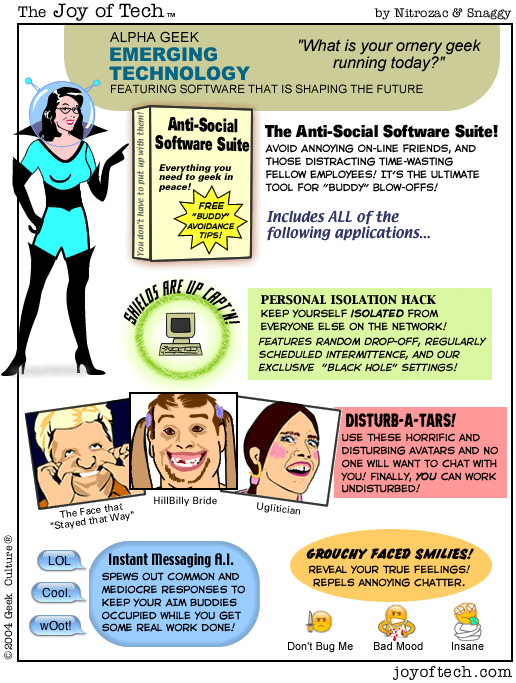
the Anti-Social Software Suite..you see me, not..

If you've been wondering why I haven't been seen online or blogging lately, here it comes:
I've been there all the time, but just wearing my new tech-ware, the Anti-Social Software Suite!

Friday, March 02, 2007

Notes on " When tags work and when they don't: Amazon and LibraryThing"

There is an excellent posting at the LibraryThing's blog on a study on tagging, it compares tags in LibraryThing and in Amazon.com. What is also a great reading are the comments, there are many of them which are very deep and reflective, too.

Lots of issues in this posting touch upon what we are currently thinking in MELT, where we are implementing a social tagging tool for teachers to tag digital learning material. A few points that I will elaborate upon later:
  • Tag categories (factual, subjective, personal); how there are so many opinion tags in Amazon compared with LT.
  • The idea of separate "buckets" vs. "works" (LT)
  • How the tagging interface works and supports the workflow (to show tags from others or not? how does this effect on convergence of tagging?)
  • Tags are not reviews or ratings! they serve different purpose.
  • Reasons and drivers for tagging
  • Number of tags to become important
  • Why implement tags in the first place, what is there for Amazon? they already have all sorts of ways to recommend content, do they still need tags? it's just another feature on top of all other whistles, it's not part of the design for the site to work.

Thursday, March 01, 2007

OLPC social features

For quite some time I've been reading about the One Laptop Per Child initiative and the new GUI that they've developed. It's been hard to get my head around how it actually would work based on screen shots.

Today I came across some YouTube clips on OLPC. Most of them were awful! Get this, they show the Linux booting up in verbose mode - as if anyone's interested!! Rest of the stuff is showing some features in too small font without commentary.

Luckily there was also this one, it pretty nicely presents the social features as part of design.


I would really love to be a fly on the wall when these laptops are introduced to kids!

I wonder what kind of sense they make for users who most likely have not seen conventional computers, nor used the Web.

A funny anecdote: I remember my fist time playing with Mac in summer of '84. I kinda liked the graphical interface (until then I had turned my head away in much of dislike from my brothers Commodor), but I was really quite baffled with icons like the trash can for delete. In Finland, the trash cans didn't look like that at all, so it was rather hard for me to make the connection. Of course one learns pretty quickly...

Connections between working items in EUN, KUL and COSL

Visiting The Center for Open Sustainable Learning (COSL) in Utah State University last week was a very rewarding experience. People there are working on many interesting things regarding the support for the use of open content in education. I had already checked their website (http://cosl.usu.edu/) before going there, but of course it's nothing compared to sitting down with people, talking about my projects and their projects, and, little by little, creating understanding on complimentary approaches and ideas to collaborate (hopefully).

To get the big picture on where I stand between all the work done in European Schoonet (EUN), KULeuven (KUL) and COSL, I created a complicated looking image that hopefully helps me to put pieces of the puzzle together.

The image here on the left represent a rather generic lifecycle of a learning resource (this is the connected part of the image) and the greenish bubbles around it are working/research items that people in EUN, KULeuven and COSL work on. With a quick look it seems that all the institutes work in the same field - providing access to learning resources - however, each has its own focus and flavour to give.

Who and what?

KUL is focused on searchability of resources across different repositories (SQI, OAI-PHM) and emphasises the generation (ALOCOM, AMG) and collection of metadata (CAM), both to describe the resource (LOM) and its context of use (Contextualized Attention Metadata).

COSL works on making the content accessible (EduCommons CMS), but is also focuses on tools to support the use of content (MOCSL). Moreover, the relations of content and content, content and users, and users and users seem to have become more important (Didly, Oz). They are also working on a recommender system.

EUN has interest in making the content available (federated search, Minor) and using the social aspects for its retrieval, the main methods being social bookmarking and user annotations (MELT).

Let's take it step by step following the scenario

1. Repositories to make content available

This image depicts a rather typical scenario of learning resources which end up in a repository; first the resource is "created", then"described" (i.e. metadata added) and "approved" (e.g. QA) to be part of a repository's collection where it is "published".

EduCommons, a plone-based CMS created by COSL folks has been developed for this reason.

eduCommons is an OpenCourseWare management system designed specifically to support OpenCourseWare projects like USU OCW. eduCommons will help you develop and manage an open access collection of course materials.
Whereas in EUN MINOR was developed. It's an open source learning resources repository that allows users to manage learning resources and their metadata. Minor comes with a built-in connector to the EUN's Federation of Internet Resources for Education, which greatly facilitates the work of connecting to other repositories and querying their resources.

2. Make the content available for search

Both EUN and KUL has been active in making the resources and/or metadata that reside in distributed collections and repositories accessible. Both have greatly contributed to Simple Query Interface (SQI). EUN and KUL, for example, demonstrated a real-time interoperability between Learning Object Repositories last summer.

Apart from SQI, folks in KUL are also looking into harvesting metadata, which seems like a suitable and complimentary solution for SQI.

3. Accessing the resources

Once the resources are made available in a way or another, there are the users who "discover" them using various methods. This is an area where quite a lot of work in done in all 3 places.

In EUN and KUL, within the MELT-project, the focus is on creating Social information retrieval (SIR) techniques for flexible access to large-scale collections of content. Here we are interested in social bookmarking and tagging, as well as on other annotations like comments, ratings, etc. This work can also lead to an implementation of a recommender system for learning resources within the federation of repositories.

COSL has also been busy thinking of how to use people, and relations that people and content have, to create serendipitous ways to discover resources. Ozmozr (Oz) is, or will be, an identity and content aggregator that leverages the power of social collaborative filtering through tagging. Currently it looks somewhat messy, but try to see for the grand idea that lies behind.

There is also Srumdidilyumptio.us, just didly among friends, that allows users to express relationships, let them between people and people, people and content or content and content, i.e. any two resources accessible by URLs. Didly might not look that cool, but one should think of it rather as an API to make use of that information in another context, I was told.

These two tools/concepts pretty well demonstrate the thinking that COSL folks take forward. One could say that they aggregate s!#t out of everything, to illustrate the Web 2.o thinking. Moreover, COSL will be working on topping up these two "relations aggregators" with a recommender system. The difference to the work in EUN is that they are planning to recommend anything that people have input in Oz, whereas EUN is only talking about recommending learning resources.

More in the same area, novel ways to access resources, one of the PhD students in KUL is working on creating a better ranking system for resources, namely the LearnRank. This will use the Contextualised Attention Metadata framwork (CAM). Another one is busy with information visualization techniques for the same purpose. We are also interested in experimenting on the combo of information visualization and social bookmarking in the future.

4. Support the decision making

Next step in discovering resources is to make the decision upon the piece of content. Usually users are exposed to a list of search results (sortable sometimes, ranked or not) or a list of recommendations. There are different ways the system can support users at this point.

EUN and COSL are both interested in user relevance judgments (AnnoRate; use of ratings and evaluations in EUN) and other annotations such as pedagogical comments, to help users to choose the content. EUN has also implemented personal collections of learning resources, so users could see in how many other collections the resource has been added in, to help them to judge its relevance.

After choosing the resource, users in EUN can add it to their favourites collection (bookmark) or choose to "obtain" the resource, its metadata or uri from the repository. Ozmozr, a COSL tool, allows users to bookmark items too, and to share them with other users. Additionally, at the same time, users can also save these bookmarks to their delicous account, for example.

It's good to make here a remark that CAM framework can be used to collect all kinds of user attention when interacting with a repository, for example, to save the search history, what items have been looked at or obtained, etc. This can be fed in again to help the discovery of resources, like is the case of LearnRank.

5. Re-using and re-purposing the content, content collaboration


Once the items have been obtained, there are the users, teachers or learners, who modify, "re-purpose", sequence or rip the resource to make it suitable for their needs.

In this sub-area ,some complimentary approaches have been taken too. Within an EUN-lead project a plone-based collaborative platform called LeMill has been developed by UIAH. LeMill is a web community for finding, authoring and sharing open and free learning resources.

In COSL some tools are under construction to support the use and re-use. Send2Wiki plug-in allows a user to send a webpage to a wiki and modify it there. It will automatically check on the CC licence and bring that info along. User can then modify the page in the wiki as they wish, for example to make a translation of it (hope to pilot this in EUN), or if it's from WikiPedia, modify the content to make it more suitable for K-12, for example (now some researchers in COSL say that Wikipedia is rather graduate level reading, thus the need for different versions).

Make a Path will help users in putting pieces of resource together for a coherent learning path. This tool is like creating your own music playlists. Once the users are using it (I hope EUN will pilot this, for example), some interesting patterns will most like start appearing. One possible way to take this forward to help sequence learning resources could be case based reasoning, like Claudio did for generating music play lists. Additionally, The INSTRUCTIONAL ARCHITECT allows teachers to find, use and share learning resources from the National Science Digital Library (NSDL) and the Web in order to create engaging and interactive educational web pages.

Moreover, there is research interest to better understand the collaboration aspects and communication patterns around content, how people work on it, share it, ask questions, help others, etc. In LeMill the collaboration aspect is important, one of the developers is currently conducting his PhD research (UIAH) on collaborative authoring of learning resources. Whereas in COSL, there is interest in looking into Yahoo! Answers, as well as there was some early work around supporting the users of MIT OpenCourseware.

I think KUL ALOCOM framework and AGM could be used here to make sure that a) the smallest possible pieces of content are saved in the repository, too, b) the correct metadata is sucked from the context. Also, CAM could be used to better track users interaction modes and patterns, etc.


6. Actual use of content and its evaluation


After ripping and mashing the content, it it usually "integrated" (e.g. using CMS, etc) to teaching and learning practices (pedagogical methods). "Use" of the learning resource takes place in its own context. Here, the CAM framework becomes useful to know more about how the resources have been used, in what context (e.g. entered by a university prof to a course, all this metadata can be sucked with the help of AGM and CAM).

Following the use, the users are given possibilities to evaluate or rate the content. The challenge here for a federation of repositories is that different repositories use different ways to rate and evaluate the content (different scale, different criteria (ped, technical, suitability in classroom,..), thus interoperability becomes cumbersome and there might be something lost in semantics (EUN). A rating service on a top of repositories like AnnoRate overcomes such hurdles.

To shortly summarise:


Everyone is interested in adding metadata, any kinds of it (LOM, attention, annotations, relations (bookmarks, sequence, ...), to the system


and using it for better retrieval of resources, and the new thing, to connect people.


"We use people to find content. We use content to find people. Information seeking behavior and social network analysis go hand in hand." Peter Morville (2004)
The really interesting part of a folksonomy is not the content item being described, and not the tags that describe the item, but the person doing the tagging. by Greenchameleon