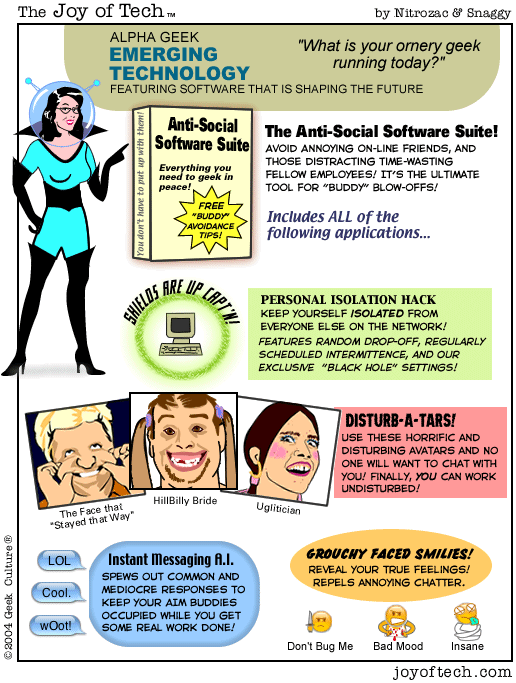
I've been there all the time, but just wearing my new tech-ware, the Anti-Social Software Suite!
Thursday, March 29, 2007
the Anti-Social Software Suite..you see me, not..
I've been there all the time, but just wearing my new tech-ware, the Anti-Social Software Suite!
Friday, March 02, 2007
Notes on " When tags work and when they don't: Amazon and LibraryThing"
Lots of issues in this posting touch upon what we are currently thinking in MELT, where we are implementing a social tagging tool for teachers to tag digital learning material. A few points that I will elaborate upon later:
- Tag categories (factual, subjective, personal); how there are so many opinion tags in Amazon compared with LT.
- The idea of separate "buckets" vs. "works" (LT)
- How the tagging interface works and supports the workflow (to show tags from others or not? how does this effect on convergence of tagging?)
- Tags are not reviews or ratings! they serve different purpose.
- Reasons and drivers for tagging
- Number of tags to become important
- Why implement tags in the first place, what is there for Amazon? they already have all sorts of ways to recommend content, do they still need tags? it's just another feature on top of all other whistles, it's not part of the design for the site to work.
Thursday, March 01, 2007
OLPC social features
Today I came across some YouTube clips on OLPC. Most of them were awful! Get this, they show the Linux booting up in verbose mode - as if anyone's interested!! Rest of the stuff is showing some features in too small font without commentary.
Luckily there was also this one, it pretty nicely presents the social features as part of design.
I would really love to be a fly on the wall when these laptops are introduced to kids!
I wonder what kind of sense they make for users who most likely have not seen conventional computers, nor used the Web.
Connections between working items in EUN, KUL and COSL
To get the big picture on where I stand between all the work done in European Schoonet (EUN), KULeuven (KUL) and COSL, I created a complicated looking image that hopefully helps me to put pieces of the puzzle together.The image here on the left represent a rather generic lifecycle of a learning resource (this is the connected part of the image) and the greenish bubbles around it are working/research items that people in EUN, KULeuven and COSL work on. With a quick look it seems that all the institutes work in the same field - providing access to learning resources - however, each has its own focus and flavour to give.
Who and what?
KUL is focused on searchability of resources across different repositories (SQI, OAI-PHM) and emphasises the generation (ALOCOM, AMG) and collection of metadata (CAM), both to describe the resource (LOM) and its context of use (Contextualized Attention Metadata).
COSL works on making the content accessible (EduCommons CMS), but is also focuses on tools to support the use of content (MOCSL). Moreover, the relations of content and content, content and users, and users and users seem to have become more important (Didly, Oz). They are also working on a recommender system.
EUN has interest in making the content available (federated search, Minor) and using the social aspects for its retrieval, the main methods being social bookmarking and user annotations (MELT).
Let's take it step by step following the scenario
1. Repositories to make content available
This image depicts a rather typical scenario of learning resources which end up in a repository; first the resource is "created", then"described" (i.e. metadata added) and "approved" (e.g. QA) to be part of a repository's collection where it is "published".
EduCommons, a plone-based CMS created by COSL folks has been developed for this reason.eduCommons is an OpenCourseWare management system designed specifically to support OpenCourseWare projects like USU OCW. eduCommons will help you develop and manage an open access collection of course materials.Whereas in EUN MINOR was developed. It's an open source learning resources repository that allows users to manage learning resources and their metadata. Minor comes with a built-in connector to the EUN's Federation of Internet Resources for Education, which greatly facilitates the work of connecting to other repositories and querying their resources.
2. Make the content available for search
Both EUN and KUL has been active in making the resources and/or metadata that reside in distributed collections and repositories accessible. Both have greatly contributed to Simple Query Interface (SQI). EUN and KUL, for example, demonstrated a real-time interoperability between Learning Object Repositories last summer.Apart from SQI, folks in KUL are also looking into harvesting metadata, which seems like a suitable and complimentary solution for SQI.
3. Accessing the resources
Once the resources are made available in a way or another, there are the users who "discover" them using various methods. This is an area where quite a lot of work in done in all 3 places.In EUN and KUL, within the MELT-project, the focus is on creating Social information retrieval (SIR) techniques for flexible access to large-scale collections of content. Here we are interested in social bookmarking and tagging, as well as on other annotations like comments, ratings, etc. This work can also lead to an implementation of a recommender system for learning resources within the federation of repositories.
COSL has also been busy thinking of how to use people, and relations that people and content have, to create serendipitous ways to discover resources. Ozmozr (Oz) is, or will be, an identity and content aggregator that leverages the power of social collaborative filtering through tagging. Currently it looks somewhat messy, but try to see for the grand idea that lies behind.
There is also Srumdidilyumptio.us, just didly among friends, that allows users to express relationships, let them between people and people, people and content or content and content, i.e. any two resources accessible by URLs. Didly might not look that cool, but one should think of it rather as an API to make use of that information in another context, I was told.
These two tools/concepts pretty well demonstrate the thinking that COSL folks take forward. One could say that they aggregate s!#t out of everything, to illustrate the Web 2.o thinking. Moreover, COSL will be working on topping up these two "relations aggregators" with a recommender system. The difference to the work in EUN is that they are planning to recommend anything that people have input in Oz, whereas EUN is only talking about recommending learning resources.
More in the same area, novel ways to access resources, one of the PhD students in KUL is working on creating a better ranking system for resources, namely the LearnRank. This will use the Contextualised Attention Metadata framwork (CAM). Another one is busy with information visualization techniques for the same purpose. We are also interested in experimenting on the combo of information visualization and social bookmarking in the future.
4. Support the decision making
Next step in discovering resources is to make the decision upon the piece of content. Usually users are exposed to a list of search results (sortable sometimes, ranked or not) or a list of recommendations. There are different ways the system can support users at this point.EUN and COSL are both interested in user relevance judgments (AnnoRate; use of ratings and evaluations in EUN) and other annotations such as pedagogical comments, to help users to choose the content. EUN has also implemented personal collections of learning resources, so users could see in how many other collections the resource has been added in, to help them to judge its relevance.
After choosing the resource, users in EUN can add it to their favourites collection (bookmark) or choose to "obtain" the resource, its metadata or uri from the repository. Ozmozr, a COSL tool, allows users to bookmark items too, and to share them with other users. Additionally, at the same time, users can also save these bookmarks to their delicous account, for example.
It's good to make here a remark that CAM framework can be used to collect all kinds of user attention when interacting with a repository, for example, to save the search history, what items have been looked at or obtained, etc. This can be fed in again to help the discovery of resources, like is the case of LearnRank.
5. Re-using and re-purposing the content, content collaboration

Once the items have been obtained, there are the users, teachers or learners, who modify, "re-purpose", sequence or rip the resource to make it suitable for their needs.
In this sub-area ,some complimentary approaches have been taken too. Within an EUN-lead project a plone-based collaborative platform called LeMill has been developed by UIAH. LeMill is a web community for finding, authoring and sharing open and free learning resources.
In COSL some tools are under construction to support the use and re-use. Send2Wiki plug-in allows a user to send a webpage to a wiki and modify it there. It will automatically check on the CC licence and bring that info along. User can then modify the page in the wiki as they wish, for example to make a translation of it (hope to pilot this in EUN), or if it's from WikiPedia, modify the content to make it more suitable for K-12, for example (now some researchers in COSL say that Wikipedia is rather graduate level reading, thus the need for different versions).
Make a Path will help users in putting pieces of resource together for a coherent learning path. This tool is like creating your own music playlists. Once the users are using it (I hope EUN will pilot this, for example), some interesting patterns will most like start appearing. One possible way to take this forward to help sequence learning resources could be case based reasoning, like Claudio did for generating music play lists. Additionally, The INSTRUCTIONAL ARCHITECT allows teachers to find, use and share learning resources from the National Science Digital Library (NSDL) and the Web in order to create engaging and interactive educational web pages.
Moreover, there is research interest to better understand the collaboration aspects and communication patterns around content, how people work on it, share it, ask questions, help others, etc. In LeMill the collaboration aspect is important, one of the developers is currently conducting his PhD research (UIAH) on collaborative authoring of learning resources. Whereas in COSL, there is interest in looking into Yahoo! Answers, as well as there was some early work around supporting the users of MIT OpenCourseware.
I think KUL ALOCOM framework and AGM could be used here to make sure that a) the smallest possible pieces of content are saved in the repository, too, b) the correct metadata is sucked from the context. Also, CAM could be used to better track users interaction modes and patterns, etc.
6. Actual use of content and its evaluation
After ripping and mashing the content, it it usually "integrated" (e.g. using CMS, etc) to teaching and learning practices (pedagogical methods). "Use" of the learning resource takes place in its own context. Here, the CAM framework becomes useful to know more about how the resources have been used, in what context (e.g. entered by a university prof to a course, all this metadata can be sucked with the help of AGM and CAM).Following the use, the users are given possibilities to evaluate or rate the content. The challenge here for a federation of repositories is that different repositories use different ways to rate and evaluate the content (different scale, different criteria (ped, technical, suitability in classroom,..), thus interoperability becomes cumbersome and there might be something lost in semantics (EUN). A rating service on a top of repositories like AnnoRate overcomes such hurdles.
To shortly summarise:

Everyone is interested in adding metadata, any kinds of it (LOM, attention, annotations, relations (bookmarks, sequence, ...), to the system
and using it for better retrieval of resources, and the new thing, to connect people.


"We use people to find content. We use content to find people. Information seeking behavior and social network analysis go hand in hand." Peter Morville (2004)
The really interesting part of a folksonomy is not the content item being described, and not the tags that describe the item, but the person doing the tagging. by Greenchameleon
Wednesday, January 17, 2007
A really bad idea of crowd-sourcing the Web
Oh my god, what's gonna be next?? It's not enough that we can practice neighbour-watching in our own neighbourhood, but now, thanks to the Web, we are able to big brother our neighbouring countries, practice border patrolling, and renounce illegal immigrants. A little respé, svp!!12,000 Estimated number of illegal immigrants apprehended at the U.S.-Mexico border in November
10 Number of illegals apprehended in November thanks to a $200,000 experimental website allowing anyone to monitor the border and alert authorities. Viewers sent 14,800 e-mails through the site.
http://www.time.com/time/magazine/article/0,9171,1576859,00.html
Notes on Combining Social- and Information-based Approaches for Personalised Recommendation on Sequencing Learning Activities
The aim of the paper is to describe a domain model for "way finding". By the term "way finding" is meant "selecting and sequencing learning activities". The raison d'etre is:
Learners' problems in way finding will decrease the efficiency of education provision (the ration of output to input) and increase the cost. The local context for this paper is Dutch Open University student who lacks adequate information on study possibilities at an early stage of study, and problems in getting a good overview of the number and best sequence to study modules.
The paper describes a personalised recommender system (PRS) model that combines social-based (i.e. completion data from other learners) and information-based (i.e. metadata from learner profiles and learning activities) data to recommend the best next learning activity. The system is currently under development, a limited implementation is running using learner profile metadata.
Note about learning activities; OUNL has been very active in developing IMS Learning Design. They (Tattersall et al. (in press)) have previously proposed IMS-LD as a candidate to model learning paths. Moreover, they argues that its selection and sequencing constructs appear suitable for learning activities (units-of-learning) as well as for higher levels of granularity (e.g. competence development programmes). Interesting. At one point of time one could look how IMS-LD information could be generated in attention metadata (CAM).
So, the idea of PRS approach is a hybrid recommender that uses
- a) information from other learners and their completion of tasks (completion is understood like rating) in a collaborative filtering manner (in text called social-based approach), and
- b) information from students profile and c) metadata about the resource in the spirit of a content-based system (in text called information based approach).
Authors also argue that it is not enough to find the most efficient learning paths (like the shortest route in GPS), but to explore which paths are most attractive or suitable (like routes suited for biking), thus personalisation needed (individualised needs, interest, preferences or circumstances).
Other key concepts are:
- learner's start position in a given domain (prior learning history)
- aimed competence profile for that domain
- learning path towards that competence
- uniform and meaningful description of formal and informal learning paths
- learning activities that are addressable and meaningfully described
- uniform learner profiles that define needs and preferences
- uniform competence description that defines proficiency levels
- a learning path processing engine
- an engine recording completion of activities
- information matching techniques to enable personalised recommendation
Related work
I will later post on my blog some excerpts from my own literature review in the field of learning to show other recommender ideas based on the same hybrid approach, as in this paper they mention that this approach has hardly been applied in learning. There was only a reference to Herlocker et al. (2004).
In the related work section it is mentioned that education field imposes some specific demands for recommender. Main differences sited between recommenders for books are the degree of voluntariness (learning is many times required to obtain some goals) and the possibility to establish an explicit completion (as most learning activities are to be assessed for successful completion). Hmm..I do agree with the statement, but had come up with different reasons myself. Goes to show, I guess, how the initial requirements for a recommender system differ from what I'm working on.
An interesting outcome is cited from Janssen et al. (in press): learners were offered a recommendation "most successful learner continued with Y after having completed X". I call this an "Amazon-like" recommendation (other people interested in this book also bought x, y, z) based on clustering behaviour. There were no personal characteristics taken into account in this study. They found out that this type of recommendation enhanced effectiveness in completion of the set of learning activities, but did not increase efficiency, the time it took to complete them.
Authors also acknowledge the problem of insufficient data that can be derived from existing log files, the same that my colleagues are working on with the view on capturing attention metadata (CAM).
Discussion
Authors state:
"From a self-organising point of view it would be ideal if way finding would emerge as a result of (in)direct interactions between members of the learning network, without being dependent of formalised descriptions in domain and user models."
I so agree: instead of investing time in describing all the information regarding the learner, his/hers existing and required competences; the resource; and the curriculum with goals and skills required, would be more interesting to tap onto existing knowledge from the masses and their previous experiences, the decisions they took to find the next suitable step, etc.
The authors also discuss the complimentary approach of controlled vocabularies or ontologies combined with annotations such as social tagging and rating, just in the same direction as we are doing in MELT (we talk about adding metadata a priori and a posterior) and what I'm interested in looking into.
Related to my work
The difference in what I'm looking into now and what this paper describes is, first of all, the context. I'm interested in a repository that is used mostly by K-12 teachers and learners (sometimes). The repository is not linked to formal learning requirements related to a curriculum, because it is used on the European level, where there are many curricula depending on a country or a local policy. However, each teacher who comes to that repository has his/hers own information seeking tasks, that I've talked about previously. Sometimes those tasks are related to covering a piece of a local curriculum, whereas some other times it is to find a piece of resource to support some generic learning goal, or find inspirational material, or something else.
Secondly, in my context of work sequencing learning resources is not the goal, rather just finding resources that fit to the search criteria and the task at hand. So I'm not so into this sequencing, however, I like the idea of playlists and using this type of expert knowledge of putting items together for learning purposes (the use of Case-based Reasoning like Claudio explore here).
Imagine if teachers could generate playlists of LOs as easily as I do playlists in iTunes (I'm NOT talking about automatically generating them, but hands-on deejaying). Then, those lists could be used as rules for generating new ones. In that case, we would not need LOM to know which item in a repository is described as "introductory item" or "motivational item" to start the lesson, or which one is good for "explaining a rule", but we could detect that information form playlists generated by teachers who knows through her domain knowledge that after this piece I put x,y and x. Let's see.
To check out from the paper:
- Koper (2005)
- Janssen et al. (in press) about the test
- Sicilia (2005) about ontologies to express competencies
- Van Setten, 2005 social-based approaches
- McCalla (2004), pragmatics-based paradigm of tagging learning activities with learner information
Wednesday, January 03, 2007
Fighting the read/write web-fatigue with interoperability
My problem with social software sites has long been my short attention span. I love to log-in - but not fully create my full profile as it is soo timeconsuming - I play around for some time to test and understand how some of the features work, and then I forget about it. Some random emails from even more random people wanting to make me their friend sometime remind me of the service. However, it's hard to go back as I can't even remember the password or which email I used to sign up.
This post, ..(cuz losing passwords is common amongst teens), really made me laugh about how teens use the Web. According to that teens would forget the password to enter to the social network service, and without any hesitation, they start a new profile, and email for that reason. I wonder if this is more the nature of teens than a new trend emerging among young users of Web?
Maybe teens just don't think the whole thing (i.e. social network sites) is that meaningful or worth saving. Or better, maybe they just really don't think about building a consistent profile of themselves, yet. Hell no, I would hate if all the stuff that I once did on the Web would be still available and indexed in Google! Everyone needs to start once in a while from scratch, cuz old habits stick (and stink)! But, maybe once those kids think that it's meaningful enough for them, and they will start remembering the passwords.
Or better, when they are old enough that they really care and want to keep all the digital pieces together, hopefully there are better ways to keep track of "yourself" than separate services with no portability of content that only rely on stupid passwords. There really should be better ways...
Anyway, the two points that I have seeing since I've opened my computer after vacations (yeah, I know how to log off) is Web-fatigue and portability of content, contacts and profile information in social networking sites, but I would really want to bring it to the whole field of social software.
Could 2007 be the year of social network fatigue? by ZDNet's Steve O'Hear --Another driving force for social networks in 07, will be the increasing
number of niche networks which are highly targeted to particular
interest groups or social activities. The question that still remains
however, is how many social networks any one user is likely to join and
remain active in? This is where Read/WriteWeb's prediction of fatigue
has more weight. Unless the time required to sign-in, post to, and
maintain profiles across each network is reduced, it will be impossible
for most users to participate in multiple sites for very long.
Therefore I think it will be essential for social networks to open up, through embracing open standards which allow for greater interoperability between networks.
Hell yeah, that would be lovely! That's what I've been wanting for some time now, well, ever since I started using social bookmarking services. I really like Furl, I think it's far nicer service to use than delicious, which I only use occasionally, because of peer-pressure, everyone else is there - well, to leverage on the crowds. But I just don't like it, for reasons that I won't go in this post.
Nevertheless, what I would like, is that having the profile and bookmarks that I've accumulated in Fulr could be taken advantage of also in delicious. There should be some way of updating my profile at the same time in both services, or that the services would have some way to make a personalised federated search across the services - sort of meta search across social bookmarking sites that would
a) allow me to browse other similar people's profiles,
b) would make active matching of my bookmarks to others in each service and recommend me links. Moreover, there should be some
c) possibility also to tap on my networks and contacts throughout the services, like that my delicious network would be notified of my new bookmarks in Furl.
Of course, now there are ways to do all that, subscribe manually users from one place to another, etc, but it would take ages to do it, and I would never be up-to-date in any of the places, I reckon.
So, this is to say that it would be really important to work on different types of interoperability between social software services. There's been posts regarding portability of contacts information, but also just plain user profile stuff (why can't I still even upload my vCard??), portability of social bookmarks (I once checked how about importing my personal links from delicious and furl to a repository of learning resources and found out that not even the RDF or XML was standard), etc.
The current way of wanting to lock-in people to a social software/service that they've started investing in (I'm thinking of investing time, knowing/inviting people and friends, creating and enriching profile, etc) is ridiculous. Only us, say, 30-years and +, are silly enough to stick around in places where we've started building up our personal portfolio of digital artefacts. We escape behind excuses like "I'm too busy to start a new blog and transfer my blogroll", or "I've lost my password to my domain name server to change it to a new one".. We should start seriously asking the providers for these services, to give us better portability of our data, do more open standards based communication layers to enable federated searches across services, etc.
Voila! My wish for 2007 is better interoperability for social software! Or otherwise, I'll just start behaving like those teens ;)
Tuesday, November 21, 2006
A Case study on 5S
The advantage of using a formal language and model, according to its creators (Goncalves, et al. ), is that they are precise and unambiguous when defining semantics of specific abstractions of a knowledge field. Thus, 5S could be used as an instrument for
1) building and interpretation of a DL taxonomy,
2) informal and formal analysis of case studies of digital libraries and utilisation as a formal bases for a DL description language.
Moreover, 5S could be used for requirements analysis in Digital Library development.
An example of a case study to describe a digital library using the main elements of 5S is presented below, taking Learning Resources Exchange as an example.
5S, a fundamental abstraction of digital libraries, stands for Streams, Structures, Spaces, Scenarios and Societies. Streams are sequences of arbitrary items used to describe both static and dynamic content. Structures impose organisation. Spaces are stets with operations on those sets that obey certain constraints. Scenarios consist of sequences of events that modify states of a computation in order too accomplish a functional requirement. Societies are sets of entities and activities and relationships among them. The below case study illustrates of what each “S” is comprised of.
Societies
- primary community: European teachers and learners
- repository providers: public authorities who make the decision about joining
- repository maintenance and running, editorial control
- some pedagogical support, etc.
- commercial providers
Scenarios (services, different corresponding scenarios)
- trainings to help authorities to hook up to the federation
- training to help teachers to use the system and submit material to it and creating the metadata
- scenarios to maintain the service and content?
- Scenarios on how to access the site, through browsing and searching, in one or federation (SQI)
Spaces
- physical location of members (a metric space)
- vocabularies and metadata used in different services (conceptual space). In addition to this, also manual, semi-automatic, and automatic indexing and classification methods to relate repositories to the conceptual space of ELR.
- User interfaces (APIs?) to relate various software routines (like LMS etc)
Streams
- simplest level they are streams of characters for text, and streams for pixels for images; audio, digital files. Challenges for quality of system if in real-tine or storage problems at the local level if downloaded and locally played
- Network protocols, transmissions of serialised streams over the network such as federated search, harvesting, hybrid services using protocols like Dienst, Z39.50, OAI-PMH,...
Structures
- database management system at the heart of the software for submission and workflow management.
- Xml to store and exchange the resources' metadata
- EUN Application profile
- structures in the form of semantic networks, any?
S5 as a description language.
The paper, using S5 Descriptive Language, defines a digital library as follows:
A digital library is a 4-tuple (R, DM, Serv, Soc), where
- R is a repository;
- DM= {DM c1, DM c2, ...DM ck} is a set of metadata catalogs for all collections {C1, C2,...Ck}
- Serv is a set of services containing at least services for indexing, searching and browsing;
- Soc is a society.
“ We should stress that the above definition only captures the syntax of a digital library, that is, what a digital library is. Many semantic constraints and consistency rules regarding the relationships among the DL components (e.g. How the scenarios in Serv should be built from R and DM and from the relationships among communities inside the society Soc, or what the consistency rules are moment digital objects in collections of R and metadata records in DM) are not specified here. Those will be a subject of future research. “
Tuple: in a database, an ordered set of data constituting a record; a data structure consisting of comma-separated values passed to a program or operating system.
GONCALVES, M., A., FOX E., A,, WATSON, L., T. and KIPP, N.,A. (200 ).
Streams, Structures, Spaces, Scenarios, Societies (5S): A Formal Model for Digital Libraries
Virginia Polytechnic Institute and State University
http://www.dlib.vt.edu/projects/5S-Model/
Monday, November 20, 2006
Workshop: Impact of Social Software on Society: PROWalk Event
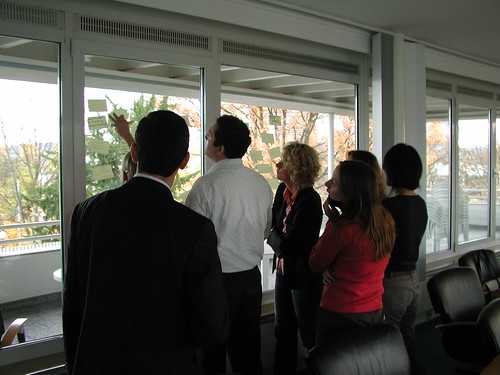
Already for some time I've been aware of the idea of BlogWalk, but only now had a chance to have my first experience. I must say that I missed the "walking" part, we did not leave the conference venue to explore other areas. Nevertheless, mentally we did and it was interesting 3h of interactions, introductions, supporting questions, personal experiences and accounts, monologues, and post-its clued on the window (i.e. window-wiki, see the pic below).
Currently, instead of getting a "pre-filtered" view, one aggregates and filters (through friends) news, opinions, digital prints and artefacts by choosing whose blogs, what news and whose pictures/videos to aggregate and actually read. There are many different context one works in during the day (different way of working, that knowledge worker-stuff).
Overdose of all this was also discussed, how time consuming it is to filter all this information, read and mull it over, etc. Check out "continuous partial attention", but it's not only about email flows or instant messaging, it's increasingly about Web-feed loads, too! From my own point of view, just to balance out all the rants and not-so-well-formed opinions on the blogosphere, there is nothing better than reading The Economist, one of the best source of journalism. I sometime think of it as an ultimate opposite to blogs: impersonal (you have no idea of who has authored the article), although views on economics, and the world (in that order) are very pre-set, they know how to be self-critical, and so on. All this coined with a previous discussion with a pal about how he, previously an avid blog reader/writer is gonna only start reading peer-reviewed articles. Of course it was just a half jokingly said, but there is a little truth there too. We are probably soon gonna see some blog-fatigue in a way or another.
While talking about all this, we posted notes on the window with issues that we thought relevant for the BlogWalk. The following categories emerged:
1) Usage (personal level)
2) Effects and Fall-out (group level)
3) Contexts of usage (organisational/societal level)
4) Convergence (deep changes behind it all)
5) On-line interaction and/vs face to face
6) Design and evaluation of tools
One gap that was identified is how little research is actually done on social practices on how the tools and systems are used. We were discussing about many different ways of how and for what reasons people aggregate Web-feeds, for example. A cognitive point of view on this is missing, which, in a way, hinders us to see and understand the phenomena that social software can be part of in our society. Some empirical descriptions are missing, or like it was put on the wiki:
To understand the social implications we need more storytelling/ethnographic/anthropologic research that starts with the individual, in stead of just looking at the 'big numbers' and large patterns. (More stuff like by Efimova and Ben Lassoued, and my blog articles on my personal information strategy: 1, 2 and 3)
Nowadays many skeptics laugh about blogs that they have only one reader, the author, attempting to put them down. Hec, blogs are great for self-reflection, too. How needs an audience for that? If we had better understanding of a diverse ways people use these tools, we could maybe make them have a better support for all the diver ways. Which made me think of many of the read/write web tools and systems being on their perpetual beta, and whether that is a good or a bad thing. It could be good, in case the developers actually followed how people use their tools and developed them accordingly. However, it can also mean that they have no interest in supporting any new features and functions, and they just leave it hanging. Thus, better exploratory field studies and different contexts are needed to be studied, which would lead to more rigorous field and lab experiments to understand this all better.
For once again, attention metadata was discussed, on the one hand from a privacy point of view, and on the other hand, as a way to better understand how users use the wide palette of tools and systems.
Wednesday, November 15, 2006
Where tags and structured vocabularies co-exist, case for tagging learning resources
Context
In the Learning Resources Exchange-portal end-users, i.e. K-12 teachers from all over Europe can access digital learning resources that are made available by European Schoolnet or by its partners from different learning repositories from a number of European country. All of the learning resources have associated metadata to them, all of the partners use Learning Object Metadata, and many of them an application profile specifically geared to European K-12 education. The indexing keywords come from a multilingual Thesaurus that currently exists in 14 languages. Additionally, teachers can add their own keywords to learning resources when saving them to their personal collections, that function like bookmarks. Also, in their personal collections teachers can evaluate their learning resources, rate them and add comments. This paper focuses on vocabularies, both unstructured and structured ones, and proposes a complimentary approaches to their use to enhance learning resources retrieval. We think that tagging has the potential to enhance the retrieval, both through the complementary features that it can offer for controlled vocabularies, as well as through its underlying social structures.
Structured and Unstructured vocabularies to access resources
The table "axes of organizational vocabularies" depicts the dimensions of structured and unstructured vocabularies. Learning resource repositories, for example, often use an authoritative vocabulary to index the material that is based on their national or regional educational needs such as requirements in curriculum or educational levels. Some of these vocabularies are structured domain taxonomies with hierarchies (LRE thes, EUN, Italy; Mobus thesaurus, France;,..) whereas others might be unstructured glossary type lists of terms (eg....). These vocabularies are used in educational repositories and portal most often to provide access to resources by classification or allowing hierarchical browsing, search functions are equally applied, however, teachers seem to prefer browsing features (based on focus groups and some Calibrate logs).
| Structured | Unstructured | |
| Authoritative | Domain Taxonomy | Glossary |
| Personal/Opportunistic | Hierarchical Filesystem | Folksonomy |
Axes of organizational vocabularies, Iverson (2006), CC some rights reserved.
As opposed to authoritative vocabularies, personal tagging of resources provides an unstructured vocabulary for resources. These end-user generated keywords serve, in the first place, personal knowledge management needs. For example by bookmarking resources one creates a link to the resources to access them later, and the use of personal keywords allows naming things in a meaningful way, grouping them, etc. Depending on the user-base and behaviour, tagging can start providing a community based vocabulary for the given community of users. This is commonly known as folksonomy. It is important to note that not all the actions of tagging and personal vocabularies allow a community folksonomy to emerge, thus the division to broad and narrow folksonomies (Vander Wal, 2005).
Classified categories or domain taxonomies offer a way to access resources, either through keyword based retrieval or browsing through categories. A solid indexing strategy based on controlled vocabularies guarantees that the searcher does not need to face all the uncertainties of natural language (synonymy, polysemy, homonymy), combined with all the uncertainties of a full text search (no relevance control on the retrieved occurrences) (Trigari, 2002). Both searching and browsing, based on metadata and controlled, structured taxonomies, are methods most used to access resources on educational portals.
Browsing and searching serve two fundamentally different information seeking tasks. It is similar to the difference between exploring a problem space to formulate questions, as opposed to actually looking for answers to specifically formulated questions (Mathes, 2005). One could say that searching happens at the stage where user already have a clearly defined task, a well formulated question, and an idea how and by what information sources to fulfill it (reference), whereas browsing many times occurs when the user has not yet a clear question or task at hand, rather just a hunch of what to look for.
Second important advantage of folksonomies is that they can serve the community by promoting a serendipitous access to resources through browsing interlinked related tag sets, also known as "tagclouds". A tagcloud can be a personal one comprised only of the personal keywords, it can be a local one to display the most common tags by a given community of uses (e.g. based on domain interest, language, etc.) or even a global one allowing an access to all resources that are available through the service.
Complicity of relationships between thesauri and folksonomies
An interesting hybrid of vocabularies will emerge within the ELR context, where users add personal keywords to learning resources that are already indexed by an authoritative, structured domain taxonomy such as the LRE Thesaurus. As opposed to most Web-based applications where no top-down vocabulary exist and where users tag content with their personal keywords (del.icio.us, Flickr,..), the situation is different in ELR. Here, a learning resource is indexed using a 1 to 3 thesaurus terms that further allow search and browsing in a multilingual context, added also with multilingual tags by end-users. This will open a number of interesting research possibilities in the twilight zone of structured and unstructured vocabularies.
In the LRE Thesaurus the structure of the descriptors follows the classical semantic relationships such as the following: intra-language equivalence (USE-UF), inter-language equivalence, hierarchical BT/NT relationship and the associative relationship (RT). The research attention will be directed to study the relations between terms in all the areas. For the revision purposes of the thesauri, we will be interested in looking whether folksonomies could provide any new descriptors for the LRE Thesaurus.
Maybe the most potential area of complicity between folksonomies and thesaurus will be in the area of inter-language equivalence (USE-UF) between the thesaurus terms and folksonomies, which could be seen as a good source for non-descriptors. Non-descriptors are part of thesaurus, they provide the intra-language equivalence that facilitates the access to resources that are indexed by using the descriptors (i.e. thesaurus term) that do not translate well to the language that the end-user uses. For example, a user could search for antiquities, but the preferred term in the thesaurus, the one used for indexing, is "ancient history". The use of antiquities as a non-descriptor thus facilitates the access to the resource.
Example of inter-language equivalence (USE-UF)
Antiquities USE ancient history
ancient history UF Antiquities
Moreover, an equally interesting area will be associative relationships (RT) and folksonomies. The associative or related term relationship is expressed in thesauri between terms that are mentally associated to such an extent that it's useful to make the link between them explicit, however, they are not members of equivalence set, neither are subordinated or superordinated to another (Trigari, 2001). We think that folksonomies could help to define and re-define a number of associative relationships in thesauri.
Example of associative (RT) relationship
NT1 old age
. . . . RT elderly person
As the ELR Thesaurus is also multilingual, we will be interested in investigating what kind of inter-language equivalence folksonomies could offer between languages. As for the area of hierarchical broad terms and narrow terms (BT/NT relationship) between the thesauri terms, we assume that folksonomies have very little to offer.
All in all, additionally to the above, for the revision purpose of the thesaurus, we think that folksonomies can be a great source to verify whether the scope of the current descriptors actually serves the need of its users for indexing and retrieval purposes.
To better understand the nature of folksonomies and tagging
A number of interesting research papers have emerged in the area of tags and folksonomies. Mathes (2005) described the phenomena, whereas the term and its main characteristics such as broad and narrow folksonomies were described by Vander Wal (2005). Broad folksonomies can be defined as social tagging systems where many people tag a few items (e.g. del.icio.us), whereas narrow folksonomies are the ones where content provider, usually the owner of the content, gives tags to items (e.g. flickr). Mainly, folksonomies emerge from broad ones, as there are many users and also niche user groups, who give the item the name that they know it for. Through the recent research we also know more about the evolution of tagging and how users provide them (Sen et al., 2006). Marlow et al., (2006) propose a model and taxonomy of different tagging systems. Moreover, Bogers et al. (2006), Lin et al. (2006) and Tonkin (2006) have provided interesting insights into the issues between classification and tagging.
By studying tagging and folksonomies more closely in this specific hybrid setting of learning resource,s that are indexed by experts and tagged by end-users, might yield some more interesting insights into its nature, both from qualitative and quantitative point of view. More so, we are interested in finding best ways to have social tagging systems to co-exist with more top-down indexing with structured vocabularies, and find out ways that can leverage such a system to better serve its users' needs. Also, research in this type of setting might allow us to better understand the many downfalls of folksonomies, such as ambiguity of tags, their synonym (different word, same meaning) and homonym (same word, different meaning) control (Guy, 2006). Moreover, we are interested in using the folksonomies to tap into the social structures and networks to, first of all, study and analyse the charasteristics and the main behavior of our user-base, and secondly, to use the social networks to enhance the information retrieval and serendipitous access to resources.
References
Bogers, T., Thoonen, W., & van den Bosch, A. (2006). Expertise classification: Collaborative classification vs. automatic extraction. Social Classification: Panacea or Pandora? 17th Annual SIG/CR Classification Research Workshop. Retrieved from http://www.slais.ubc.ca/users/sigcr/sigcr-06bogers.pdf.
Guy, M., & Tonkin, E. (2006). Folksonomies: Tidying up Tags? D-Lib Magazine, 12(1). Retrieved November 10, 2006, from http://www.dlib.org/dlib/january06/guy/01guy.html.
Iverson, L. (2006). Thomas Vander Wal on Folksonomy. Blog posting. Retrieved from http://www.ece.ubc.ca/~leei/weblog/2006/03/thomas_vander_wal_on_folksonom.html.
Lin, X., Joan, B., Yen, B., et al. (2006). Exploring characteristics of social classification. Social Classification: Panacea or Pandora? 17th Annual SIG/CR Classification Research Workshop. Retrieved from http://www.slais.ubc.ca/users/sigcr/sigcr-06lin.pdf.
Long, K. (2005). Leveraging folksonomy - flickr clusters at ExperienceCurve. Blog posting. Retrieved November 10, 2006, from http://blog.experiencecurve.com/archives/leveraging-folksonomy-flickr-clusters.
Marlow, C., Naaman, M., boyd, D., et al. (2006). HT06, Tagging Paper, Taxonomy, Flickr, Academic Article, . Hypertext 06. Retrieved from http://www.danah.org/papers/Hypertext2006.pdf.
Mathes, A. (2004). Folksonomies - Cooperative Classification and Communication Through Shared Metadata. Retrieved November 13, 2006, from http://www.adammathes.com/academic/computer-mediated-communication/folksonomies.html.
Sen, S., Shyong K., L., Cosley, D., et al. (2006). tagging, community, vocabulary, evolution. Proceedings of CSCW 2006. Retrieved from http://www.grouplens.org/papers/pdf/sen-cscw2006.pdf.
Tonkin, E. (2006). Searching the long tail: Hidden structure in social tagging . Social Classification: Panacea or Pandora? 17th Annual SIG/CR Classification Research Workshop. Retrieved from http://www.slais.ubc.ca/users/sigcr/sigcr-06tonkin.pdf.
Trigari, M. (2001). Multilingual thesaurus, why? . European Schoolnet, ETB project.. Retrieved November 13, 2006, from http://etb.eun.org/eun.org2/eun/en/etb/content.cfm?lang=en&ov=3813.
Vander Wal, T. (2005). Explaining and Showing Broad and Narrow Folksonomies :: Personal InfoCloud. Blog posting. Retrieved November 13, 2006, from http://www.personalinfocloud.com/2005/02/explaining_and_.html.
Monday, November 13, 2006
List of some good reading on folksonomies
Guy, M., & Tonkin, E. (2006). Folksonomies: Tidying up Tags? D-Lib Magazine, 12(1). Retrieved November 10, 2006, from http://www.dlib.org/dlib/january06/guy/01guy.html.
Iverson, L. (2006). Thomas Vander Wal on Folksonomy. Blog posting. Retrieved from http://www.ece.ubc.ca/~leei/weblog/2006/03/thomas_vander_wal_on_folksonom.html.
Lin, X., Joan, B., Yen, B., et al. (2006). Exploring characteristics of social classification. Social Classification: Panacea or Pandora? 17th Annual SIG/CR Classification Research Workshop. Retrieved from http://www.slais.ubc.ca/users/sigcr/sigcr-06lin.pdf.
Long, K. (2005). Leveraging folksonomy - flickr clusters at ExperienceCurve. Blog posting. Retrieved November 10, 2006, from http://blog.experiencecurve.com/archives/leveraging-folksonomy-flickr-clusters.
Marlow, C., Naaman, M., boyd, D., et al. (2006). HT06, Tagging Paper, Taxonomy, Flickr, Academic Article, . Hypertext 06. Retrieved from http://www.danah.org/papers/Hypertext2006.pdf.
Sen, S., Shyong K., L., Cosley, D., et al. (2006). tagging, community, vocabulary, evolution. Proceedings of CSCW 2006. Retrieved from http://www.grouplens.org/papers/pdf/sen-cscw2006.pdf.
Tonkin, E. (2006). Searching the long tail: Hidden structure in social tagging . Social Classification: Panacea or Pandora? 17th Annual SIG/CR Classification Research Workshop. Retrieved from http://www.slais.ubc.ca/users/sigcr/sigcr-06tonkin.pdf.
Vander Wal, T. (2005). Explaining and Showing Broad and Narrow Folksonomies :: Personal InfoCloud. Blog posting. Retrieved November 13, 2006, from http://www.personalinfocloud.com/2005/02/explaining_and_.html.
Wednesday, October 25, 2006
Information seeking, teachers and what a digital repository could offer?
Too many times repositories are developed with a glorious idea "if we build it, they will come". But to start with, do we really ask teachers whether they need a repository for digital learning resources?
Building a repository or a federation of them without asking this "raison d'ĂŞtre" is like creating a product to sell without a need or demand for it. That happens often, without doubt, but with the difference that there is a big marketing budget to create the need. Thus, teachers are stuck with bad looking search interfaces that hide potentially interesting technology without any needs and desires to use it.
To backtrack a bit, one should look at what teachers are doing in their work and how they are doing it. Ok, they teach, right. They have a goal, usually laid out in a curriculum, that they are set out to fulfill. They might have different requirements for the material to use; in some countries teachers have more freedom on choosing educational material than in others. To facilitate their job, teachers like to use the material that they are comfortable with and know well. They might use ready-made lesson plans by school book publishers or prefer to create their own material from bits and pieces.
Moreover, there are the routines to save time and efforts - information seeking, like learning, is a fundamental and high level cognitive process (Marchionini, 1995). People like to resort to something that they know does the job. Teachers are social animals, too, maybe a few hints from a colleague will settle a teacher for the day's task. Thus, the needs are rather contextualised (the given age, curriculum) and socially supported (accepted and negotiated educational practices, hints from colleague teachers,.. ).
Where does the digital learning material stand in this picture and how do teachers see the need for using a repository to better do their teaching? On the long term we are interested in looking at teachers' tasks in their teaching and see how digital learning resources repositories could better support teachers in their daily quest to make the learners better learners. Two main areas are concerned, namely information seeking and social information retrieval. We will argue that digital repositories should do more to offer social and contextual support for teachers and learners to discover relevant resources from a repository. But this blab is about looking into information seeking and the review on existing literature.
Information seeking, teachers and what a digital repository could offer?
When we think of a teacher preparing for a new lesson, we can think that it is part of larger information seeking behaviour, which is contextually driven, i.e. there is the national or regional curriculum, its topics, goals and learning activities to fulfill. The current information seeking research defines information seeking as a conscious effort to acquire information in response to a need or gap in your knowledge (Case, 2002).
For a teacher there is a diversity of support material available to fulfill the task, some of it being paper-based teaching material, some digital and others might relay on human resources. A teacher might also address a digital learning repository for the purpose of finding suitable digital learning resources. This teacher might already know exactly what he is looking for, a piece of material that he has seen before, or he might look for some motivational piece of information or some assessment material, for example.
However, often times digital repositories are not well prepared to serve different individual tasks that teachers might have at hand when they come to a repository. For that reason, more job-level analyses would be needed to look into individual tasks that teachers are to perform when they are using a learning resources repository. In general, the repositories have very little observation on patterns across tasks and contexts. So we ask, what are those general patterns that we can find across tasks that teachers are set out to perform at a digital repository?
Moreover, information seeking, in some cases, can be a social activity. Wilson (2005), for example claims that more information is communicated by word of mouth than is ever retrieved from databases. Many other researchers in the field of information seeking talk about its social layer. Hargittai & Hinnant (2006), who lay out a social framework for information seeking, argue that an “important factor influencing users’ information-seeking behavior concerns the availability of social support networks to help address users’ needs and interests. People’s information behavior does not happen in isolation of others.“
Thus, when we are looking into teachers information seeking tasks at the learning repository, it becomes important to think of the support for such social networks to tap onto. We can think of these networks in two different ways, as human resources themselves (such as getting in touch with an expert in a given field, etc) or as secondary support to help the teacher to find the suitable resource for the lesson. Or, like Peter Morville (2004) says; We use people to find content. We use content to find people. Information seeking behavior and social network analysis go hand in hand.
Information seeking ranges from forming question to gathering, synthesising and using information. It is usually cyclic and iterative process from seeking to gathering, refining questions, to evaluating and synthesising information to using it. A holistic view of information seeking process comes near to ideas of inquiry learning, both emphasising an iterative question-driven process of finding, managing and evaluating information. (Lallimo, et al. 2004).
Moreover, Kuhlthau (Wilson, 2004) also talks about search process in similar terms as educationalists, introducing the notion of the 'Zone of Intervention', similar to Vygotsky's Zone of Proximal development (Vygotsky, 1978), where the learner, when engaging in collaborative problem-solving with a guidance of an adult or more experienced student, can reach better level than without. Kuhlthau talks about five intervention zones, in some of which the advancement is dependent of collaborating with others, such as the librarian providing the quick reference or someone helping discovering potentially useful information resources.
We should further investigate how these zones of interventions could be supported in a digital learning repository when a teacher is looking for learning resources, or when a learner is there with his own information seeking intention to attain a task. We are interested in looking into supporting users in different ways, by designing better tools and interfaces, but also to build in support from fellow users.
This support could appear in different ways, such as "leaving traces" of information seeking patterns by other users or by creating social connections between users where they did not previously exist. The following can be envisaged: leveraging the previous search histories of other users; tapping into similarities in interest displayed by bookmarking action; looking into subjective relevance judgements such as annotations, tagging and end-user evaluations and ratings. Moverover, the use of existing social networks (such as expressed by using FOAF or FXML) should be supported, but more importantly, also the emerging ones, that could be detected by using social network analysis should be investigated.
---------
Case, D.O. (2002). Looking for informaiton: A Survey of Research on Information Seeking, Needs and Behavior, San Diego: Academic Press.
Hargittai, E. and Hinnant, A. (2006). Toward a Social Framework for Information Seeking. In New Directions in Human Information Behavior by Amanda Spink and Charles Cole.
Järvelin, K., Ingwersen, P. (2004). Information seeking research needs extension towards tasks and technology. Information Research, 10(1) paper 212 [Available at http://InformationR.net/ir/10- 1/paper212.html]
Lallimo, J., Lakkala, M. and Paavola, S. (2004) How to Promote Students' Information Seeking? ERNIST Answers archive, European Schoolnet.
Marchionini, G. (1995). Information Seeking in Electronic Environments, Cambridge, UK: Cambridge University Press.
Morville, P. (2004). Ambient Findability. http://www.digital-web.com/articles/ambient_findability/
Vygotsky, L.S. (1978). Mind and society: The development of higher mental processes. Cambridge, MA: Harvard University Press.
Wilson, T.D. (2004) Review of: Kuhlthau, C.C. Seeking meaning: a process approach to library and information services. 2nd. ed. Westport, CT: Libraries Unlimited, 2004. Information Research, 9(3), review no. R129 [Available at: http://informationr.net/ir/reviews/revs129.html]
Wilson, T.D. (2005). Review of: Ingwersen, P. and Järvelin, K. The turn: integration of information seeking and retrieval in context. Dordrecht, The Netherlands: Springer, 2005. Information Research, 11(1), review no. R189 [Available at: http://informationr.net/ir/reviews/revs189.html]
Links to other things I'm reading about the topic: http://www.furl.net/members/vuorikari/info_seeking
Tuesday, October 10, 2006
An interesting new acquaintance: the field of information seeking and retrieval
This book introduces a new field called"information seeking and retrieval", which combines two existing ones, namely the research in information seeking and information retrieval. I have a feeling that this is something important for my studies, as I am not only interested in information retrieval in the context of a LOR, but I think the information seeking task at hand has important implications.
The reviewer explains information seeking being
concerned with the discovery of the appropriate information for tasks, research, everyday life, etc., regardless of the way that information is packaged.
Another important idea from the book, that the reviewer underlined, is that research should not be too narrowly system-oriented - otherwise it might run into the risk of being development of technology with no carefully analyzed use contexts. That is something that I have to also keep in mind, not to be too focused on one system that I study, but keep my mind and door open for further applicability. Looking forward reading the book!
Furthermore, I was reading about the book called Ambient Findability by Peter Morville, that my promoter wanted to bring into my attention. In an article dating in 2004 with the same name (what a stupid name, btw) he goes like this:
It is this subtle power of context that intrigues me in the realm of networked information environments. We use people to find content. We use content to find people. Information seeking behavior and social network analysis go hand in hand. In today’s knowledge economy, learning and finding are powered by all sorts of invisible links between and among people and documents.
Very interestingly, when he says "Information seeking behavior and social network analysis go hand in hand." makes me nod my head. Yes, that is the way it goes and we need tools that help those two to better work together, and add information retrieval into it, maybe from the cognitive approach, as Ingwersen and Järvelin suggest. But for that, I have to read the book to know more.
Wilson, T.D. (2005). Review of: Ingwersen, P. and Järvelin, K. The turn: integration of information seeking and retrieval in context. Dordrecht, The Netherlands: Springer, 2005. Information Research, 11(1), review no. R189 [Available at: http://informationr.net/ir/reviews/revs189.html]
Wednesday, October 04, 2006
Virtual co-learners may provide keys to faster, deeper learning
“The findings were that people learned much more with a supportive agent,” observes Nass. ”Some of our other findings indicate that a smarter co-learner (or agent), the one who gets the answer right, helps people learn more than dumber agents. It is clear that in any teaching or learning situation it is worthwhile to have a co-learner – someone else who appears interested.”
http://scil.stanford.edu/news/virtual10.htm
Yes, I want an agent based co-learner who would learn everything that I learn and never forget! Isn't it annoying when reading a text, half way through you say: well, I think I've read this text! That would never happen with the agent.
I already see myself having conversations with my agent: "Really, I know this already? So you mean I don't need to learn this anymore?".
In the future I might just kick back and let my virtual agent do all the communication and tackle the situations where I'm supposed to do something that I have already learnt.
Tuesday, October 03, 2006
school innovation
E-learning area seem to be the other domain where learning styles pop up often. Many times it is claimed that e-learning allows personalised learning, e.g. learner is presented with material that marches his/her learning styles. Commonly we see references to VAKT (Visual, auditory, kinaesthetic and tactile) or some dimensions like holistic vs. analytic or linear, etc.
I took a quick (fix) review on learning styles after a short discussion that I had with a colleague of mine. I, totally mistakenly (of course, not) mentioned something along the lines of learning styles, where my colleague mentioned "aren't they already so passe". Uuhmm, yeah, sure...
So I duck up some literature on the Web and realised: which learning style? There sure are many of them, Goffield et al. (2004), for example, identified 71 in the literature, out of which his team chose 13 most influential and potentially influential models of learning styles for a systematic and critical review.
After reading "Learning styles and pedagogy in post-16 learning;
A systematic and critical review" one becomes humble about quick assumptions regarding learning styles. Table 44. presents these 13 Learning styles models matched against minimal criteria that was used in the review (p.139). Findings...
Only three of the 13 models – those of Allinson and Hayes, Apter and Vermunt – could be said to have come close to meetingthese criteria. A further three – those of Entwistle, Herrmann and Myers-Briggs met two of the four criteria. The Jackson model is in a different category, being so new that no independent evaluations have been carried out so far.
Oookey, seems like there is really something in this area of learning styles that hints that one should be rather wary and critical about quick fixes. Moreover, the plethora of models in the area should probably ring a bell. Along Coffield et al.
These central features of the research field – the isolated research groups, the lack of theoretical coherence and of a common conceptual framework, the proliferating models and dichotomies, the dangers of labelling, the influence of vested interests and the disproportionate claims of supporters – have created conflict, complexity and confusion. They have also produced wariness and a growing disquiet among those academics and researchers who are interested in learning, but who have no direct personal or institutional interest in learning styles. After more than 30 years of research, no consensus has been reached about the most effective instrument for measuring learning styles and no agreement about the most appropriate pedagogical interventions. p. 137
The main charge here is that the socio-economic and the cultural context of students’ lives and of the institutions where they seek to learn tend to be omitted from the learning styles literature. Learners are not all alike, nor are they all suspended in cyberspace via distance learning, nor do they live out their lives in psychological laboratories. Instead, they live in particular socio-economic settings where age, gender, race and class all interact to influence their attitudes to learning. Moreover, their social lives with their partners and friends, their family lives with their parents and siblings, and their economic lives with their employers and fellow workers influence their learning in significant ways. All these factors tend to be played down or simply ignored in most of the learning styles literature.
Coffield et al. are truly critical about this field of research, however, they don't, all together, through it to the waste-basket. They actually endorse some of the models which, instead of simplifying learning styles as anything like "deep-sealed features of the cognitive structure" or "components of a relatively stable personality type", see them more related to "learning preferences" or "learning approaches, strategies, orientations and conceptions of learning". They embrace these tools to help learners to gain more self-awareness and become more familiar with their metacognition, e.g. how to enhance their learning.
One of the main aims of encouraging a metacognitive approach is to enable learners to choose the most appropriate learning strategy from a wide range of options to fit the particular task in hand; but it remains an unanswered question as to how far learning styles need to be incorporated into metacognitive approaches. (p.132)
also
The positive recommendation we are making is that a discussion of learning styles may prove to be the catalyst for individual, organisational or even systemic change.
All right, now we are getting somewhere. Seems like it would be acceptable to say that people have learning preferences or "individual dispositions which influence the reactions of learners to their learning opportunities, which include the teaching style of their teachers." According to Bloomer and Hodkinson (2000) dispositions are both psychological and social. It is notable, however, that these individual dispositions constitute only a minor part of what can effect on learning.
To enlighten other effects or intervention on learning, Hattie (1992, 1999) synthesised 630 studies. If individualised learning means offering learning according to students' learning styles, the average effect size is not significant for individualised teaching in schools (significant<0 .40=".40" br="br">

So, where does all this leave e-learning? Are we all just armchair psychologist looking for a quick fix to talk about how different ways of personalisation that ICT and multimedia offer can enhance learning? Maybe not, as the Coffield report leaves a back door open by saying that the potential of ICT to support individualised instruction "has not been fully evaluated".
Interestingly, this leads me where I want to go: look what ICTs can do. I will continue these notes with some reviews on papers on adaptive learning systems. For example, I'll look at this "Reappraising cognitive styles in adaptive web applications" that used Felder-Solomon Inventory of Learning Styles (ILS) instrument (which did not even make it to the 13 models studied by Coffield et al.) Oops, they say: "Contrary to previous findings by other researchers, we found no significant differences in performance between matched and mismatched students. Conclusions are drawn about the value and validity of using cognitive styles as a way of modelling user preferences in educational web applications." WoW!
It might be reasonable to note that in my research I'm not interested in adaptive learning or any of that, but I'm just doing this for the literature review to make my case of social information retrieval.
F Coffield, D Moseley, E Hall, K Ecclestone - Learning and Skills (2004). Learning styles and pedagogy in post-16 learning: A systematic and critical review. Research Centre, Wiltshire, UK.
Bloomer M and Hodkinson P (2000). Learning careers: continuing and change
in young people’s dispositions to learning. British Educational Research Journal, 26, 583–597.
Hattie J. 1999 speach where the table is extracted by Coffield et al.0>
Friday, September 29, 2006
"Hello YouTubists...!"
Today I came across "geriatric1927" (http://www.youtube.com/profile_videos?user=geriatric1927), number 1927 probably being his date of birth. This grandpa has found YouTube, and an amazing audience there, to tell about his life, and especially about his life during the years of World War II in England. I find it adoring, I thought that only the young generation uses YouTube, and there he is: this nearly 80 year old man, sitting in front of his computer, telling us all about his life. And that he learned about editing music and putting images in his video, and all!
It's worth watching a few of his babbles, some of which have been watched over 100 000 times by YouTubists. He seems to always start by saying "Hello YouTubists...!", he talks about war times, his youth, life after war and such. It's like anyone's grand-dad; taking time to tell you a story in his own time, space and pace. Very touchy! He also goes into talking about the media exposure that he's received, about communicating with people who post him messages and who send him mails, etc. It's gotta have taken his life into totally new dimension!
I love when new media is used in a new context and especially when its take-up reaches new groups of users that we never thought it might. Imagine the designers of YouTube, early in the day when they thought about setting it up, creating use cases for this! "Use case no 12: the 3rd generation using YouTube to record their experiences of life - hey, this might also help to integrate the oldies into the Web 2.0...". Well, I don't think!
This post is just to remind myself about wonders of the Web!
Wednesday, September 20, 2006
Is rating broken?
However, it seems like there is more to rating than meets the eye, and it becomes increasingly complicated for services to make the best use out of it. In the Recommenders06 conference issues with ratings were mentioned, but not discussed thoroughly. To me this seems a highly important issue, as current services are using rating as a primary input for their recommenders and many of the algorithms work based on ratings.
The following issues came up with ratings (unordered list):
- Semantics of rating are pretty unclear; what does a user actually mean with 3.5?
- Meaning of ratings is very subjective; does my 2.5 mean the same as your 2.5?
- Ratings are straight out unclear; on the scale 1 to 5, does one (1) mean that I really don't want to ever see it again or does it mean that I just quite don't like it?
- What does a single attribute actually mean when rating for example one movie; is it about the plot, the actor, soundtrack? What if I like the plot but hate the main actor, how to express that?
- Love/Hate-ratings: many services are getting more and more ratings only on the far dimentions of the scale; rating value distribution is large.
- Binaries like thumbs up and down have issues too; How do I interpret something that has 10 thumbs-ups and 10 downs? Am I going to take the risk to either really like it or really hate it?
- Rating variance; how does 10 up and 10 down rating effect on people's choice? Do people go for the middle way? Apparently not, see Jolie's presentation.
- Only a few have rated many, many have rated a few – distribution of ratings is very sparse. It is hard to recommend something for those many with few ratings.
- Rating distribution between genres: some genres are more predictable than others thanks to user ratings. How to recommend the ones not so ofter rated? In Netflix comedies and drama are more predictable than musicals, for example. The presentage of 4-5 start movies rented has increased, as prediction accuracy becomes better.
- Do users understand what ratings are for? Whether users really understand what ratings can do for them when using Yahoo! Music stuff or Netflix? It's about the trade-off between control gained over the service but yielding to users' convenience that they give up when taking time to rate.
- Feedback loop between rating and recommendations can become self-promoting. If I rate something good, the recommender keeps recommending that or similar items to me (also known as similarity-trap). There is the popularity bias: at the end, everything is related to Britney Spears.
- Knowing the users' intentions: wanna buy or listen?
- Ratings depend on when the item was rated (Netflix found out that ratings done immediately after watching the movie vary from the ones made at the later stage!).
- Ratings are vulnerable to chilling, intentionally bad ratings, want to lift some music up on the list by rating it high, etc. (influencing the vote is relatively easy using some algorithms whereas hybrids might be more robust against manipulation, see Mr Mobasher’s persentation).
- Does the user feel home with the other raters? Am I sure that I belong to this group of users and tastes? For example Last.fm started as a rather geek service, thus lots of users have rated items that match geeky music taste! This becomes really important when we think about internationalisation of recommender services, can my taste match with white-male-middle-class American taste?
- Computing affinities with userprofile, editorial rankings, etc can take a long time, for example some Yahoo! services are only updated weekly since it's so computing intensive.
Ok, I think it's broken, but the question is can it be fixed? Well, that looks like a long list of issues to deal with, but I'm sure nothing has gone beyond repairing.
However, there are many remaining questions: How to help people who don't rate? How to better understand users behaviour, what do they like and what not, and get that information in a more implicit way? The following remedies were mentioned in the conference:
- Going beyond rating for data input for recommenders by monitoring the play events in an online radio.
- Uploaded playlists by users can yield important information about sequencing music, moods that they are played in, etc.
- Netflix talked about encoding traits of movies that predict emotional responses, for example. Maria, one of the students, talked about combining personality traits and mood settings to further personalise and contextualise recommendations.
- Prof.Riedl talked about letting users know the value of their rating to the community, e.g. how important rating one given item is to make better recommendations for this given group. It seems like people care about others, they are willing to make ratings to help other people similar to them finding better items.
- Using social networks to better make and find recommendations.
- Imporving ROI for users; with fewer inputs get more valuable outputs like playlists, concerts, videos, music news, etc.
Some more ways that I could think of:
- If binary types of ratings are something that people do, let's just use thumbs up and thumbs down.
- If scales are used, be explicit about them. No one really knows what the stars mean in iPod! Say clearly: O means “never play again”.
- Multi-attribute ratings: if you allow people to rate, give them also options to be more clear about it; I think the plot is good, but acting sucks. There are people who love to do ratings and evaluations (just look at Amazon.com with their reviewers lists!) and many times they are good in doing it.
- Leverage on re-using ratings from other services: Netflix, Yahoo!, MovieLense and God knows how many other services rate the movies. Think about webservices or harvesting those ratings and get rid of the sparsity problem! There should be some interoperability between user ratings and other evaluations between services.
- I want a meta-recommender! Would be good to know if my music taste matches with other people's taste in a given service or whether I should hang out somewhere else to get favourable recommendations.
- Anyway, those services are too focused only getting people to use that one and only service, by pooling up and letting users to take advantage of their profile in place a in place b would be convenient for me! Maybe Attention metadata could become to help here. Attention XML and Attention Metadata: Collecting, Managing and Exploiting of Rich Usage Information at International ACM Workshop
Monday, September 18, 2006
Anousheh Ansari: currently in orbit
Not that I want to overemphises that latter fact, but I must say that it really makes me feel shivers and smile proudly - we need this kind of examples to inspire us. A quote from BBC world:
The Star Trek fan, who spent her early childhood in pre-revolutionary Iran, has spoken of the nights on the balcony gazing at the stars and a longing to become an astronaut.Imagine that! And now she's in space, blogging away, after making it to Fortune magazine's "40 under 40", ha! Kinda person that makes me want to achieve something too. Being an example to someone else and make a positive impact on them.
Touché!
Her spaceblog is at: http://spaceblog.xprize.org/