Friday, March 20, 2020

Jumissa kotona: Sevilla päivä 6

Paddle on todella susittu peli Espanjassa, tai ainakin Sevillassa, se on vähän kuin kössin ja tenniksen välimuoto. Täällä on paljon ulkokenttiä ja niissä käydään pelaamassa porukalla, esim. duunista, naapureiden kesken, kaveriporukassa.
Eilen iltapäivästä avoimesta ikkunasta kuului pallon pomputusta. Hetkinen! Kohta huomasin mailan heiluvan kattoterassilla ja pallo lensi pyykkinarujen yli toiselle pelaajalle! Tätä en ollutkaan ennen nähnyt, naapurin sedät olivat paddle puuhissa katolla.Kuvassa näkyy vasemmalla alhaalla mailansyrjää ja jos tarkkaan katsoo, niin näkyy myös pallo lentämässä pyykkinarujen yli.

Tälläiset kattoterassit on yllättävän vähän käytössä täällä Sevillassa muuhun kuin pyykkienkuivatukseen. Jokaisella on omat narut ja niitä käytetään. Muuten siellä ei ole kukaan. Kun etsin asuntoa, olisin halunnut myös terassin, mutta sitä ei löytynyt. Kysyin välittäjältä, että voinko viedä kattoaterassille esim aurinkotuolin, hän katsoi minua hieman huvittuneena mainiten, että ainoastaan ulkkarit haluaa olla yksin katolla, kaikki sevillaanot ovat porukalla ulkobaareissa. 

Sellaista - tämä linkki on muuten aivan liikkis, tässä samalla kadulla asuvat soittavat joka ilta yhdessä parvekkeiltaan Espanjan ja Andalusian kansallishymnin! He kuuluvat samaan kirkkoporukkaan (hermandad) ja koska nyt Semana Santa on peruttu, se tarkoittaa että heidän suuri pääsiäiskulkue, jossa torvisoittokunta soittaa, on myös peruttu, mutta harjotukset pidetään! Ole!

Thursday, March 19, 2020

Jumissa kotona: Sevilla päivä 5

Kotoilu toimii ihan hyvin. Eniten ehkä kummastuttaa, kuinka hiljaista on. Luulin, että sevillaanot ovat kyvyttömiä hiljaisuuteen tai hiljaisena olemiseen, mutta tässähän ollaan. Juuri nyt, kun naapurin rouvakin lopetti puhelunsa sisäpihalla, niin avoimesta ikkunasta ei kuulu mitään. Yöllä olin jo ihan ihmeissäni. Bravoo, ehkä heistä sittenkin olisi tolkun suomalaisiksi ;)

Eilen kuningas Felipe VI piti pateettisen puheen. En kyllä kuunnellut siitä kun n 40 sekuntin osion, jossa hän painotti "yhdessä tästä selviämme" ja yritti tehdä itseään tärkeäksi. Toimii ja ei; ihmisiä oli kehoitettu protestoimaan kattilankansia kolkuttaen parvekkeilla ja ikkunoissa hänen päätöstä isänsä  julkitulleita salaisia tilejä kohtaan Sveitsissä. Niiden alkuperäähän ei sitten sen enempää tulla tutkimaan (eikä niitä miljoonaakaan, joka päättyi hänen rakastajattarelleen lahjana).

Itse Felipe VI on irtisanonut oman perintöoikeuden näihin sveitsin rahoihin- how noble. Meidän kadulla oli aika hiljaista kattilankansien kolkuttamisessa, asumme aika "konsis" alueella, mutta naapurin tytöt olivat sentään ikkunassa.

Päivän aktiviteettien ajoittaminen toimi jo hieman paremmin, vaikkakin pyykkeine ja muine se tuntui hieman sillisalaatilta. Mutta en ollut koko päivää koneella! Kävin myös kaupassa, joogasin ja soitin pianoa, se sujuu jo hieman paremmin. Vähän oli kyllä hermot kireällä ja huono keskittyminen työhön, sitä yritän parantaa.

Wednesday, March 18, 2020

Jumissa kotona: Sevilla päivä 4

Etätyön huono puoli on, että tulee kokoajan tunne, että pitäisi olla tekemässä töitä. Koko päivä meni päätteen ääressä, siis koko päivä! Ja jos ei ole vastaamassa johonkin viestiin, niin tulee huono omatunto. Kummallista. Tänään kyllä voisi vaikka pestä pyykkiä, sitähän aina vitsaillaan, että etätyöpäivä on pyykkipäivä.

Ehdin kyllä  myös päivän mittaan tehdä mun Covid-19 parvekepuutarhaa. Sokeriherneet, jotka laitoin kasvamaan n. viikko sitten, on nyt jo pari senttisiä. Harjottelin myös pianinsoittoa, en tiedä olisiko edesmennyt pianonope Kaija Markkanen mielissään vai vaan kiristelisi hampaitaan epäuskoisena? Yritän harjoitella Bachin Perludea, mutta ensimmäinen hidaste on nuottien luku ja toinen, että en kyllä saa sellaista oikeaa poljentaa  siihen....

Matt yritti mennä juoksulenkille, mutta parin kadunkulman jälkeen joku tyyppi pysäytti sen, sanoi olevansa vapaalla oleva poliisi, että hänen pitää mennä kotiin, että etkö ymmärrä mitä karanteeni tarkoittaa? Hups.

Illalla katsoimme uutisia, pelkkää covidiä. Melkein kun katsoisi jotain sci-fi jatkosarjaa.

Tuesday, March 17, 2020

Jumissa kotona: Sevilla päivä 3

Tänään oli ensimmäinen etätyöpäivä - hieman haasteinen teknologian puolesta. Meidän pulju on pääasiassa rakennettu sen varaan, että olemme paikalla toimistossa viimeistään 9:30 ja aikaisintaan saa poistua 16:30. Kun aloitin 2013, etätyö yksikössäni oli tyyliin "unheard of", vaikka siis teemme työtä e-learningin ja uusien teknologioiden kanssa.

Kävin puolenpäivän aikaan leipäkaupassa. Poistuessani, ulkona odotti seuraava asiakas. Tajusin, että ihmiset todella noudattavat sääntöä, että vaan muutama asiakas sisätiloissa kerrallaan. Kauppahalli näkyi olevan auki, mutta "kiina-kauppa" (chino) oli kiinni, mitä ei tapahdu ikinä.

Kotiin tuleesaa Matt kysyi, näinkö armeejan autoja. Armejan jeeppi oli ajanut kadullamme ja kuuluttanut, että pysykää sisällä. Eräs espanjalainen kaveri kommentoi, että armeejan joukkoja ei olekaan näkynyt kaduilla sitten 1981 vallankaappausyrityksen. Täytyy kysyä joskus asiasta lisää...
  
Uusi työkaverini, joka on ollut täällä vasta kuukauden, sumpli tilanteen niin, että päätti lähteä miehensä luoke Kreikkaan. Aika härdelli. Lentojen hinnat nousi heti perjantai-illasta, kun tämä internointi alkoi, joten hän otti lennon aamulennon Lisbonista ajatellen, että yöbussilla pääsee sinne. Viime yönä hän oli paniikissa, koska Portugali oli sulkenut rajat Espanjasta tulevilta turisteilta ja bussifirma ei osannut antaa tietoja. Tänä aamuna sain viestin häneltä Brysselistä, että "Lissabonin reitti" oli suljettu ja hän odottaa nyt jatkolentoa sieltä.

Päivä oli tuulinen, viileä ja pilveet liikkuivat vauhdilla - taivas näytti ajoittain dramattiselta mustine pilvineen ja sitten taas paistoi. Säätiedotus lupaa huonoa keliä ja sateita, mikä on sevillaanoille onni, sillä niitä ei saa sateella kirveelläkään ulos. Edes luonnonvoimat ovat hieman puolellamme!  


Monday, March 16, 2020

Jumissa kotona: Sevilla päivä 2

Hyttynen! Aamulla jo kahdeksalta heräsin ininään korvan juuressa. Kevään aikana lämpötilat ovat olleet normaalia lämpimämmät, mutta tänään on jo viileämpi (n 12 astetta). Varmaan hyttynen etsi lämmintä sisäilmaa. Päätin kokeilla aamujoogaa kattoterassilla, ehkä tästä saisi hyvän rutiinin internoinnin ajaksi.

Syömme brunssilla köyhiä ritareita (French toast) eilisen leivän jämistä. Kaikilla on parvekkeen ovet auki ja meilläkin naapurit huikkailevat kadun toiselta puoleta "hola!". Vaikka kadulla on hiljaista,  muuten elämää on ympärillä. Yksi naapuri kuuntelee ällöttävää musaa ikkunat auki. Katolta taas kuuluu jalkojen kopsetta, naapurin pikkupojat pelaavat pallolla. Heille kattoterassi on iso onni, perheitä on kehotettu olemaan viemättä lapsia ulos ollenkaan. 

Hyviä puolia koronavirukseen liittyen: Ryanairilta tulee ilmoitus, että nyt lentopäiviä voi muuttaa  ilman korvausta. Vaihdankin tämän viikon Brysselin lennon toukokuun puoleen väliin, jonka kollegat ovat hyvässä toivossa ja/tai optimismia täynnä valinneet.

Illalla jäin jumiin sosiaaliseen mediaan. FB:ni on täynnä eläinaiheisia söpöjä videoita, onkohan tämä tarkoituksenmukaista manipulointia heidän puoleltaan?


Sunday, March 15, 2020

Jumissa kotona: Sevilla päivä 1

Eilen oli ensimmäinen "aislamiento" päivä ja tuntuu, että perjantain (siis 13.pvä maaliskuuta 2020) ja nyt sunnuntain mittaan tieto ihmisten liikkumisen rajoituksista muuttuu hetki hetkeltä. Juuri vasta tajusin, että poikkeustilan lisäksi Espanjaan on myös nyt julistettu yleinen ulkonaliikkumiskielto, joka virallisesti alkaa maanataiaamusta eteenpäin, vaikka onkin jo jotenkin voimassa jo nyt.

Asia eteni loppujen lopuksi nopeasti: tiistaina töissä tiedotettiin, että todennäköisesti koronavirus tulee vaikuttamaan toimistojen aukioloon. Kehotettiin iltaisin viemään läppärit kotiin, tyyliin: tiedä vaikka. Sitten keskiviikkona tuli tieto, että kaikki ylimääräiset aktiviteetit kuten meidän joogaklubi on peruttu (siis first things first). Torstaiaamuna oli jo huhu, että ensi viikosta ollaan jo varmaan kiinni, ja ihmiset rupesi testaamaan etätyö mahdollisuuksia. Iltapäivästä tulikin jo selväksi, että maanatainsta 16.3. eteenpäin olemme etätöissä.

Samanaikaisesti eri puolilla Espanjassa oli jo suljettu kouluja 2 viikoksi ja Andalusiaan tieto tuli myös torstaina. Silloin ajattelin vielä, että eihän se mitään, tehdään töitä kotoa käsin ja kyllähän sitä pääsee ulos pyöräilemään ja vaikka puistoon joogaamaan. Ajatuksena oli myös kivat ratsastusretket metsässä, vaeltelu Sierra Nortella ja ehkä kävelyä Atlantinrannalla (siis normaalia etätyötä :)).

No, ensin pe-illasta tuli ilmoitus, että poikkeustila (state of alarm) alkaa epävirallisesti heti. Puistotkin ovat siis kiinni, ja sitten vielä tämä ulkonaliikkumiskielto, jonka siis vasta tajusin hetki sitten. Käytännössä se tarkoittaa, että ruokakauppaan pääsee sekä esim. lehtikiskalle ja tupakkiostoksille (huom! oikein erikseen mainittu että OK). Koiraakin saisi kävelyttää yksikseen, jos sellainen olisi. Hieman nyt rupeaa mietityttämään, että mitenkähän nämä kaksi viikkoa tulee menemään....

Perjantai-iltana siis raahasin duunista kotiin ylimääräisen näyttöpäätteen ja otin myös viherkasvit mukaan. Monet epäili, että vasta pääsiäisen jälkeen palaisimme duuniin. Lauantaina päivällä ihan hyvällä mielellä sisustin vierashuoneesta toimistotilan, joka näyttää ja tuntuu ihan kivalta (kuva).


Brunssille kävin hakemassa leipäkaupasta leipää, joka on siis auki. Illalla söimme kalaa, jonka olin savustanut parvekkeella. Illallisella löimme vetoa Ramon Bilbaon viinipullosta, josko kumpikaan meistä saa koronaa ennen kesäkuun loppua (veikkaan, että jompikumpi sairastaa sen enne tuota, Masa ei). Naureskelimme myös, että pitäisi ostaa Netflixin osakkeita, varmaan arvo nousee, jne. Eli siis aika normi lauantai, vaikka kadut olikin illalla todella hiljaiset ja naapuri baariinkin oli laitettu lappu luukulle.

Tasan kello kymmeneltä illalla kadulta kuului taputusta. Parvekkeen ovelta näkyi, että kaikki olivat avoimissa ikkunoissa ja partsoilla taputtamassa (ja kuvaamassa kännyllä, tietty). Naapurin tytöt sanoivat, että se on solidaarisuuden osoitus niille, jotka ovat sairaaloissa töissä! Kaunis ele, tänään siitä oli paikallisessa lehdessäkin.

Tuesday, June 11, 2019

When AI gets used to "teach to the test"

Artificial intelligence (AI) is changing the field of technology enhanced learning - slowly but surely. But is it for better, we do not know yet.

Whereas Intelligent Tutoring Systems have been studied since late 1970s and 80s, lately, there is some fresh air in the stuffiness of it all thanks to AI. (disclaimer: I personally think if ITS didn't take off in its first 30 years, it will not do it now). With better machine learning algorithms and computing power, questions are asked: how new technologies, including AI, could be used to transform education systems for the requirements of the future, instead of just fixing problems that are created by the aging education systems? In the latter scenario, while technologies are deployed to fix existing problems, what happens often is that at the same time, they consolidate and prop up the existing aging context and structure. We build an information system that serves the setup and problem of yesterday - and it becomes one of those legacy systems that will keep the future as the presence is.

So seeing AI, for example, helping kids manage better their day-to-day emotional growth or to build and acquire complex competences such as citizenship (including resilience and mitigating conflict resolutions) and helping them understand how they learn (competence: learning to learn) are "spot on" questions to ask and we are slowly starting to see people engaging in discussion about such use cases for AI in education (see report).

However, the old problems still persist. What we are seeing is that the new goodies of AI technologies are successfully being applied to "Teaching to the test". A prime example is the collaboration of Khan Academy with SAT. SAT being one of the biggest American company to administer Standardized Tests which are used for the purpose of university admission. The test literally puts people in a ranking order from best to worst so that the best universities can pick the students they want. Plethora of problems exists in such set up (e.g. kids' socioeconomic background plays a huge role), however, one pretty problematic is that universities do not see a correlation between the SAT results and students' latter success in their studies. So people say that the test does not even effectively test what it is supposed to test. There is a lot of writing about the topic on the internet, choose your side on it.

Anyway, back to the point. Bring in Khan Academy and AI. Kids can now take a prep SAT test in Math, for example, and bring in their results to Khan Academy, so that the system can effectively analyse (diagnose) where the mistakes were made and offer content to teach and revise it. Kids doing so do so much better in SAT. So, in other words, what the system does is the same as the old good ITS ideology promotes: it essentially says that each kid will need to learn the same material (the content that they are tested for) but they can choose a personalised (I prefer customised or differentiated) way to go through it. The latter also includes lot of fluffy words about how each kid is an individual and how they should all be taught in a personalised way.

Basically, what is said is that "one size" teaching, as we know it from the classroom (=teacher-led where most students advance in the same pace) is not OK, but it is OK to teach that very same "one size" content to kids if they can pick and choose their own learning pathway or if they are assisted by the system to choose it. So far I am totally down with it, it's a fine approach and can help some students and can free teachers time to other tasks.

What I am not OK with is that this all is done with a test as a motivator and the major goal in mind. Especially when that test is not even that justified in the first place! (some universities in the US apparently allow candidates to submit alternative test scores, for example from their past semester). So the tutoring system that Khan Academy makes available to everyone for free of charge (noble aim) is actually used to consolidate and justify the existence of standardised tests such as SAT as a determinator for university admission. This is very sad, now AI is really effectively used to "teaching to the test".

What prompted me to think about this is also that Khan Academy is not the only place where this is seen. Someone I know was just applying to a university in Finland and the new university admission system apparently allows a similar kind of prepping for the content using some kind of diagnostics to offer you study material to better succeed in the admission test. This as such is nothing new (pay prep courses always exist, even in Finland!), so maybe technologies are used here to democratizise the system. It is just a bit sad, though, as this kind of tutoring systems seem to be the low-hanging fruit of AI in education.

I wish we did not stop here, but push the use of AI even further to empower the learners and their agency.

................
PS. An idea: to judge or evaluate the purpose of an AI based application in education using the scale of "ethical continuum". The scale from 1 (ethical) to 7 (unethical) is presented below

Just a guess, Khan Academy and SAT would fall somewhere around 5, so still ethical, but at the far end of it!! (this is really a guess: I've never taken SAT so I don't even know if the format is really the same, but you could easily think it is).  

"A 1989 study on teaching to the test evaluated the ethical "continuum" of the practice. It identified seven practice points, ranging from most to least ethical:
  1. 1. General instruction on local objectives
  2. 2. Instruction on general test-taking skills
  3. 3. Instruction on objectives generally measured by standardized tests
  4. 4. Instruction on objectives specific to the test used
  5. 5. Instruction on objectives specific to the test used and using the same format
  6. 6. Instruction using a released test or a "clone" test that replicates the format and content of the test used
  7. 7. Instruction using the test to be used, either before or during test administration
The study concluded that the ethical boundary fell between points three and five, with points one and two being ethical and points six and seven being unethical." From the above link on Wikipedia Teaching to the test. By Mehrens, W.A.; Kaminski, J (1989). "Methods for Improving Standardized Test Scores: Fruitful, Fruitless or Fraudulent?". Educational Measurement: Issues and Practice8 (1): 14–22.
................ 

Some interesting (and some biased) reading:

Personalised learning and otherwise interesting stuff (e.g. neuroscience meets AI):

Wednesday, January 09, 2019

New Year Resolution 2018: 7 out of 12

Not bad! 7 out of 12, that's more than half, clearly.

With my goal of getting to know my city, Sevilla, better, in early 2018, I set out to discover something every month (ok, along the way, it was extended to be Andalucia or even Spain...). It could be anything, but nothing that I had already done once. And it would need to consist of a visit, a discovery, or "something",  and it be followed-up, or could be preceded to, by some research into the topic.

So, out of 12 months, I was able to deliver 7 posts. For the remaining 6, for many of them, I had done either one or the other thing - in addition to some months where I miserably failed.... "nothing to see here, folks..."

Topics that will get coverage one day, just missing the final, eeh, proof-reading and referenes....
  • the overly borroc Iglesia de San Luis de los Franceses
  • La Teide in Teneriffe
  • http://www.museodecarruajes.es/, not only for the old carriages, but acutally for the history of the building which was the monesty of the monks who always had herbs to cure the poor, hence the name of the area, Los Remedios  (En el año 1526 existió una pequeña ermita en honor de la Virgen de los Remedios a la que los marineros saludaban desde el río...En notre dia,
    EL EXCONVENTO DE LOS REMEDIOS es
    el  Museo De Carruajes de Sevilla, cerca de la Plaza del Cuba.)
  • Possibly the outlet store of La Cartuja or El Gordo (for which I have bought a desim twice now...)
So, 4 unfinnished topics plus 7, that leaves really just one month out. I'd call it a succecss! I bet I cannot continue keeping the same pace this year - could I ever? (was that a challenge - really??)

  • Anecdote: I should actually write a proper post of the first (and the last) vegeterian monjas in Triana: http://www.minimas.org/conventos.aspx?c=8&t=1&id=46 

Sunday, November 18, 2018

New Year's resolution 11: an airplane called Triana

Yesterday, we visited the Airbus factory here in Seville. We were able to see some of the airplanes being constructed (e.g. A400M) in the huge hangars that are situated close to the airport San Pablo. We were also told that building airplanes in Seville had a long history, some of which even coincided with Triana!

I had heard about an airplane factory at Calle San Jacinto and there is actually a small sign on the wall (just by the bar "El Tejar") commemorating it. A bit googling around and I found this neat blog post telling the story. By the way, the hangars are still there, for example two of them are used as gyms.

In short, in the beginning of the 1900's, a car factory was operating in the premises and they also constructed some airplane engines. The old picture above shows the logo of the original factory, "Fábrica Hispano-Suiza de Automóviles". That portal is still on Calle San Jasinto. The truck is transporting an airplane wing to a nearly airport called "La Tablada", situated a bit further down the river, where Matt still goes running.

The factory later became nationalised by Franco and called  Hispano Aviacion (which then later changed hands and is now merged with Airbus). The first plane constructed was called  HA-100 Triana (it was, btw, designed by a German called Messerschmitt - the name might sound familiar for the planes used in the second world ward?). Even if the first model was not that successful, it was used as a basis for the second model, called "El Saeta", which was more successful and also sold abroad.

Check the old advertisement with the drawing of La Giralda! A few links below about the planes and their history linked with Seville:


Sunday, November 04, 2018

New Year's Resolution 10: mountain spring water in Sierra de Aracena

Over a beautiful hike in Castaño del Robledo, which actually goes around the highest peak of the Aracena mountain range (969 m), we found this pretty looking water foundation near the parking place. It had a sign saying something about "agua de manantial" and we could not really work out if it meant that the water was drinkable or not...

In any case, we filled up an empty bottle on our way out and decided to check the word in the dictionary once at home - and before drinking the water!

It turns out that Aracena, which is part of the province of Huelva, has loads of spring water fountains. For example the peak that we hiked around, a very mellow hike btw, was formed due to volcanic activities and it has been able to maintain its hight because it is some sort of material that was resistant to erosion. It seems that this is also very good for filtering water, when looking at the hiking map over the whole region, there seems to be many springs around. (more information on the rock on this website "carbonate rocks, limestones and dolomites").

On the way home, we also stopped at a small and very cutre looking village called Fuenteheridos. Later, when looking for the word "manatial" in an online dictionary (= mountain spring water), I found out that Fuenteheridos has one very famous spring in it with a funny name: Spring of 12 canons (fuente de los 12 caños). I also found out that the area had actually lots of agriculture thanks to abundant flows of water, and that they farmed  lots of potatos back in the day when it was first brought in from the Americas! 

The water from the spring in Castano del Robledo was veeery good, btw, and it made me think why do we not have better sping water bottled available in Seville....? Business idea, anyone?

Tuesday, September 04, 2018

New Year's Resolution 8: «Los cuatro muchachos de Liverpool»

This month's Spanish culture discovery is a bit weak. I was going to visit the Ceramics Center of Triana, but their opening times are prohibitive for those who work, so even if I pass by every day on my way to work and back, I didn't manage.

I also though about writing about a ceramics/porceline factory called La Cartuja, as I wanted to visit their Outlet store to buy some little neat things, but that didn't happen either. I hope I get around to those two things - eventually...

Instead, my pop-cultural discovery of the month is a Spanish release of the Beatles' album, or a soundtrack, which they call "Que Noche La De Aquel Dia" - a hard days night. I happen to find an LP which, according to the internet, is the second pressing of the album in Spain. It's not from 1964, but  like these guys say, it's from1982. It looks like this:
The cover is different to both the first
Spanish pressing and the UK version (says this site)

The LP was first released in Spain in October 10 1964. It's actually pretty curious to think that during the hard core Franco time, the release was allowed. I need to talk to people whose parents were young then, maybe they remember and have some memories to tell.

Googling a bit around, I found this interesting exposition from 2016 in Barcelona which was about banned rock songs during the Franco time. The Guardian writes the following: 
From 1960 to 1977 the four censors working the afternoon shift at the Directorate of Popular Culture in Madrid banned a total of 4,343 songs on grounds of their sexual, blasphemous or politically subversive content.

Most songs cited in it are from the 70's or so, nothing that early as 1964 though. Maybe pop was so pop already then that no one was able to find it offensive ;p

Regading the reference to the film and Spanish industry to produce their own, in this book, I found an interesting passage about popular films at that epoque, which I should try to find and see!!


Epiloque: as after finishing the post, I could not stop googling around about the topic, I found this interesting article which explains the heading.

Mental note: study the perception of Western pop music in Spain in the early 60s and its own response to it, e.g. https://es.wikipedia.org/wiki/Los_chicos_con_las_chicas


Sunday, July 22, 2018

New Year's resolution 7: Palacio de Alba


The Duchess of Alba (no: 18), also known by one of her many names as Cayetana de Alba, was a figure often seen in Spanish gossip magazines when I moved to Spain in mid-2013. With her wild, white, frizzy curly hair and being well past 80 years, she seemed always up for little fun - usually a move of sevillanas, which, of course, people here in Seville loved!

Stables with an old arch
from a mosque built by mores.
One of her Palacios is open to public since 2016 (she passed away in 2014). It is called Palacio de las Dueñas, the name pointing to an old monastery called Santa María de las Dueñas which used to be in the same premises (from 1248 onwards).

But, as the visit to the Palacio's stables reveals, the arches that hold up the stalls are from some old mosque that was built there already in the 4th or 6th century! Apparently they go down underground some 2m deep.

The place is a mix of styles, like everything is Andalusia, from gótico-mudéjar style to Luise XV and renaissance. It was constructed in the late 15th century onwards. It has great gardens too. Somehow, though, the place is a bit shallow, it does not really tell much about the last Duchess, even if she lived there among many other places that she owned.

So I googled something more about her, a few funny anecdotes will follow.

I found some really neat pictures from her youth which reveal some more personality about her. What, of course, pleases me most are the pictures of her on horse-back!

La duquesa de Alba es una mujer que vive con toda pasión la fiesta sevillana. Foto: Archivo ABC


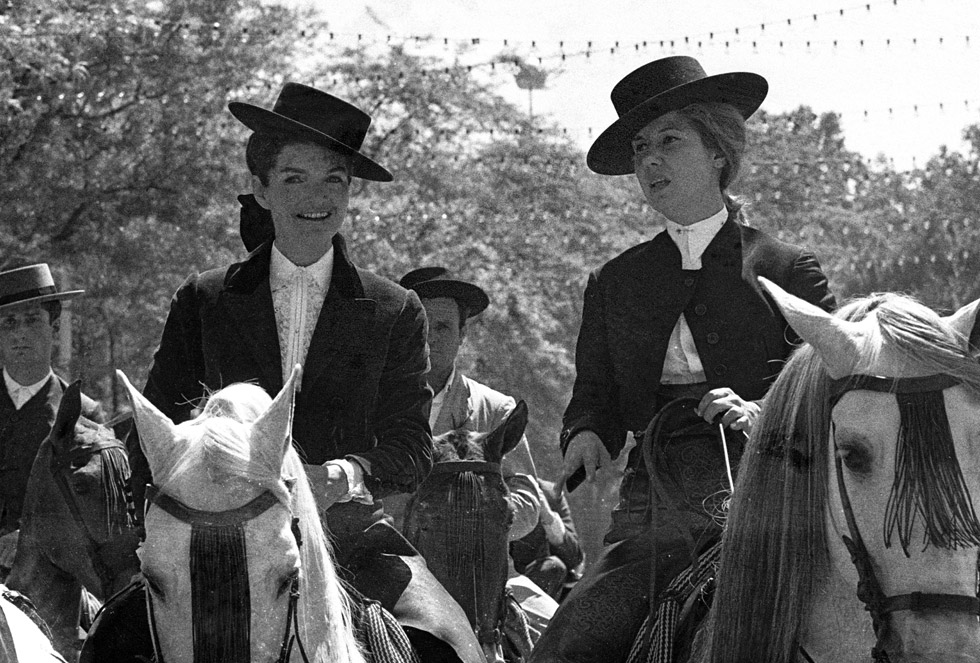
Apparently, she even took Jackie Kennedy out to Feria on a horse-back!

Jacqueline Kennedy visita la Feria de Abril de Sevilla en 1966 acompañada de la duquesa de Alba.
Also, because of her many titles (the most titled aristocrat in the world!) and privileges, she also had a right to enter the cathedral of Seville on a horse!! I wonder if that ever happened?

Apart from the passion for horses and dogs, she of course also had a big collection of art, and she did some painting herself too. Interestingly, when she wanted to marry for the 3rd time in her 80s, there was some push-back from her children. In order to marry, she passed on much of her wealth (which was estimated at somewhere between €600 million and €3.5 billion) to her children and her soon-to-be-husband renounced any claim to her wealth. The list of much valued art is amazing, but funnily enough, it also included a first-edition copy of Cervantes's Don Quixote!!

One of her ancestors, who also held the dukedom of Alba, was also called Cayetena (13th duchess of Alba), was somewhat a rebel of the time and there are some famous Goya painting of her. But there is also the story of La Maja vestida de Goya, and that of a nude one being her, which apparently is fake news!

Here is also a link about her by her own words (in Spanish) and one in English

Sunday, May 20, 2018

New Year's resolution 5: the prison where Cervantes served his time

I finally got around to start reading the massive book of Don Quijote de la Mancha, not in Spanish though. I had already heard that Cervantes has some connection with Seville, but now that I started reading his main piece of art, it also felt natural to check about his time in my hood.

Here is an image of how the prison looked back in the day.
It turns out that he spent about a year in prison here betwen 1597-1598! At the time, the prison, called La Cárcel Real de Sevilla, was situated right in the centre of the city (by the city hall at the end of La Calle Sierpes).

A bit ironically, they have erected his statue there to commomorate him, or his prison spell here...I've passed it by about a million time but never really paid attention to it.

So, what was he doing in the prison? It appears that he was working as a tax collector in Andalucia but got his books cooked up a bit. So he had to pay his debt to the Crown, which meant that he had to collect more money. So he did, but unfortunately to him, the bank where he deposited the money got bankrupted and he lost it all. That ment that he had to serve his time in prison.

Apparently, while there, he was helping his fellow illiterate prisoners by writing letters on their behalf! Also around this time, he started thinking about Don Quijotte as a character.

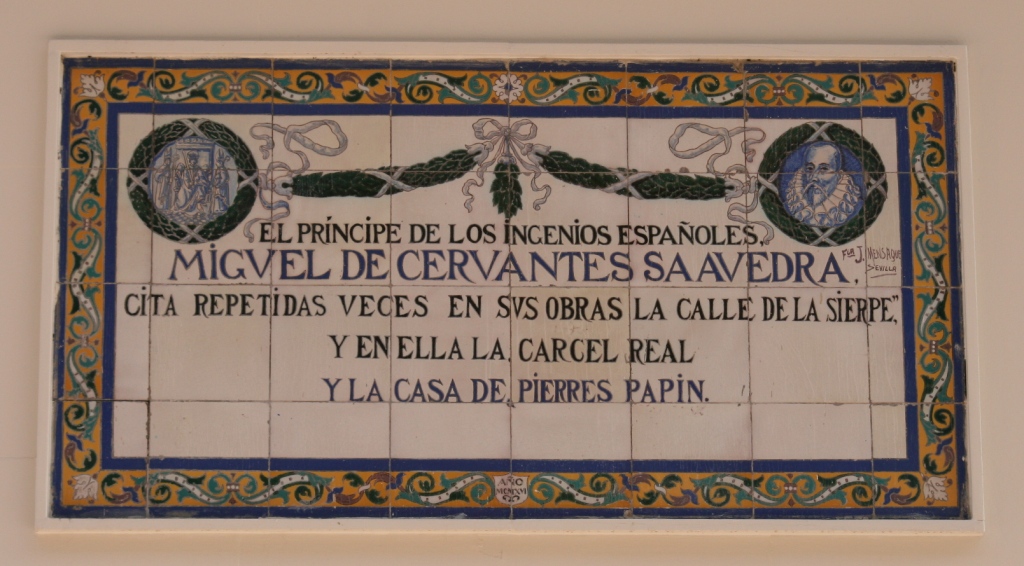
This travel site talks about Cervantes' Seville in English. There are a few things in town, like this walking tour with tiles around the city (see below). This page has more about him and Seville (in Spanish). 


Miguel de Cervantes Saavedra (Alcalá de Henares, 29 de septiembre de 1547 - † Madrid, 22 de abril de 1616), llamado el «príncipe de los ingenios», escritor.

Sunday, March 25, 2018

New Year's resolution 3: The Palace of the Countess of Lebrija

This town-palace is special for the personal collection of art and antiques that its owner, Regla Manjón Mergelina, who was also known as the countess of Lebrija, collected and installed in it.

She bought the place in 1901, when she was in her 50s and after her husband had already died, and started making it her personal legacy based on her interest in, and access to, art and antiquities, most of which had a connection to Andalusia.

It took her 13 years of works to re-model and refit the place so that it could host her amazing collection. She died in it in her mid-80s. The house was passed on, and lived-in, within the family and eventually in 1999, it was made into a museum.

It's absolutely worth the visit not only for its content (like the beautiful Roman mosaic in the patio that is excavated from Italica), but also to ponder about the special taste and personality of the countess!

Don't only go for the ground floor where most of the mosaics and tile work is hosted (summer residence), but make sure to include the guided visit at the second floor (winter residence). That's where her personal taste comes through more profoundly, she mixes everything with everything. This text has good hints about the place and this one has a good description.

Well, the creation of such private collection of arts and especially antiquities in not without a controversy either; wouldn't those Roman mosaics be best placed where they first belonged to? During the visit, there is hardly any material available to understand the dynamics of what went on back then (e.g. only in 1911 a law related to national partimony started stipulating such things), but this newspaper article (in Spanish) gives good insight to it (watch out for the long sentencces, though!).  Here is a good posting in English. This blog post is also good, and it has very detailed pictures of the ground floor, too!


Sunday, February 25, 2018

New Year's Resolution 2: el Hospital de la Caridad

"Thus passes the glory of the world" - is a phrase that well describes the work of art displayed in the Hospital de la Caridad, one of the most famous barroca churches in Seville (see a good resolution picture on wikipedia). It is one of the two paintings displayed right at the entrance to the church to remind people about the passing glory of life and earthy belongings.

This is a pretty grim painting, very dark and macabre. One has to take time to look at it and decrypt its symbolism, this blog post has an excellent dive into it. Check the scale for details:
"the two trays of the balance are labeled in Spanish: Nimas & Nimenos, or Neither More Nor Less. Nimas, at left, weighs animals that represent the deadly sins: a peacock for vanity, a dog for anger, a goat for avarice/greed, a monkey for lust, a hog for gluttony, a sloth for laziness (or sloth, ha, ha, ha), and a bat perched on a human heart for envy. “Nothing more [than these] is needed for damnation.”
The other piece is pretty grim too, called "In the Blink of an Eye" (In Ictu Oculi) where a skeleton pinches the flame off of a candle reminding us about the shortness of life and its quick disappearance.This piece is full of symbolism too, like how the skeleton has his foot on the globe!

There is also a "urban legend" related to the founder of the hospital and the church, Miguel Mañara, allegedly being the origin of the legend of Don Juan, which probably wasn't the case, but makes an interesting anecdote!

What's interesting to know is that at the time of Miguel Manara, Seville was going through a big decline. Apparently, at the time, it was "fashionable" for nobel men to set up a hospital and tend the poor. There are many such big hospitals around the town, for example, the current parliament and the Fine arts museum building.

This sentnce describes the mood well:
In Seville, the popular riots of 1642, the Black Death of 1649, the drought of 1682 along with the floods of 1683 caused the disappearance of a large amount of population as well as the gradual weakening of its social and economic structure.

Sunday, January 14, 2018

New Year's Resolution 1: knowing my city better

In early 2018, I decided to get to know better the city that I live in, especially its culture and history.

In Seville, there is so much to see and to know, but as in any city, once you live there, you become less interested in visitng places. While living in Paris between 1997-1999, for example, I never visited the Eiffel tower (granted, I had visited it when 8 years old).

The first target in January 2018 was the famous Church of Saint Luis (en), or La Iglesia de San Luis de los Franceses (es), as it is called in Spainish. I already wanted to visit it for a while, as it's been touted to be the epitome of Barroc art in Seville. The visit was guided by this group.

...To be continued...

Thursday, March 23, 2017

Free schools in Sweden


I visited Sweden already some years back and was intrigued by their Free schools. The Free school system was instituted in 1992 and already for sometime, serves as a model for the charter school reform in the UK. Free schools are publicly funded by school vouchers.

In 2011 (figure reported in March 2011[ii]), some 15% of Swedish children go to free schools (friskola). In general, parents view the opportunity of selecting the school for their children as an important part of their freedom. Parents with children in private school (87 percent) are more satisfied than those with children in public schools (74 percent)[iii].

There is currently a big debate going on around Free schools in Sweden. The most controversy is around some small number of private companies that run tax-funded schools "for profit". For example the biggest enterprise, Academedia, in 2009 had sales of SEK 2.1 billion, compared with 2006, when turnover was 222 million SEK. According to Wikipedia, the Group has in total around 44 000 pre-school children and students, and approximately 20,000 adult learners in their activities (figures from 2012).

The quality of education in Free schools has also been in headlines. Additionally, the debate is on-going whether they also increase equity gap among Swedish society. For example Pasi Shalberg says "In Sweden, everybody now agrees free schools were a mistake. The quality has not improved and equity has disappeared.[iv]"


For profit debate:

  • In 2012, there are 906 companies who offer free schools and kinder gardens. 97% of them are small with one to four schools. On average, they are run on 3% marginal of profit. 54% generate a surplus.
  • A small number of them are run on risk capital which has made big headlines lately. Recently, bankruptcy has been claimed while previously such schools were paying hefty profits to their risk capital funders.
    • See for example John Bauerskola, which now has failed bankrupt, but previously, according to headlines, put about 2.6 million euros of tax payers' money into paying school rent to big banks (e.g. see: John Bauerskolorna, som gick i konkurs i juni 2013, betalade 24 miljoner i räntor på sina lån 2012[v])

Quality debate:

One free school enterprise called Distra Utbildningscenter in the south of Stockholm is risking to face a penalty of 500.000 kronor if the results do not show better quality. The school inspectorate refers to weak leadership, unqualified teachers and lack of competences in special education. The school is small, only about 30 students, the same company also runs an upper secondary school that also received complaints by the school inspectorate.  (translated from: http://www.svt.se/nyheter/regionalt/abc/friskoleforetag-riskerar-vite)

Website by the major newspaper (Svenska Dagbladet) to help choose a school: http://www.svd.se/nyheter/skolvalet/skolsok/


[i] http://sv.wikipedia.org/wiki/Friskola
[iii] http://www.svensktnaringsliv.se/skola/valfrihet-lyfter-alla-skolor-i-en-kommun_205490.html
[iv] http://www.theguardian.com/education/2013/jul/01/education-michael-gove-finland-gcse

Monday, January 09, 2017

Suomenhevosten historiaa ja vähän sukuhistoriaakin

Vaikka suomenhevosen kantakirja on perustettu vasta vuonna 1907, hevosten systemaattista jalostustoimintaa on harjoitettu iät ja aja, Suomessakin.
Ensimmäinen nimellä tunnettu valokuva suomalaisesta hevosesta
(Jaakko Tt 118, kuva 1882 Moskovassa)

Vanhempieni muuton yhteydessä selailin vanhoja valokuva-albumeita, jotka olivat kulkeutuneet äidilleni erinäisten sukulaisten kuoleman jälkeen, ja rupesin pohtimaan, että minkähänlaisia hevosia se iso-vaari oli oikeasti kasvattanut?

Henkilönä tämä kyseinen Leander Tiihonen (1848-1907) Rautalammilta oli jäänyt minulle hyvin kaukaiseksi. Oma vaarini, siis yksi hänen lapsistaan, kuoli kun olin vielä aika pieni, joten en muista juurikaan mitään juttuja, ainakaan hevosiin liittyviä, joita iso-vaarista olisi kerrottu (paitsi sen, että hän olisi myynyt/lahjoittanut tsaarille hevosen, mutta tällä hetkellä en tiedä asiasta yhtään sen enempää).

Aikani googlattuani löysin kaksi hyvää lähdettä: Sukuposti.net-nimisen suomalaisen hevosalan sivuston ja Kansalliskirjaston Digitoidut aineistot, jossa on aivan valtava määrä vanhoja sanomalehtiä haettavana.

Ensimmäinen tuttavuus - tamma nimeltä Linkki

Ensimmäinen uusi "tuttavani", jonka löysin tuolta Sukuposti-sivulta, on Linkki niminen suomenhevostamma, joka on syntynyt 1887. Sen omistajaksi on merkitty "Tiihonen Leander, Rautalampi, Suomi" - bingo!

Luulen, että tämä Linkki-tamma olisi ehkä ollut yksi iso-vaarin lempihevosista, ainakin vuonna 1915 ilmestyneessä Hevoshoitolehdessä siitä oli kirjoitettu kovin kauniisti:
"Linkillään Leander ajoi kymmenkunta palkintoa, niistä monet ensipalkintoja. Linkki hoidettiin hyvin kuolemaansa asti Lender Tiihosen omistamalla Maukola-nimisellä tilalla ja jätti tamma jälkeensä sievän ryhmän kauniita ja arvokkaita varsoja, joista monet ovat tulleet palkituiksi." (Hevoshoitolehti 10/1915)

En ole päässyt käsiksi ko. Hevoshoitolehteen enkä siis tiedä, miksi tuo juttu on aikanaan kirjoitettu. Leander itsehän kuoli siis paljon aiemmin, 1907, eli olisikohan ollut kyseessä joku muistokirjoitus, tms?

Löysin kyllä sanomalehti arkistoista muutaman viittauksen Linkkiin, mutta en löytänyt mitään ensipalkintoja. Esim.
  • 1893 Keski-Suomi kirjoittaa kilpa-ajoista Rantasalmella: "...neljännen talokas Leander Tiihosen Raulammilta tamma Linkki joka juoksi radan 4 m. 3 s." (07.01.1893 Keski-Suomi no 3 ) 
  • 1894 Aura no 22 kirjoittaa ajoista Jyväskylässä: Neljännen 200 mk. Tiihosen tamma Linkki, 5,38. (Aura 22.02.1894
  • 1896 oli merkintä, että tamma olisi hänen ohjastamanaan tullut kolmanneksi (30.12.1896 Suomalainen no 149).  Eli tuolloin tamma olisi ollut 9 jo vuotias.
Tietojen mukaan Linkki oli hyvän kokoinen suomenhevoseksi, säkä 155 cm. Tuossa Sukuposti sivustolla myös mainitaan, että se olisi "Monen juoksijan kantaemä, nimittäin Riukon, Nopsan ym." (Pohjois-Savon tammakantakirja II).

copyright: Hevoshoitolehti 10/1915
Yksi näistä Linkin jälkeläisistä oli ori nimeltään Ilo, jonka kasvattajaksi mainitaan Tiihonen, eli aika takuuvarmasti Leander, koska emähän oli hänen.

Ilo oli syntynyt vuonna 1899. Merkinnöissä lukee, että Ilo oli myyty 1904 vuotiaana, jolloin se on saanut ensimmäisen  palkintonsa Jyväskylässä 3 vuotiaiden sarjassa. Sukuposti-sivustolla tälle oriille on merkitty paljon jälkeläisiä (55), etenkin Jyväskylän alueella. Ja siitä löytyy kuvakin, ilmeisesti silloisen omistajansa kanssa (A. B. Fagerström).


Ruununoriit

Toinen mielenkiintoinen juttu, joka liittyy niin suomenhevosten kuin iso-vaarinkin historiaan, on "ruununoriit" eli kruununsiitosorit. Wikipediassa niistä kerrotaan seuraavaa:
Suurilla nälkävuosilla 1866–1868 oli suuri vaikutus Suomen hevoskantaan. Monien kasvattajien oli myytävä parhaat oriinsa Venäjälle henkensä pitimiksi. Suuret määrät hevosia teurastettiin ruoaksi. Arvokkaiden jalostuseläinten korvaamiseksi ja hevoskannan kasvattamiseksi Suomen senaatti määräsi vuonna 1869 pahimmin kärsineet Vaasan, Hämeen ja Kuopion läänit hankkimaan sopivia oriita ja tarjoamaan niitä paikallisten tammanomistajien käyttöön.

Kipakka (s.1883)

Savo-lehdessä 17.01.1889 (nro 7, s. 2) on seuraavanlainen maininta Kuopion tammimarkkinoilta:
"Warsinaisten kilpa-ajojen jälkeen saiwat juosta näkeeksi wielä siitosoriiksi tarjotut. Niiksi ostettiin illemmalla sitten seuraawat neljä seuraawista hinnoista: Leander Tiihosen ,,Kipakka" 1,400 m:kasta, kauppias A. I. Ollikaisen ,,Pelle" 1,400 Mikasta, raatimies I. F. Malmborgein ,,Matti" 950 miksta ja maanmiljelijä I. Lagus'en ,,Pulmu" 1,100 m:ksta."

Kun katsoo tarkemmin tietoja, mitä Sukupostissa on merkitty Kipakasta, siellä näkyy merkintä "ro" ennen rekisterinumeroa. Tuo "ro" juuri tarkoittaa ruununoria. "Tt", jos nyt ihan oikein ymmärrän, tarkoitti työhevossuuntaa jalostuksessa (vaikka nykyään se on pelkkä T). Sivuilla näkyy myös, että omistaja oli Leander Tiihonen juuri tuohon 1889 vuoteen saakka.

Eli tulkintani mukaan, Leander oli kasvattanut Kipakan, jonka hän myi 6 vuotiaana Kuopion tammimarkkinoilla kruunun siitosoriksi ja hevonen sitten sijoitettiin uuteen kotiin. Kiva nähdä, että Kipakasta maksettiin hyvä hinta, ainakin verrattuna muihin, jotka myytiin samoilla markkinoilla.

Löysin Tampereen Sanomista jutun vuotta aiemmin (1888), joka mainitsee kilpa-ajoista Viitasaaren kirkonkylässä, "2:sen p. sai taloll Leander Tiihonen, Rautalampi, 4 m. 16,/2 s.”. Löysin myös maininnan, että tuo palkinto tuli juuri Kipakalla (28.01.1888 Keski-Suomi no 8). Tuossa jälkimmäisessä on myös hauska kuvaus kila-ajosportista:
"Katsojia oli kokoontunut radan ympärille joukottain ja näyttiwät he uteliaisuudella seuraaman jokaisen helvosen juoksua, Kilpa-ajosportti onkin saawuttanut paljon harrastajia Keski-Suomen miehissä. Tämän talvisissa waltion kilpa-ajoissa taas warmaankin moni heistä nopeakulkusella hewosellaan woittaa kunniaa ja rahaa.”
"Rata oli epätasainen, paikoin wettäkin, ilma riewuinen ja lämmin, joista syistä näin huonot tulokset. Tämä oli ensimmäinen kilpa-ajo meillä sitten wuoden 1881. Rahaa jäi kassaan 90 m. ensi wuodeksi, jolloin toiwokaamme parempaa tulosta.” 

Polle (s.1902)

Toinen kruununsiitosori, joka liittyi iso-vaariin, on Polle, joka sijoitettiin Leander Tiihosen tilalle vuonna 1907. Uutisen ilmestyi Uusi Suometar-nimisessä lehdessä 26.06.1907 ja se kertoo Kuopiossa tapahtuneista Waltion ravikilpailuista seuraavanlaisesti:
Ruunnnoriiksi ostettiin waltion kilpa-ajojen aikana Kuopiossa maanwilj. Pekka Jalkaselta, Rautalammilta, ori "Polle" 1,800 markan hinnalla ja sijoitettiin maanwilj. Leander Tiihoselle, Rautalammilla. 

Pollen tarina liene jatkui, mutta Leander itse kuoli muutamia kuukausia myöhemmin. Siitäkin kirjoitettiin Savon Työmiehessä (09.11.1907), jossa oli juttu, että Rautalammin kihlakunnan lautamies (siis Leander) kuoli sydänhalvaukseen lähes kuudenkymmenen vuoden vanhana. Jutussa mainitaan myös, että hän kuoli pitäessään puhetta tilaisuudessa
Leander Tiihosen puhetta pitäessä sapuikin tuonen kowa koura, joka kaatoi maahan ja vei hengen heti

Muutamia muita hevosia mainittu lehdissä

punainen ori

Keski-Suomi: 21.01.1880: merkintä osallistumisesta kilpa-ajoihin Kuopiossa “talokas Leander Tiihonen Rautalammilta, punainen ori, 5 w., 10 k. (juoksi hywästi, waan ajoi kumoon kilpailussa)”. En löytänyt mitään muita tietoja, mistä hevosen nimi olisi tullut ilmi. Tämä muuten taisi olla ensimmäisiä ilmoituksia kilpa-ajoista, joihin iso-vaari osallistui. Mitä lie tehnyt sitä ennen?

Jutussa myös mainitaan kuinka korkeatasoiset ravit olivat:
Yleensä onnistuimat kilpa-ajot niin hywästi, että niiden wertaa tuskin milloinkaan on täällä nähty. Myöskin oliwat hewoset nyt paljon paremmin hoidetut kuin ennen.

Kilpa

Keski-Suomi 15.06.1897 (no 68) mainitsee: 
I pall. 20 ml. maanwilj. Leander Tiihoselle Rautalammin Maukolasta 133 cm. lort. ,Kilpa"-nimisestä oriwarsasta;

Karjalatar 14.06.1898 no 66: tästä löytyy merkintä hevosnäyttelyyn osallistumisesta ja Kilpa niminen ori  sai maininnan, mutta ei palkintoa, 2 ja 3 vuotiaiden luokasa.

Wäkewä

Savo-Karjala15.01.1890 no 5: tuloksia raveista liinaharjaorilla Wäkewä. Toisessa osassa mainitaan, että Leander voitti 10 markkaa ja sai kolmannen sijan.
Kolmannen palkinnon, 10 markkaa, sai Leander Tiihonen ja neljännen, 5 markkaa, Pekka Roininen. Rata oli Englannin peninkulman pituinen, joka kaksi kertaa ajettiin wuorottain. Kaikki juoksijat oliwat ehkä ensikerran radalla, joten tulokset, warsinkin kun se oli huononpuoleiscssa kunnossa, oliwat myös huonot. Ilma myös ei ollut mikään „kilpa-ajoilma, joka näytti hewoisiin nukuttawasti waikuttawan.


Kuopion tammimarkkinat vuodelta 1889

Tuo juttu Kuopion tammimarkkinoista Savo-lehdessä muuten kannattaa lukea kokonaisuudessa allaolevasta linkistä, siinä on kullanarvoisia kuvauksia kuten esim:
  • hevosmiehistä kaupungissa: Pakkasen puremaan kadun lumeen karskahuttelee kawioitaan hänen korkea jalkainen hewosensa, kaula kyömynä, kieli pitkällä ja sieramet huurua suitsuttaen. Ei ole miestä toista sen enemmän toimessaan olewan näköistä kuin hewoismies ajojen aattopäilvänä.
  • siitä minne parhaat hevoset myydäänUsein tapahtuukin, että wenäläiset ostajat jo tammikuussa sieppaawat pois paremmat oriit ja maahan jääpi waan heidän tähteensä. 
  • analyysejä hevosten tasostaMeillä sawolaisilla ei kuitenkaan ole kowin suurta syytä iloita näistä kilpailuista, sillä ori-palkinnoista ei jäänyt yhtään Sawoon eikä Karjalaan. Kaikki ne ynnä ensimäinen tamma-palkinto meniwät Keski-Suomeen, joka jo monena wuotena on wienyt woiton kaikista muista Suomen maakunnista siinä suhteessa. Karjalaiset ja sawolaiset kyllä koettiwat parastaan, mutta 6 minuuttia alemma ei heistä yksikään päässyt. Siitä päättäen ansaitseisi hewoisrodun parantaminen suurempaa huolta näillä paikkakunnilla. Sillä juoksuwoimista on kuitenkin hewosen hywyys taikka huonous parhaiten päätettäwä.” 
  • ja juhlista:  Kun jäältä wihdoinkin oli kellon neljättä käydessä päästy pois, kiiruhtiwat hewoisasiain harrastajat seurahuoneelle, jossa odottiwat pulskat päiwälliset musiikin kanssa. Syödessä tietysti maljoja tyhjennettiin päiwän merkityksen johdosta, Hewosmiehet niitä hewosmiehille pitiwät ja eläköön-huutoja huudettiin niin hewosten kuin miestenkin kunniaksi. Maamme molemmat wiralliset kielet oliwat tilaisuudessa edustettuina. Ruotsikin, jota käytti eräs sawolainen hewosmies puhuessaan waltion asiamiehen assessori O. Stählbergin kunniaksi. Hra Stahlberg wastasi kuitenkin suomeksi, osoittaen siten kohteliaisuutta niille, joidenka kieli paikkakunnalla on enemmistön.
Savo, 17.01.1889, nro 7, s. 2 http://digi.kansalliskirjasto.fi/sanomalehti/binding/449346?page=2 Kansalliskirjaston Digitoidut aineistot