Sunday, November 18, 2018

New Year's resolution 11: an airplane called Triana

Yesterday, we visited the Airbus factory here in Seville. We were able to see some of the airplanes being constructed (e.g. A400M) in the huge hangars that are situated close to the airport San Pablo. We were also told that building airplanes in Seville had a long history, some of which even coincided with Triana!

I had heard about an airplane factory at Calle San Jacinto and there is actually a small sign on the wall (just by the bar "El Tejar") commemorating it. A bit googling around and I found this neat blog post telling the story. By the way, the hangars are still there, for example two of them are used as gyms.

In short, in the beginning of the 1900's, a car factory was operating in the premises and they also constructed some airplane engines. The old picture above shows the logo of the original factory, "Fábrica Hispano-Suiza de Automóviles". That portal is still on Calle San Jasinto. The truck is transporting an airplane wing to a nearly airport called "La Tablada", situated a bit further down the river, where Matt still goes running.

The factory later became nationalised by Franco and called  Hispano Aviacion (which then later changed hands and is now merged with Airbus). The first plane constructed was called  HA-100 Triana (it was, btw, designed by a German called Messerschmitt - the name might sound familiar for the planes used in the second world ward?). Even if the first model was not that successful, it was used as a basis for the second model, called "El Saeta", which was more successful and also sold abroad.

Check the old advertisement with the drawing of La Giralda! A few links below about the planes and their history linked with Seville:


Sunday, November 04, 2018

New Year's Resolution 10: mountain spring water in Sierra de Aracena

Over a beautiful hike in Castaño del Robledo, which actually goes around the highest peak of the Aracena mountain range (969 m), we found this pretty looking water foundation near the parking place. It had a sign saying something about "agua de manantial" and we could not really work out if it meant that the water was drinkable or not...

In any case, we filled up an empty bottle on our way out and decided to check the word in the dictionary once at home - and before drinking the water!

It turns out that Aracena, which is part of the province of Huelva, has loads of spring water fountains. For example the peak that we hiked around, a very mellow hike btw, was formed due to volcanic activities and it has been able to maintain its hight because it is some sort of material that was resistant to erosion. It seems that this is also very good for filtering water, when looking at the hiking map over the whole region, there seems to be many springs around. (more information on the rock on this website "carbonate rocks, limestones and dolomites").

On the way home, we also stopped at a small and very cutre looking village called Fuenteheridos. Later, when looking for the word "manatial" in an online dictionary (= mountain spring water), I found out that Fuenteheridos has one very famous spring in it with a funny name: Spring of 12 canons (fuente de los 12 caños). I also found out that the area had actually lots of agriculture thanks to abundant flows of water, and that they farmed  lots of potatos back in the day when it was first brought in from the Americas! 

The water from the spring in Castano del Robledo was veeery good, btw, and it made me think why do we not have better sping water bottled available in Seville....? Business idea, anyone?

Tuesday, September 04, 2018

New Year's Resolution 8: «Los cuatro muchachos de Liverpool»

This month's Spanish culture discovery is a bit weak. I was going to visit the Ceramics Center of Triana, but their opening times are prohibitive for those who work, so even if I pass by every day on my way to work and back, I didn't manage.

I also though about writing about a ceramics/porceline factory called La Cartuja, as I wanted to visit their Outlet store to buy some little neat things, but that didn't happen either. I hope I get around to those two things - eventually...

Instead, my pop-cultural discovery of the month is a Spanish release of the Beatles' album, or a soundtrack, which they call "Que Noche La De Aquel Dia" - a hard days night. I happen to find an LP which, according to the internet, is the second pressing of the album in Spain. It's not from 1964, but  like these guys say, it's from1982. It looks like this:
The cover is different to both the first
Spanish pressing and the UK version (says this site)

The LP was first released in Spain in October 10 1964. It's actually pretty curious to think that during the hard core Franco time, the release was allowed. I need to talk to people whose parents were young then, maybe they remember and have some memories to tell.

Googling a bit around, I found this interesting exposition from 2016 in Barcelona which was about banned rock songs during the Franco time. The Guardian writes the following: 
From 1960 to 1977 the four censors working the afternoon shift at the Directorate of Popular Culture in Madrid banned a total of 4,343 songs on grounds of their sexual, blasphemous or politically subversive content.

Most songs cited in it are from the 70's or so, nothing that early as 1964 though. Maybe pop was so pop already then that no one was able to find it offensive ;p

Regading the reference to the film and Spanish industry to produce their own, in this book, I found an interesting passage about popular films at that epoque, which I should try to find and see!!


Epiloque: as after finishing the post, I could not stop googling around about the topic, I found this interesting article which explains the heading.

Mental note: study the perception of Western pop music in Spain in the early 60s and its own response to it, e.g. https://es.wikipedia.org/wiki/Los_chicos_con_las_chicas


Sunday, July 22, 2018

New Year's resolution 7: Palacio de Alba


The Duchess of Alba (no: 18), also known by one of her many names as Cayetana de Alba, was a figure often seen in Spanish gossip magazines when I moved to Spain in mid-2013. With her wild, white, frizzy curly hair and being well past 80 years, she seemed always up for little fun - usually a move of sevillanas, which, of course, people here in Seville loved!

Stables with an old arch
from a mosque built by mores.
One of her Palacios is open to public since 2016 (she passed away in 2014). It is called Palacio de las Dueñas, the name pointing to an old monastery called Santa María de las Dueñas which used to be in the same premises (from 1248 onwards).

But, as the visit to the Palacio's stables reveals, the arches that hold up the stalls are from some old mosque that was built there already in the 4th or 6th century! Apparently they go down underground some 2m deep.

The place is a mix of styles, like everything is Andalusia, from gótico-mudéjar style to Luise XV and renaissance. It was constructed in the late 15th century onwards. It has great gardens too. Somehow, though, the place is a bit shallow, it does not really tell much about the last Duchess, even if she lived there among many other places that she owned.

So I googled something more about her, a few funny anecdotes will follow.

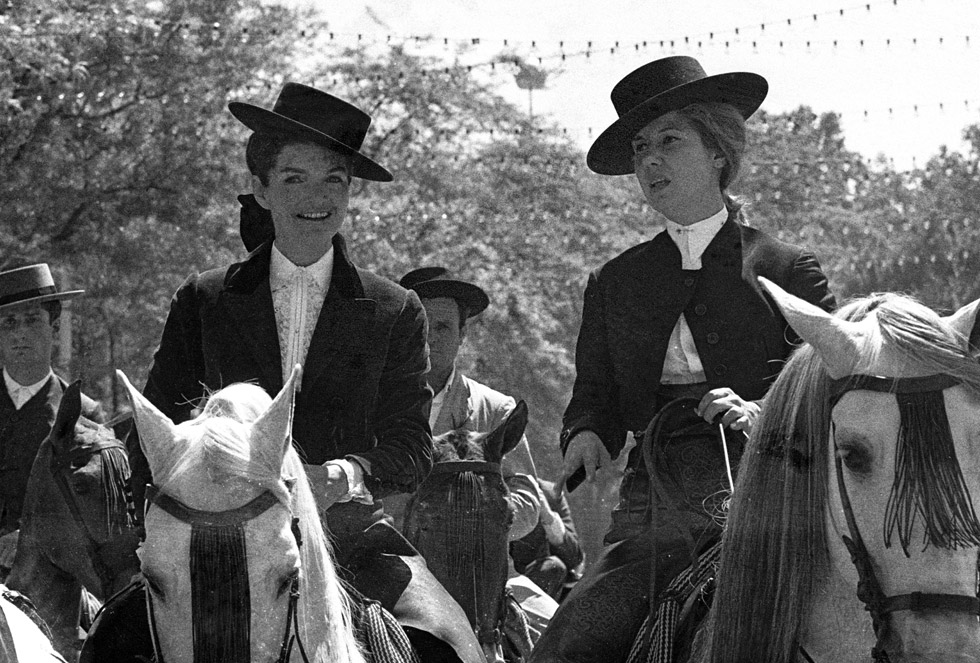
I found some really neat pictures from her youth which reveal some more personality about her. What, of course, pleases me most are the pictures of her on horse-back!

La duquesa de Alba es una mujer que vive con toda pasión la fiesta sevillana. Foto: Archivo ABC


Apparently, she even took Jackie Kennedy out to Feria on a horse-back!

Jacqueline Kennedy visita la Feria de Abril de Sevilla en 1966 acompañada de la duquesa de Alba.
Also, because of her many titles (the most titled aristocrat in the world!) and privileges, she also had a right to enter the cathedral of Seville on a horse!! I wonder if that ever happened?

Apart from the passion for horses and dogs, she of course also had a big collection of art, and she did some painting herself too. Interestingly, when she wanted to marry for the 3rd time in her 80s, there was some push-back from her children. In order to marry, she passed on much of her wealth (which was estimated at somewhere between €600 million and €3.5 billion) to her children and her soon-to-be-husband renounced any claim to her wealth. The list of much valued art is amazing, but funnily enough, it also included a first-edition copy of Cervantes's Don Quixote!!

One of her ancestors, who also held the dukedom of Alba, was also called Cayetena (13th duchess of Alba), was somewhat a rebel of the time and there are some famous Goya painting of her. But there is also the story of La Maja vestida de Goya, and that of a nude one being her, which apparently is fake news!

Here is also a link about her by her own words (in Spanish) and one in English

Sunday, May 20, 2018

New Year's resolution 5: the prison where Cervantes served his time

I finally got around to start reading the massive book of Don Quijote de la Mancha, not in Spanish though. I had already heard that Cervantes has some connection with Seville, but now that I started reading his main piece of art, it also felt natural to check about his time in my hood.

Here is an image of how the prison looked back in the day.
It turns out that he spent about a year in prison here betwen 1597-1598! At the time, the prison, called La Cárcel Real de Sevilla, was situated right in the centre of the city (by the city hall at the end of La Calle Sierpes).

A bit ironically, they have erected his statue there to commomorate him, or his prison spell here...I've passed it by about a million time but never really paid attention to it.

So, what was he doing in the prison? It appears that he was working as a tax collector in Andalucia but got his books cooked up a bit. So he had to pay his debt to the Crown, which meant that he had to collect more money. So he did, but unfortunately to him, the bank where he deposited the money got bankrupted and he lost it all. That ment that he had to serve his time in prison.

Apparently, while there, he was helping his fellow illiterate prisoners by writing letters on their behalf! Also around this time, he started thinking about Don Quijotte as a character.

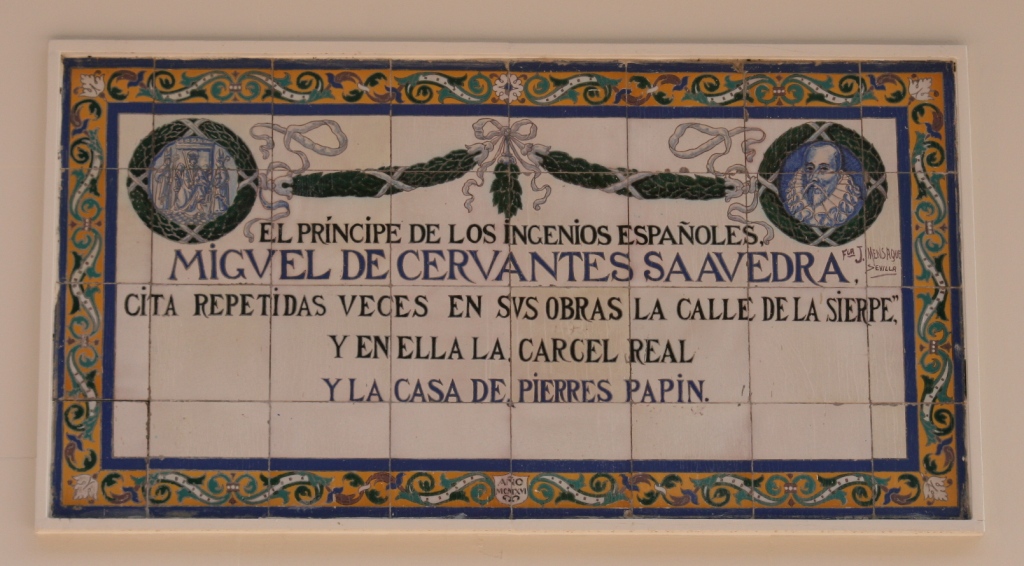
This travel site talks about Cervantes' Seville in English. There are a few things in town, like this walking tour with tiles around the city (see below). This page has more about him and Seville (in Spanish). 


Miguel de Cervantes Saavedra (Alcalá de Henares, 29 de septiembre de 1547 - † Madrid, 22 de abril de 1616), llamado el «príncipe de los ingenios», escritor.

Sunday, March 25, 2018

New Year's resolution 3: The Palace of the Countess of Lebrija

This town-palace is special for the personal collection of art and antiques that its owner, Regla Manjón Mergelina, who was also known as the countess of Lebrija, collected and installed in it.

She bought the place in 1901, when she was in her 50s and after her husband had already died, and started making it her personal legacy based on her interest in, and access to, art and antiquities, most of which had a connection to Andalusia.

It took her 13 years of works to re-model and refit the place so that it could host her amazing collection. She died in it in her mid-80s. The house was passed on, and lived-in, within the family and eventually in 1999, it was made into a museum.

It's absolutely worth the visit not only for its content (like the beautiful Roman mosaic in the patio that is excavated from Italica), but also to ponder about the special taste and personality of the countess!

Don't only go for the ground floor where most of the mosaics and tile work is hosted (summer residence), but make sure to include the guided visit at the second floor (winter residence). That's where her personal taste comes through more profoundly, she mixes everything with everything. This text has good hints about the place and this one has a good description.

Well, the creation of such private collection of arts and especially antiquities in not without a controversy either; wouldn't those Roman mosaics be best placed where they first belonged to? During the visit, there is hardly any material available to understand the dynamics of what went on back then (e.g. only in 1911 a law related to national partimony started stipulating such things), but this newspaper article (in Spanish) gives good insight to it (watch out for the long sentencces, though!).  Here is a good posting in English. This blog post is also good, and it has very detailed pictures of the ground floor, too!


Sunday, February 25, 2018

New Year's Resolution 2: el Hospital de la Caridad

"Thus passes the glory of the world" - is a phrase that well describes the work of art displayed in the Hospital de la Caridad, one of the most famous barroca churches in Seville (see a good resolution picture on wikipedia). It is one of the two paintings displayed right at the entrance to the church to remind people about the passing glory of life and earthy belongings.

This is a pretty grim painting, very dark and macabre. One has to take time to look at it and decrypt its symbolism, this blog post has an excellent dive into it. Check the scale for details:
"the two trays of the balance are labeled in Spanish: Nimas & Nimenos, or Neither More Nor Less. Nimas, at left, weighs animals that represent the deadly sins: a peacock for vanity, a dog for anger, a goat for avarice/greed, a monkey for lust, a hog for gluttony, a sloth for laziness (or sloth, ha, ha, ha), and a bat perched on a human heart for envy. “Nothing more [than these] is needed for damnation.”
The other piece is pretty grim too, called "In the Blink of an Eye" (In Ictu Oculi) where a skeleton pinches the flame off of a candle reminding us about the shortness of life and its quick disappearance.This piece is full of symbolism too, like how the skeleton has his foot on the globe!

There is also a "urban legend" related to the founder of the hospital and the church, Miguel Mañara, allegedly being the origin of the legend of Don Juan, which probably wasn't the case, but makes an interesting anecdote!

What's interesting to know is that at the time of Miguel Manara, Seville was going through a big decline. Apparently, at the time, it was "fashionable" for nobel men to set up a hospital and tend the poor. There are many such big hospitals around the town, for example, the current parliament and the Fine arts museum building.

This sentnce describes the mood well:
In Seville, the popular riots of 1642, the Black Death of 1649, the drought of 1682 along with the floods of 1683 caused the disappearance of a large amount of population as well as the gradual weakening of its social and economic structure.

Sunday, January 14, 2018

New Year's Resolution 1: knowing my city better

In early 2018, I decided to get to know better the city that I live in, especially its culture and history.

In Seville, there is so much to see and to know, but as in any city, once you live there, you become less interested in visitng places. While living in Paris between 1997-1999, for example, I never visited the Eiffel tower (granted, I had visited it when 8 years old).

The first target in January 2018 was the famous Church of Saint Luis (en), or La Iglesia de San Luis de los Franceses (es), as it is called in Spainish. I already wanted to visit it for a while, as it's been touted to be the epitome of Barroc art in Seville. The visit was guided by this group.

...To be continued...

Thursday, March 23, 2017

Free schools in Sweden


I visited Sweden already some years back and was intrigued by their Free schools. The Free school system was instituted in 1992 and already for sometime, serves as a model for the charter school reform in the UK. Free schools are publicly funded by school vouchers.

In 2011 (figure reported in March 2011[ii]), some 15% of Swedish children go to free schools (friskola). In general, parents view the opportunity of selecting the school for their children as an important part of their freedom. Parents with children in private school (87 percent) are more satisfied than those with children in public schools (74 percent)[iii].

There is currently a big debate going on around Free schools in Sweden. The most controversy is around some small number of private companies that run tax-funded schools "for profit". For example the biggest enterprise, Academedia, in 2009 had sales of SEK 2.1 billion, compared with 2006, when turnover was 222 million SEK. According to Wikipedia, the Group has in total around 44 000 pre-school children and students, and approximately 20,000 adult learners in their activities (figures from 2012).

The quality of education in Free schools has also been in headlines. Additionally, the debate is on-going whether they also increase equity gap among Swedish society. For example Pasi Shalberg says "In Sweden, everybody now agrees free schools were a mistake. The quality has not improved and equity has disappeared.[iv]"


For profit debate:

  • In 2012, there are 906 companies who offer free schools and kinder gardens. 97% of them are small with one to four schools. On average, they are run on 3% marginal of profit. 54% generate a surplus.
  • A small number of them are run on risk capital which has made big headlines lately. Recently, bankruptcy has been claimed while previously such schools were paying hefty profits to their risk capital funders.
    • See for example John Bauerskola, which now has failed bankrupt, but previously, according to headlines, put about 2.6 million euros of tax payers' money into paying school rent to big banks (e.g. see: John Bauerskolorna, som gick i konkurs i juni 2013, betalade 24 miljoner i räntor på sina lån 2012[v])

Quality debate:

One free school enterprise called Distra Utbildningscenter in the south of Stockholm is risking to face a penalty of 500.000 kronor if the results do not show better quality. The school inspectorate refers to weak leadership, unqualified teachers and lack of competences in special education. The school is small, only about 30 students, the same company also runs an upper secondary school that also received complaints by the school inspectorate.  (translated from: http://www.svt.se/nyheter/regionalt/abc/friskoleforetag-riskerar-vite)

Website by the major newspaper (Svenska Dagbladet) to help choose a school: http://www.svd.se/nyheter/skolvalet/skolsok/


[i] http://sv.wikipedia.org/wiki/Friskola
[iii] http://www.svensktnaringsliv.se/skola/valfrihet-lyfter-alla-skolor-i-en-kommun_205490.html
[iv] http://www.theguardian.com/education/2013/jul/01/education-michael-gove-finland-gcse

Monday, January 09, 2017

Suomenhevosten historiaa ja vähän sukuhistoriaakin

Vaikka suomenhevosen kantakirja on perustettu vasta vuonna 1907, hevosten systemaattista jalostustoimintaa on harjoitettu iät ja aja, Suomessakin.
Ensimmäinen nimellä tunnettu valokuva suomalaisesta hevosesta
(Jaakko Tt 118, kuva 1882 Moskovassa)

Vanhempieni muuton yhteydessä selailin vanhoja valokuva-albumeita, jotka olivat kulkeutuneet äidilleni erinäisten sukulaisten kuoleman jälkeen, ja rupesin pohtimaan, että minkähänlaisia hevosia se iso-vaari oli oikeasti kasvattanut?

Henkilönä tämä kyseinen Leander Tiihonen (1848-1907) Rautalammilta oli jäänyt minulle hyvin kaukaiseksi. Oma vaarini, siis yksi hänen lapsistaan, kuoli kun olin vielä aika pieni, joten en muista juurikaan mitään juttuja, ainakaan hevosiin liittyviä, joita iso-vaarista olisi kerrottu (paitsi sen, että hän olisi myynyt/lahjoittanut tsaarille hevosen, mutta tällä hetkellä en tiedä asiasta yhtään sen enempää).

Aikani googlattuani löysin kaksi hyvää lähdettä: Sukuposti.net-nimisen suomalaisen hevosalan sivuston ja Kansalliskirjaston Digitoidut aineistot, jossa on aivan valtava määrä vanhoja sanomalehtiä haettavana.

Ensimmäinen tuttavuus - tamma nimeltä Linkki

Ensimmäinen uusi "tuttavani", jonka löysin tuolta Sukuposti-sivulta, on Linkki niminen suomenhevostamma, joka on syntynyt 1887. Sen omistajaksi on merkitty "Tiihonen Leander, Rautalampi, Suomi" - bingo!

Luulen, että tämä Linkki-tamma olisi ehkä ollut yksi iso-vaarin lempihevosista, ainakin vuonna 1915 ilmestyneessä Hevoshoitolehdessä siitä oli kirjoitettu kovin kauniisti:
"Linkillään Leander ajoi kymmenkunta palkintoa, niistä monet ensipalkintoja. Linkki hoidettiin hyvin kuolemaansa asti Lender Tiihosen omistamalla Maukola-nimisellä tilalla ja jätti tamma jälkeensä sievän ryhmän kauniita ja arvokkaita varsoja, joista monet ovat tulleet palkituiksi." (Hevoshoitolehti 10/1915)

En ole päässyt käsiksi ko. Hevoshoitolehteen enkä siis tiedä, miksi tuo juttu on aikanaan kirjoitettu. Leander itsehän kuoli siis paljon aiemmin, 1907, eli olisikohan ollut kyseessä joku muistokirjoitus, tms?

Löysin kyllä sanomalehti arkistoista muutaman viittauksen Linkkiin, mutta en löytänyt mitään ensipalkintoja. Esim.
  • 1893 Keski-Suomi kirjoittaa kilpa-ajoista Rantasalmella: "...neljännen talokas Leander Tiihosen Raulammilta tamma Linkki joka juoksi radan 4 m. 3 s." (07.01.1893 Keski-Suomi no 3 ) 
  • 1894 Aura no 22 kirjoittaa ajoista Jyväskylässä: Neljännen 200 mk. Tiihosen tamma Linkki, 5,38. (Aura 22.02.1894) 
  • 1896 oli merkintä, että tamma olisi hänen ohjastamanaan tullut kolmanneksi (30.12.1896 Suomalainen no 149).  Eli tuolloin tamma olisi ollut 9 jo vuotias.
Tietojen mukaan Linkki oli hyvän kokoinen suomenhevoseksi, säkä 155 cm. Tuossa Sukuposti sivustolla myös mainitaan, että se olisi "Monen juoksijan kantaemä, nimittäin Riukon, Nopsan ym." (Pohjois-Savon tammakantakirja II).

copyright: Hevoshoitolehti 10/1915
Yksi näistä Linkin jälkeläisistä oli ori nimeltään Ilo, jonka kasvattajaksi mainitaan Tiihonen, eli aika takuuvarmasti Leander, koska emähän oli hänen.

Ilo oli syntynyt vuonna 1899. Merkinnöissä lukee, että Ilo oli myyty 1904 vuotiaana, jolloin se on saanut ensimmäisen  palkintonsa Jyväskylässä 3 vuotiaiden sarjassa. Sukuposti-sivustolla tälle oriille on merkitty paljon jälkeläisiä (55), etenkin Jyväskylän alueella. Ja siitä löytyy kuvakin, ilmeisesti silloisen omistajansa kanssa (A. B. Fagerström).


Ruununoriit

Toinen mielenkiintoinen juttu, joka liittyy niin suomenhevosten kuin iso-vaarinkin historiaan, on "ruununoriit" eli kruununsiitosorit. Wikipediassa niistä kerrotaan seuraavaa:
Suurilla nälkävuosilla 1866–1868 oli suuri vaikutus Suomen hevoskantaan. Monien kasvattajien oli myytävä parhaat oriinsa Venäjälle henkensä pitimiksi. Suuret määrät hevosia teurastettiin ruoaksi. Arvokkaiden jalostuseläinten korvaamiseksi ja hevoskannan kasvattamiseksi Suomen senaatti määräsi vuonna 1869 pahimmin kärsineet Vaasan, Hämeen ja Kuopion läänit hankkimaan sopivia oriita ja tarjoamaan niitä paikallisten tammanomistajien käyttöön.

Kipakka (s.1883)

Savo-lehdessä 17.01.1889 (nro 7, s. 2) on seuraavanlainen maininta Kuopion tammimarkkinoilta:
"Warsinaisten kilpa-ajojen jälkeen saiwat juosta näkeeksi wielä siitosoriiksi tarjotut. Niiksi ostettiin illemmalla sitten seuraawat neljä seuraawista hinnoista: Leander Tiihosen ,,Kipakka" 1,400 m:kasta, kauppias A. I. Ollikaisen ,,Pelle" 1,400 Mikasta, raatimies I. F. Malmborgein ,,Matti" 950 miksta ja maanmiljelijä I. Lagus'en ,,Pulmu" 1,100 m:ksta."

Kun katsoo tarkemmin tietoja, mitä Sukupostissa on merkitty Kipakasta, siellä näkyy merkintä "ro" ennen rekisterinumeroa. Tuo "ro" juuri tarkoittaa ruununoria. "Tt", jos nyt ihan oikein ymmärrän, tarkoitti työhevossuuntaa jalostuksessa (vaikka nykyään se on pelkkä T). Sivuilla näkyy myös, että omistaja oli Leander Tiihonen juuri tuohon 1889 vuoteen saakka.

Eli tulkintani mukaan, Leander oli kasvattanut Kipakan, jonka hän myi 6 vuotiaana Kuopion tammimarkkinoilla kruunun siitosoriksi ja hevonen sitten sijoitettiin uuteen kotiin. Kiva nähdä, että Kipakasta maksettiin hyvä hinta, ainakin verrattuna muihin, jotka myytiin samoilla markkinoilla.

Löysin Tampereen Sanomista jutun vuotta aiemmin (1888), joka mainitsee kilpa-ajoista Viitasaaren kirkonkylässä, "2:sen p. sai taloll Leander Tiihonen, Rautalampi, 4 m. 16,/2 s.”. Löysin myös maininnan, että tuo palkinto tuli juuri Kipakalla (28.01.1888 Keski-Suomi no 8). Tuossa jälkimmäisessä on myös hauska kuvaus kila-ajosportista:
"Katsojia oli kokoontunut radan ympärille joukottain ja näyttiwät he uteliaisuudella seuraaman jokaisen helvosen juoksua, Kilpa-ajosportti onkin saawuttanut paljon harrastajia Keski-Suomen miehissä. Tämän talvisissa waltion kilpa-ajoissa taas warmaankin moni heistä nopeakulkusella hewosellaan woittaa kunniaa ja rahaa.”
"Rata oli epätasainen, paikoin wettäkin, ilma riewuinen ja lämmin, joista syistä näin huonot tulokset. Tämä oli ensimmäinen kilpa-ajo meillä sitten wuoden 1881. Rahaa jäi kassaan 90 m. ensi wuodeksi, jolloin toiwokaamme parempaa tulosta.” 

Polle (s.1902)

Toinen kruununsiitosori, joka liittyi iso-vaariin, on Polle, joka sijoitettiin Leander Tiihosen tilalle vuonna 1907. Uutisen ilmestyi Uusi Suometar-nimisessä lehdessä 26.06.1907 ja se kertoo Kuopiossa tapahtuneista Waltion ravikilpailuista seuraavanlaisesti:
Ruunnnoriiksi ostettiin waltion kilpa-ajojen aikana Kuopiossa maanwilj. Pekka Jalkaselta, Rautalammilta, ori "Polle" 1,800 markan hinnalla ja sijoitettiin maanwilj. Leander Tiihoselle, Rautalammilla. 

Pollen tarina liene jatkui, mutta Leander itse kuoli muutamia kuukausia myöhemmin. Siitäkin kirjoitettiin Savon Työmiehessä (09.11.1907), jossa oli juttu, että Rautalammin kihlakunnan lautamies (siis Leander) kuoli sydänhalvaukseen lähes kuudenkymmenen vuoden vanhana. Jutussa mainitaan myös, että hän kuoli pitäessään puhetta tilaisuudessa
Leander Tiihosen puhetta pitäessä sapuikin tuonen kowa koura, joka kaatoi maahan ja vei hengen heti

Muutamia muita hevosia mainittu lehdissä

punainen ori

Keski-Suomi: 21.01.1880: merkintä osallistumisesta kilpa-ajoihin Kuopiossa “talokas Leander Tiihonen Rautalammilta, punainen ori, 5 w., 10 k. (juoksi hywästi, waan ajoi kumoon kilpailussa)”. En löytänyt mitään muita tietoja, mistä hevosen nimi olisi tullut ilmi. Tämä muuten taisi olla ensimmäisiä ilmoituksia kilpa-ajoista, joihin iso-vaari osallistui. Mitä lie tehnyt sitä ennen?

Jutussa myös mainitaan kuinka korkeatasoiset ravit olivat:
Yleensä onnistuimat kilpa-ajot niin hywästi, että niiden wertaa tuskin milloinkaan on täällä nähty. Myöskin oliwat hewoset nyt paljon paremmin hoidetut kuin ennen.

Kilpa

Keski-Suomi 15.06.1897 (no 68) mainitsee: 
I pall. 20 ml. maanwilj. Leander Tiihoselle Rautalammin Maukolasta 133 cm. lort. ,Kilpa"-nimisestä oriwarsasta;

Karjalatar 14.06.1898 no 66: tästä löytyy merkintä hevosnäyttelyyn osallistumisesta ja Kilpa niminen ori  sai maininnan, mutta ei palkintoa, 2 ja 3 vuotiaiden luokasa.

Wäkewä

Savo-Karjala15.01.1890 no 5: tuloksia raveista liinaharjaorilla Wäkewä. Toisessa osassa mainitaan, että Leander voitti 10 markkaa ja sai kolmannen sijan.
Kolmannen palkinnon, 10 markkaa, sai Leander Tiihonen ja neljännen, 5 markkaa, Pekka Roininen. Rata oli Englannin peninkulman pituinen, joka kaksi kertaa ajettiin wuorottain. Kaikki juoksijat oliwat ehkä ensikerran radalla, joten tulokset, warsinkin kun se oli huononpuoleiscssa kunnossa, oliwat myös huonot. Ilma myös ei ollut mikään „kilpa-ajoilma, joka näytti hewoisiin nukuttawasti waikuttawan.


Kuopion tammimarkkinat vuodelta 1889

Tuo juttu Kuopion tammimarkkinoista Savo-lehdessä muuten kannattaa lukea kokonaisuudessa allaolevasta linkistä, siinä on kullanarvoisia kuvauksia kuten esim:
  • hevosmiehistä kaupungissa: Pakkasen puremaan kadun lumeen karskahuttelee kawioitaan hänen korkea jalkainen hewosensa, kaula kyömynä, kieli pitkällä ja sieramet huurua suitsuttaen. Ei ole miestä toista sen enemmän toimessaan olewan näköistä kuin hewoismies ajojen aattopäilvänä.
  • siitä minne parhaat hevoset myydään: Usein tapahtuukin, että wenäläiset ostajat jo tammikuussa sieppaawat pois paremmat oriit ja maahan jääpi waan heidän tähteensä. 
  • analyysejä hevosten tasosta: Meillä sawolaisilla ei kuitenkaan ole kowin suurta syytä iloita näistä kilpailuista, sillä ori-palkinnoista ei jäänyt yhtään Sawoon eikä Karjalaan. Kaikki ne ynnä ensimäinen tamma-palkinto meniwät Keski-Suomeen, joka jo monena wuotena on wienyt woiton kaikista muista Suomen maakunnista siinä suhteessa. Karjalaiset ja sawolaiset kyllä koettiwat parastaan, mutta 6 minuuttia alemma ei heistä yksikään päässyt. Siitä päättäen ansaitseisi hewoisrodun parantaminen suurempaa huolta näillä paikkakunnilla. Sillä juoksuwoimista on kuitenkin hewosen hywyys taikka huonous parhaiten päätettäwä.” 
  • ja juhlista:  Kun jäältä wihdoinkin oli kellon neljättä käydessä päästy pois, kiiruhtiwat hewoisasiain harrastajat seurahuoneelle, jossa odottiwat pulskat päiwälliset musiikin kanssa. Syödessä tietysti maljoja tyhjennettiin päiwän merkityksen johdosta, Hewosmiehet niitä hewosmiehille pitiwät ja eläköön-huutoja huudettiin niin hewosten kuin miestenkin kunniaksi. Maamme molemmat wiralliset kielet oliwat tilaisuudessa edustettuina. Ruotsikin, jota käytti eräs sawolainen hewosmies puhuessaan waltion asiamiehen assessori O. Stählbergin kunniaksi. Hra Stahlberg wastasi kuitenkin suomeksi, osoittaen siten kohteliaisuutta niille, joidenka kieli paikkakunnalla on enemmistön.
Savo, 17.01.1889, nro 7, s. 2 http://digi.kansalliskirjasto.fi/sanomalehti/binding/449346?page=2 Kansalliskirjaston Digitoidut aineistot


Tuesday, March 15, 2016

"Herding cats" - that's what I remember from Erik Duval's talk . . .

... when I first saw him. According to the date in this news clip, in which I reported about that event, it must have been summer 2002. Afterwards, me and my colleague followed him out for a cigarette - his talk was so different from the others in that event, so we wanted to know more.

Later, in 2005, I signed up for the pre-doctoral programme in his department at KULeuven. Erik Duval had such a magnetic stage personality and strive for his thing. I thought that if I'm going to stick with the field of Technology Enhanced Learning, I'd better be with people who are inspirational - with those who are the "doers and shakers". So I kicked off into a slow uphill scramble with my doctoral studies and we managed to do a few things together.

But the story didn't turn out to be a sweet one. If he was the reason for me to sign up at KULeuven, a few years later, he was also the reason for me to sign out. It was troubling times, for both of us, I assume. When we last talked then, he said something that stuck with me. It was something like "one day, much later, we will talk and you will tell me what went wrong". I was thinking "WTF, I will never talk to you - not ever again". We did talk, and even reconciliated, but we never talked about that. I hope the thing did not stick with him like it did with me.

Now I feel grateful that only some half a year ago, through some professional exchange, I had a chance to let him know that I actually had learned to appreciate that period in my life and that there was a lot that I had learned from him. Sometimes we don't really know it right away, but for me, little things in my academic practices would remind of him (e.g. the rigour to demand user studies and not to accept papers on prototypes only; asking "how do you know you are successful with your study/experiment/?").

It's funny how some people just stick with you - I guess Erik is one of them.

I cannot imagine the loss that his family is feeling now - my thoughts are with them.

Thursday, February 25, 2016

Call for Papers: ICCE 2016 Sub-Conference on Advanced Learning Technologies (ALT), Learning Analytics and Digital Infrastructure

ICCE 2016 Sub-Conference on Advanced Learning Technologies (ALT), Learning Analytics and Digital Infrastructure

Mumbai, India

November 28 - December 2 (Monday-Friday), 2016

Organized by the Asia-Pacific Society for Computers in Education http://www.apsce.net/
Hosted by Indian Institute of Technology Bombay, India

In response to emerging research diversity, ICCE2016 will be a meta-conference, comprising seven co-located theme-based conferences. This is the Call for Papers for the theme-based conference, C3: Sub-Conference on Advanced Learning Technologies (ALT), Learning Analytics and Digital Infrastructure

All accepted papers will be published in proceedings which will be indexed by Elsevier Bibliographic Databases (e.g., Scopus, Engineering Village and others). Authors of accepted distinguished full papers will be invited to submit extended versions of their papers for consideration of publication in Research and Practice in Technology Enhanced Learning (RPTEL), the official academic journal of the Asia Pacific Society for Computers in Education.

This sub-conference of ICCE 2016 will focus on recent and emerging directions in aligning digital infrastructure requirements with innovations in digital learning. In particular, it focuses upon advancements in learning technologies due to new and inventive use of data as representations of learning activities and also as a resource for learning. This brings into scope learning analytics and its sub-processes of capturing, collecting, storing, analyzing, visualizing and using data to improve learning, and processes that enable it, such as educational data mining, open educational resources, interoperability standards, and digital infrastructures.

This theme-based conference of ICCE will provide an opportunity to present and exchange ideas and results about recent research in the application of digital technologies in education and training. This conference focuses also on innovation that spans open educational resources and interoperability standards, both of which are important driving forces of sustainable digital technology adoption in education and training. The conference aims to inform standards development in the area of systems and resource interoperability and to report on and inspire design of new and advanced learning technologies.
The scope of the conference will cover but not be limited to the following topics
  • Implementation and organisational development of advanced learning technologies
  • New generations of educational technologies
  • Design and application of learning analytics systems
  • Data sharing for learning analytics
  • New repository technologies and network systems
  • Pedagogical models and learning analytics
  • Gathering diverse learning data, e.g., related to linked and open data
  • Development and management of algorithms for analytics based on gathered data
  • Predictive models, visualisation and statistical analysis
  • Privacy concerns and policy aspects related to learning analytics
  • Open platforms, Open Educational Resources (OERs), Massive Open Online Courses (MOOCs), open data, and open learning methods
  • Evaluation and Assessment, including E-testing and new test theories
  • International developments in open source and open standards
  • Technology standards for content, portfolios, learner information, and competencies
  • Life cycle management of technical learning objects
  • Organizational readiness
  • Social media and learning
  • Personalized educational and learning systems
  • Learning systems platforms and architectures
  • E-learning, knowledge management and their organizational management
  • Automated assessments
  • Recommender systems
  • Open Educational Resources (OER) – systems and application
  • Learning content retrieval and recommendation 
  • New directions for standards development in the field of digital learning
  • Digital Badges and open badging systems
  • Design Thinking & Human Computer Interaction
  • The Internet of Things and the future of learning
Paper categories(Note the revised page limits)
  • Full paper (8-10 pages)
  • Short paper (5-6 pages)
  • Poster paper (2-3 pages)
The paper template is available here. For past authors of ICCE, please note that the template has been substantially revised since ICCE 2015. Do download the latest version of the template when preparing your manuscript.
All the accepted full papers are eligible for the competitions of
  • Best Overall Paper Award
  • Best Student Paper Award (restricted to papers whose first authors are graduate or undergraduate students)
  • Best Technical Design Paper Award
In addition, all the accepted poster papers are eligible for the competition of Best Poster Design Award(s). Please visit this URL for the award rules and criteria.

Important dates (Main Conference)

Paper Submission Due: May 10, 2016
Notification of Acceptance: August 2, 2016

Program Co-chairs

Tore HOEL, Oslo and Akershus University College of Applied Sciences, Norway (executive program chair)
Ulrich HOPPE, Univerisity of Duisburg-Essen, Germany
Xavier OCHOA, Escuela Superior Politécnica del Litoral, Ecuador
Jin Gon SHON, Korea National Open University, South Korea

Program Committee

Irene CHEN, National Changhua University of Education, Taiwan
Jean-Noel COLIN, University of Namur, Belgium
Ingo DAHN, University of Koblenz, Germany
Dai GRIFFITS, University of Bolton, United Kingdom
Seungyeon HAN, Hanyang Cyber University, Korea
Yih-Ruey JUANG, Jinwen University of Science and Technology, Taiwan
Fanny KLETT, German Workforce ADL Partnership Lab, Germany
Tatsuhiro KONISHI, Shizuoka University, Japan
Eugenijus KURILOVAS, Vilnius University, Lithuania
Lam-for KWOK, City University of Hong Kong, Hong Kong
Chien-Sing LEE, Universiti Tunku Abdul Rahman, Malaysia
Jerry LEESON, University of Adelaide, Australia
Ching-Jung LIAO, Chung Yuan Christian University, Taiwan
Kin Chew LIM, SIM University, Singapore
Jon MASON, Charles Darwin University, Australia
Kenji MATSUURA, Tokushima University, Japan
Kuo-Liang OU, National Hsinchu University of Education, Taiwan
Luis ANIDO RIFON, University of Vigo, Spain
Robby ROBSON, Eduworks Corporation, USA
Manuel Caeiro RODRIGUEZ, University of Vigo, Spain
Eunice SARI, Univeristy of Western Australia, Australia
Hitoshi SASAKI, Takushoku University, Japan
Marcus SPECHT, the Open University of the Netherlands, Netherlands
Riina VUORIKARI, Institute for Prospective Technological Studies, European Commission, Belgium
Maggie M. WANG, The University of Hong Kong, Hong Kong

Saturday, February 20, 2016

The view on churches from the roof top in Triana

Triana, and Seville for that matter, is full of churches. They are everywhere; from one street corner you can always see another one (hmm, this is probably where Starbuck's got their idea…). From our roof top, you can count 8 church towers, some of them on the Triana side and others in Seville. This article is a good source of information on them, here are some excerpts.

Starting from North, you can see:
  • The tower of the Moorish Revival style Chapel of El Carmen with an altarpiece of the Virgen del Carmen. This is the cute mini-chapel just on the side of the Triana bridge (Isabella II, built in 1854). It's built by Aníbal González in 1927, but there is a long history to it.

    It is located where the old castle of Triana once was, first built in the 10th century. Later, it was made the seat of a fraternal society, the Order of Saint George, which changed its name to Castillo de San Jorge (Castle of Saint George). Later, in 1481, under the rule of the Catholic Monarchs (Isabella I), it was made the seat of the Spanish Inquisition until 1785.

  • La Giralda, the bell tower of the Seville Cathedral, was originally built as a minaret during the Moorish period (started in 1184), with a Renaissance style top subsequently added by Spaniards.

  • One church tower can be seen by the Maestranza, the bullfighting ring, but I don't have the name.

  • The Church of Santa Ana (Iglesia de Santa Ana), considered the Cathedral of Triana by popular sentiment. It was the first Catholic church built in Seville after Muslim rule ended in the city in 1248; its architecture combines early Gothic and Mudéjar styles.

  • Capilla de los Marineros (Sailors' Chapel), seat of the popular brotherhood known as La Esperanza de Triana (Our Lady of Hope of Triana). Their Easter procession is impressive, it starts at 1am and lasts some 11h.

  • One of the towers of Plaza de España, although not a church tower as such, so does not count.

  • The top of the tower of the Capilla de Ntra. Sra. del Rocío where the Hermandad del Rocío de Triana is located. During El Romero, one can see the departure of the procession with horses and covered wagons to El Rocío.

  • Iglesia de San Vicente de Paúl on Pages del Corro. In front of the church, there is a statue of Rodriques de Triana, a trianero sailor who first spotted America with Cristobal Columbus.
    On the outside wall, there is a memorial plate  for the first single voyage of global circumnavigation. It started and ended here in Seville between 1519 and 1522 (the Magellan–Elcano expedition).

  • San Jacinto church, built in 1676 by Matías de Figueroa for the Dominican order, just in front of our beloved tapas place Paloma Blanca.

Friday, February 19, 2016

Expo '92, Suomi paviljonki - The Finnish Pavilion - El Pabellón de Finlandia

The old Expo'92 site in Seville is somewhat a magical place. It's easy to dismiss its charm as everything is run down and sorta abandoned. It's amazing to think that this year we are coming up to its 25th anniversary.

Not that I ever visited it back then, but once, while digging out some information on the Finnish Pavilion, I found this awesome news clip from the Finnish news which I actually think I remember seeing!

It says it's from summer 1992 and in the opening speech the dude, still a politician, mentions that Finland just turned in the application for the EU membership! Wow, these days, the whole idea of Finland not being part of the EU sounds crazy. It's kind of cool to think that today I work for the EU in Seville, and at the same building that was the Expo'92 headquarter.

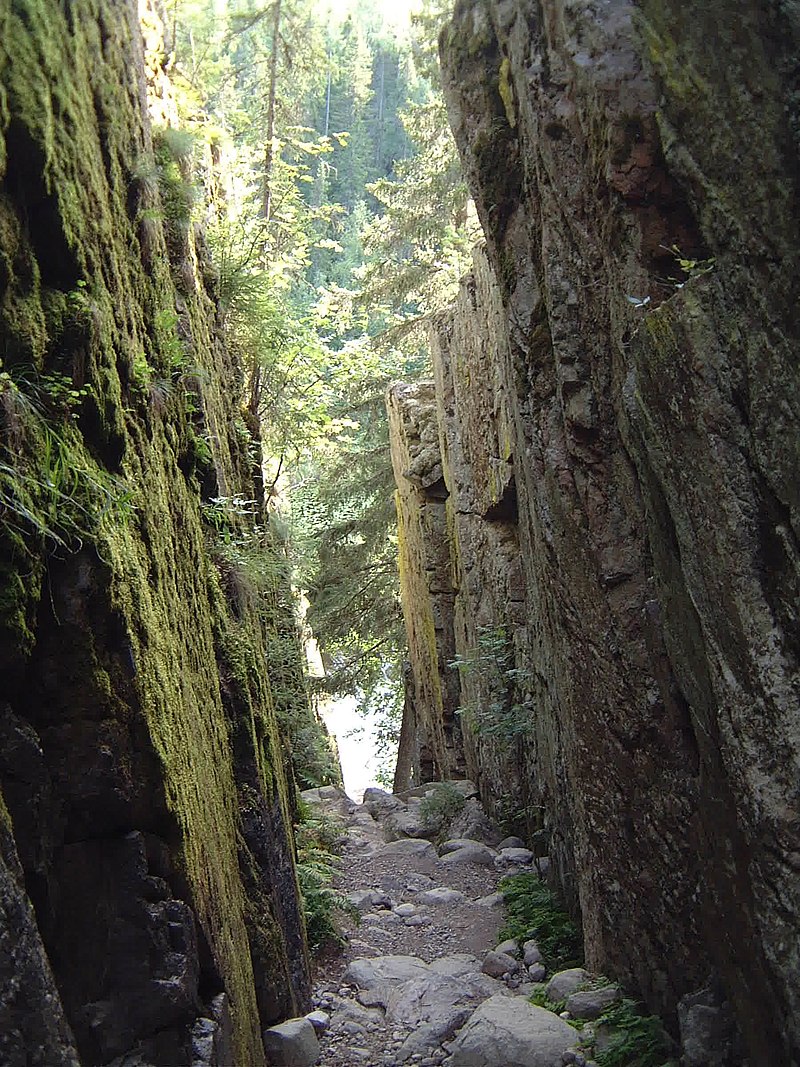
Anyway, back to the Finnish Pavilion which is called "Helvetinkolu", a"Gorge of Hell". It's situated on Calle Marie Curie, 1 and can be viewed through the gates. It's still in use, namely by the Foundation for Research and Promotion of Architecture. The name of the building, I suppose, is a reference to a gorge in Finland with the same name. The geological features of this area were created millions of years ago (pic below right), says the web.


The building is pretty cool, its combo of rusting steel and natural wood has weathered well its time. On wikipedia it says that the Finnish Pavilion is divided into two buildings, called "keel" (wooden: a reference to the nature and tradition) and "machine" (steel, glass, black: represent industrialisation and modernity), leaving between them a narrow open space of only two meters wide, kind of a gorge. 

The cool thing about the wooden structure is that it is supposedly made of Finnish pine and its artisan execution follows the principles of shipbuilding.

I also found out that one of the architects is still in practice and works with pretty interesting looking wooden structures. There is a link under projects to the Finnish Pavilion. The designers and architects were young architect students; Juha Jääskeläinen, Juha Kaakko, Petri Rouhiainen, Matti Sanaksenaho and Jari Tirkkonen, they are also interviewed at the news clip.

Last, worth watching is this promotional documentary from the Expo site, it's crazy to see how it actually looked like back then....