Tuesday, April 11, 2006

Weekly PhD Report 06, week 12 13 14

An update long overdue.

Things done:

  • Worked on analysing some LO evaluation models - this contributes to a book chapter that is due at the end of May 06. It's about reuse of LO evaluations, annotations and ratings in the context of social information retrieval.
  • Worked on creating a new social networking concept for an EUN tool called "school basket". Part of these ideas are under development into a short paper with Jehad and Martin. This will look how school basket type of data can be described in CAM.
  • Attended CALIBRATE meeting (http://calibrate.eun.org)
  • Attended the EUN meeting on learning resources issues. My summary on EUN event on Learning Resources Exchange, at http://insight.eun.org/ww/en/pub/insight/interoperability/monthlyinsight/lre_presentations.htm
  • Hung out with Griff Richards to exchange ideas on the common work done on LO evaluations and cognitive mapping. Envisaged to make a period of studies in Canada, why not?
  • Sent out the Community Consultation on Industrial property (stuff about software patents) to the Commission, text available at: http://wiki.ossite.org/index.php?title=No_eLearning_Patents_Consultation.
    • FYI, almost 500 people have signed the petition by now. We plan to continue the campaign, as it seems that a lot of e-learners are not aware of the ramifications of such EU-wide directive.
  • Finalised a chapter for an "open source for education" book on ten (10) European educational authorities actions regarding FOSS and open content.
  • I've enrolled in the Summer school at http://www.eudoraportal.org/Learn/ip2006/schedule2006/
planned to-dos
  • finalise the paper and the chapter sometime soon
  • plan some work with teachers on folksonomies for the upcoming MELT project

other stuff:

Monday, March 20, 2006

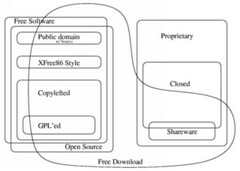
Work on defining open content


open source
Originally uploaded by vuorikari.
Interesting LOMI seminar, we talked about open content. The confusion that it creates with people makes me think a bit like talking about FOSS with people some years back - everyone talked about open source software, but they mixed all the terms and everyone had a different idea in their heads; while some meant using stuff like Mozilla on Windows, others were musing about how it is so difficult because running Linux is so dam hard.

I love the graph from Chao-Kuei that clearly puts things in places. I want to see something like this for open content, too. We have to elaborate on the concept of open content and allow it to expand to cover different variations; what happens when the content is of public domain, what can be done when Creative Commons are used, etc.

Open content made available under Creative Commons license, for example,
might allow you to access it and use it, but not to make any derivative
works. That means you can't rip, mix and mash it the way you would like,
let alone release it out to anyone else. Having content under CC pretty
much, though, goes under the understanding of open content. The "source
code" might be made available for reviewing, but not for modifications!

The same availability of source code would suit for the cases of "freeware" content, the free stuff that is made available by publishers, for instance, but can't be ripped, not can't be modified, as no source code is made available. This is kind of "read only" content that can be very valuable, however, has no re-use aspect for modifications and re-distribution. Someone mentioned in the LOMI seminar that free/shareware never made it big, but it does have its marketing value. And that is the stuff that publishers are eager to give away for free, however there is no way a user can play around ripping and mashing it. So, defining what is free/shareware of open content would be useful.

Also, it should be addressed whether there can be open content that is
commercial in the same way that there is commercial open source
software. Some might be interested in developing products and services
around that idea. Hec, I want to see someone making money of WikiPedia! Thus, to define open content one should not use the price as an identifier. Rather, if commercialisation of open content is
allowed, a better starting point for the definition of open content
should better be, for instance, proprietary or non-proprietary content?


In the LOMI seminar we also talked about open content and tried to define it through three different degrees: Open for access; open for modification and re-distribution; open for ....I cant remember. As open source software, most participants agreed that it is important to allow modification and re-distribution. However important that is, and however important the FSF thinks it is, for the average user like me and my mom, it is not that important. I don't have any knowledge to modify the code nor do any modifications, I just want stuff that works. That why for me "access" is important! If I can't have it, I can't use it.


Rambling thoughts, by no means written in stone! I'm very willing to work on defining open content by working on its concept based on Chao-Kuei's graph. I like the idea of displaying a variety of choices and having something to show and give a common group for discussion.

Tuesday, March 14, 2006

Edublog award nominees - the women

the most kick-ass woman in open source

Ok, I kinda missed it, it was International Women's day and there was all kinds of happenings going on. For example Josie asked all the people, especially gals, to blog and mention "International Edublogging Women's Day 2006".

I went to see her nominations today and this is an honor! Although she misspelled my name (many do, no hard feelings...), here is what she had put in the end of the posting "I can't wrap up without a shout out to Rinna Vuorikari of the Flosse Posse - the most kick-ass woman in open source;" Yeah, that's me :)

PRESS RELEASE: Don’t allow software patents to threaten technology enhanced learning in Europe – Sign the petition!

noelearningpatents

March 14 2006 (Brussels, Belgium) Sign now the petition that aims to alert European authorities and policy-makers to the dangers of software patents, and particularly to the negative impact they could have on e-learning that uses information and communication technologies (ICT) to enhance education.

All the European and international e-learning practitioners, as well as other concerned citizens, are welcome to sign the petition which will be sent to the European Commission as an input for the “Consultation on future patent policy in Europe” by the March 31st. Moreover, the petition will be distributed to other European and national decision-makers to rise awareness on the issue of EU-wide software patents and how they threaten to inhibit innovation among European e-learning developers and practitioners.

“Money spent on software patent and defending against litigation would be better spent on development, education and training” states the petition that is drafted by a community of e-learning practitioners after the first European Conference on Open Source for Education in the Netherlands in Nov 2005.

“The software patents present a clear danger for the whole field of e-learning, not only for its open source community, but for each developer and decision-maker who is responsible for delivering better education with the support of ICTs.” states Ms. Vuorikari from Flosse Posse.

The petition “Don’t allow software patents to threaten technology enhanced learning in Europe” aligns itself with the policy of the Foundation for a Free Information Infrastructure (FFII). The topic of EU-wide directive on software patents is rarely mentioned with regards to the field of e-learning, although its ramifications could be quite serious. Therefore it is important that this issue is brought to the attention and discussed by those in the field, so that those who oppose it can convey a common and unified position to the decision-makers across Europe.

If you are a concerned teacher, learner, parent, researcher, decision-maker, e-learning practitioner, developer or citizen, read and sign this petition on-line:
http://www.noelearningpatents.net

Make sure others know about it!
We are aiming to raise awareness and gather as many signatures as possible by Thursday 30th March 2006.

For more information address: info@noelearningpatents.info
-----------------------------------------------------------

Background information: In July 2005 the European Parliament rejected the proposed European software patent law (i.e. the directive on Computer Implemented Inventions) after years of "ping-ponging" between European institutions and fierce lobbying by both the pros and con sides. This directive sought to regulate the scope of patentability of software within the EU.

In July 2005 the proponents of software patentability agreed to drop the directive and push for the Community Patent instead. The Community Patent plan doesn’t even mention the subject of software, although, make no mistake about it, software patentability is one of the main drivers of these plans.

Seek more information and points of argument at the following site:

No Software Patents!
http://www.nosoftwarepatents.com

Foundation for Free Information Infrastructure
http://swpat.ffii.org/index.en.html
http://swpat.ffii.org/log/intro
http://patinfo.ffii.org/faq.en.html

FLOSSE POSSE:
http://flosse.dicole.org

Thursday, February 16, 2006

Thoughts about "the Search"

So I've been reading the book with a quite interest, and I'll blurb about a few things that stuck and might be worth mentioning. In the very beginning J.Battelle (can't find the page number now, that dam Ctrl+F does not work with paper,..wait a minute, maybe I should go to Amazon and search inside the book!) mentions that about 25% of searches that people make are intended to find or re-discover something that they've seen or read before. That's a lot! When reading it I thought of myself and how many times that has happened. Of course by that Battelle makes the case for the clickstream and how it will be the key element of search in the days and years to come. I kinda also like the social bookmarking aspect to it, "keep found things found", but this requires intent and action from the user, which can be avoided by just saving every click you take. Comes close to one of the themes of my interest, the level of user input required.

I especially liked the parts where Battelle was visioning and letting off his obsession of Google personalities (he talked in quite a few occasions about them, them, them, like they were some bloody simiantwins with a weird management style. Shows that the author is a freelance journalist, aren't all the bosses power obsessed freaks!?). The parts where he talked about personalised search (p.259) and how search would be linked to all types of services around was inspiring (p. 167). Everything would be indexed, even your kids and car keys. Imagine: "Honey, can't find my kids, can you Google them for me?" Well, seriously, I really dig the idea that if I make a search on the Web the rendered results would not be the same as the results that the guy next to me gets even for the same search term.

The whole deal with AdWord and purchasing the keyword for marketing purposes makes me think of "tags" and how could we use that idea for better things in education. It was something that I was thinking of last summer when writing this, but now reading about AdWord and such, it all became clearer to me. People tagging their own content, photos, blog posting, school assignments, etc, would not only tag it for their personal knowledge management purpose, but also like an advertiser buying a keyword to match it with other's demand, the tagger would better match hers own content to what ever is out there that might be relevant to her. For the educational purposes, both for formal and informal education, the possibilities could be enormous. And I'm not talking about matching people selling you an on-line course in French, but matching other people with similar interest to you, creating social networks where they previously didn't exist and allow learning to take new turns.

Towards the end of the book (p.137) J.Battelle talks about the differences between Google and Yahoo!. That was a very insightful part, and something that we've seen coming. Think of the difference between Google search results (algorithm+ adWord) vs. Yahoo! with some editorial touch adding Yahoo!'s search shortcuts, Google news (algorithm) vs. Yahoo! News (editorial), and now the whole service that Yahoo! is offering with 360 degree (hmm, not much hype there anymore and still in beta!). MySearch is about adding a social layer of Friends and Friends-of-a-Friend on the top of your search "to better understand the intent of your query" (p. 259). I love that last phrase!

This, to me, brings me back to quite a few discussions that I've had with my professor about the way my research should take. He seems to be the Google guy, whereas I see something more interesting and, ahem, intentional, in Yahoo!'s approach. I want to be able to give the steering wheel to user and say, "Fine, point me to the direction that you want to go and I'll refine the search and give you the best stuff!", instead of trusting a Good-mighty-algorithm to trust that it knows better what you like than you even think you do. I see this polarisation appearing in many places, services and applications on the Web, and I think it's great. I always think that with all the technologies that we have today we should be able to serve people's different preferences, was it then the Google guy or the Yahoo! guy.

Finally, I want to highlight this about how search pretty much still works these days: "Like DOS before Windows or the Mac, search's user interface is pretty much command driven: you punch in a query, you get a list of results." I think there is much to impove out there (like I think there is much to improve with anything that requires command line, e.g. installing most applications on Linux and how it sucks deeply), and the good thing is that, like the book says in one page, the search as a research area is still pretty uncharted, some estimate that we've covered only one digit % of it so far. Good, more to do for me :)

Monday, February 13, 2006

Weekly PhD report week 5-6

Work done:
  • Defined my research questions (below). Of course this is a piece of work that undergoes constant modifications, but at least this is now what I'm focusing on.
  • Worked on the plan for the Social Information Retrieval chapter. This is something that I'll be working on for the next 3 months.
    • The idea is to review some 20 LORs that use reviewing and ratings for LOs, look into classifying them using EQO model and repository, and eventually creating xml schema that allows saving them in a format that is interoperable. This was not only the metadata about a LO is interoperable, but also the annotation part.
    • This becomes be part of the work Jehad is on.

Things to do:
  • Continue by paper reviews
  • Continue the LOR annotation reviews
  • Enjoy the Idaho snow for the upcoming 2 weeks (20.2.-7.3.)

PhD research questions

Last weeks I've been trying to concentrate on defining my research questions. It's not an easy task. Firstly, there are so many things to look at, and then once you start framing the questions, they all becomes slippery and unclear, redundant and such. However, this is my last take on it:

Main question: What are the main barriers to discovery, re-discovery and use learning objects and how can Social Information Retrieval help?

  • Subquestion 1: Are there any specific requirements for the recommender system for LOs?
    Do we need to have any kind of “pedagogically aware” data or is it enough to use the existing models (such as movie, book recommenders) based on CF and content filtering methods?

  • Subquestion 2: What is the role of explicit information input such as ratings, reviews and annotations to enhance the discovery and and use of LOs? Related to "classical" collaborative filtering using ratings, reviews. (these are the reviews that people do mainly to help other people)

  • Subquestion 3: How can tags, lists and bookmarks enhance the discovery, recovery and use of LOs? e.g. “Playlist”, a feature in teachers' basket that allows them to make lists of LOs for a lesson, course, etc. “sequencing” This is stuff that people do for themselves, as part of PKM.

  • Subquestion 4: When using social information retrieval (SIR) techniques, what are the differences between anonymous (such as classical collaborative filtering using ratings, reviews) vs. self-manifested, explicit social networks (e.g. Yahoo MyRank2) as input for a recommender system? How do users perceive these, are there preferences, what type of interactions, etc? What would be the hybrid model like?

Monday, January 30, 2006

Weekly PhD Report 06, week 4

Work done:


- Presented the topic of my research interest at HMDB lunch


- Kept on reading research papers on different recommender systems and issues


- Finalised the chapter for the LOR review


Things to do:


- Continue by paper reviews


- Continue to work on my research questions and establish a plan for it


- Start preparing the work on a social information retrieval book chapter that was accepted in a call for contributions. See an abstract below


Towards Interoperable Social Recommendation: Storing, Sharing, and Reusing Evaluations of Learning Objects


Abstract


Since the early days of the use of digital learning resources in teaching and learning, quality has played an important role, sometimes more implicitly than explicitly. In the domain of digital learning resources, a plethora of ways to evaluate learning resources exists. However, limited ways to share and reuse these evaluations for social information retrieval purposes currently exist. Social recommendation is based on the opinions of the members of a community, in order to help individuals in that community more effectively identify content of interest from a potentially overwhelming set of choices.


This chapter emphasises the importance that the representation and storage of user experiences and evaluations of learning resources has, as a means to support social recommendation, and help users search the Web for learning resources in an effective and efficient manner. Thus, this chapter proposes a scheme for storing results from learning resources’ evaluation in a structured and reusable way, so that they can be shared between social recommendation systems. More specifically, the chapter develops an Evaluation Learning Object Metadata (evaLOM) model, a metadata schema that allows the description of the evaluation method used for learning resources, as well as storing its evaluation results. This model is part of a larger specification called Learning Object Log Specification (LO Log).

Friday, January 27, 2006

World according to World66

World66 ("the travel guide you write") is a great place, and it has become better and better over the years (still in perpetual beta, I see). There is this funny tool that let's you create a world map of countries that you've visited.

Mine looks like this:


Create your own visited country map
or check our Brussels travel guide

Tuesday, January 24, 2006

Weekly PhD Report 06, week 3

Work done:
  • I worked on my initial and preliminary research questions
  • Continued my paper review on different types and applications of recommender systems
  • Worked on my study plans
  • Worked a day in EUN and on my plan for 2005
  • Blogged about the new round on EU patent law: http://flosse.dicole.org

Things to do remains pretty much the same:
  • Continue by research reviews
  • Continue to work on my research questions
  • Give on more round on the LOR book chapter

Wednesday, January 18, 2006

Weekly PhD Report 06, week 2

Work done this week:
  • Participated in the HMDB lunch about clustering
  • Worked on the bookchapter about LORs.
    • The good news: the deadline has been extended until the end of the month, so we'll have time to adapt it according to some comments (Thanks Jehad and Martin!)
    • I'll send a new version around later this week in case someone wants to give it another try
  • Continued my paper review on different types and applications of recommender systems
  • Started working on my more precise research questions, hurray!
  • Checked a new application called http://www.yelp.com/ It's a social networking tool where you can find, review and talk about what's going on in your neighborhood, meaning in SF and a few other big cities in the US.
    • They have it all what you need nowadays for a YASNS (Yet Another Social Networking Service http://en.wikipedia.org/wiki/YASNS), you can add your network of friends, profiles and a Firefox toolbar for a direct search.
  • Tried to convince my promoter to do my pending administrational paper work

Things to do:
  • I'll start at EUN again, only one day a week and with less to do than last year (oh yeah!)
  • Continue my research reviews
  • Continue to work on my research questions
  • Continue to follow up the EC Patents discussion now with Open Consultation round
  • Put hard pressure on my promoter to finalise my pending administrational paper work.
  • Work on the LOR book chapter

Wednesday, January 11, 2006

Weekly PhD Report 06, week 1

work done:

  • Started an extensive review on recommendation systems, especially looking for papers on LORs and social networks
    • I'm looking especially design requirement and needs for LO recommender system, but interested in dilemmas found in the field and open questions such as what would the benefit of having a distributed service over a centralised one, etc.
  • Worked on the book chapter on LORs that I sent you a while ago.
  • Worked on a plan for the year and looked into some possible collaboration paths with people, namely picked up on an idea to write something with David Tosh from ELGG.
  • Tried to revitalise the plan for NING developments in vain
  • Kept Furling my reading and findings: http://www.furl.net/members/vuorikari

work to be done:

  • Continue my reading and note taking on recommendation systems
  • finalise the book chapter
  • write a scenario for Jehad on using the logs for LO review purposes
  • work on a plan to run a pilot on Ning
  • keep up the good spirit

Weekly PhD Report 51-52

  • Spent time writing a part for a paper "An Overview of Learning Object Repositories" with Argiris Tzikopoulos, Nikos Manouselis. Argis has made a survey on 59 repositories, and I was asked to help writing a part of it. I wish to send you this paper for comments later this week.
  • Worked on a proposal for a book chapter which would be called "Towards Interoperable Social Recommendation: Storing, Sharing, and Reusing Evaluations of Learning Objects". The idea would contribute to Jehad&all's Log specifications. This would also be used for recommendation purposes. See the attachment for more information.
  • Played around with swicki, see: http://riina1-swicki.eurekster.com/
    • Swickis are community search engines that learn from users

  • Checked out http://digg.com, the new hot tool for the community to review news. This is an interesting post about Digg and some other relevant social software.
    http://thomashawk.com/2006/01/digg-delicious-kaboodle-and-wink.html
    • The kick in Digg is that when you submit a link there, it will be Dugg [imperfect] by other news readers. As soon as one post starts getting Diggs on it, i.e. it is read by many other who think it's relevant, it will climb higher up on the relevance ranking list, thus appear on the front page of the Digg.
  • Worked on Ning.com application on social recommendation with Julien, Ben and Bram. We were not able to make it search Ariadne yet, but should be feasible soon.
    • The issues seems to be that we added our, well, Julien's own SOAP library to make the connection. However, the Amazon services module in Ning is pure PHP running in the Playground, as are the modules that use other web services (such as Flickr and Gmail). they said "You should be able to make external HTTP requests from Ning just fine, whether using curl or PEAR's HTTP::Client (both of which we support)." Hmmm...


Weekly PhD Report 51-52

  • Spent time writing a part for a paper "An Overview of Learning Object Repositories" with Argiris Tzikopoulos, Nikos Manouselis. Argis has made a survey on 59 repositories, and I was asked to help writing a part of it. I wish to send you this paper for comments later this week.
  • Worked on a proposal for a book chapter which would be called "Towards Interoperable Social Recommendation: Storing, Sharing, and Reusing Evaluations of Learning Objects". The idea would contribute to Jehad&all's Log specifications. This would also be used for recommendation purposes. See the attachment for more information.
  • Played around with swicki, see: http://riina1-swicki.eurekster.com/
    • Swickis are community search engines that learn from users

  • Checked out http://digg.com, the new hot tool for community reviewing of news.
  • Worked on Ning.com application on social recommendation with Julien, Ben and Bram. We were not able to make it search Ariadne yet, but should be feasible soon.


Saturday, December 31, 2005

10 Web Trends That Should Die in 2006

Yeah, there are so many good points. Things that I've been thinking about too, like spliting up the article (it is just so much easier to scrol down, don't you understand?), tiny font, etc.


One thing I would like to see on this type of a list is "Create the entire navigation menu in Flash". It is so last millennium, but people still keep doing it! I hate it, especailly because I don't have Flash installed in my default browser (I'm tired of seeing things and adds flying around on my screen). Many times those Flash navigation menus don't give any alternatives, thus I'm not even able to see the whole site. Dah, get over this, people!!

read more | digg story

Tuesday, December 13, 2005

Weekly PhD Report 49

Things done last week:

Unfortunately not much dedicated PhD work got done last week apart from some interesting encounters with researchers and practitioners attending the same event as I did, e.g. EduExchange in the NL http://eduexchange.kennisnet.nl/ and Eminent http://eminent.eun.org.

A few interesting leads I gathered: Networks seems to be popping up everywhere. Of course, not on the official agenda, but during the coffee brake discussions and dinner, etc. Many prominent e-learning researchers and practitioners dig the idea of bottom-up approach, thus social network analyses and social recommendations are being mentioned more and more.

Some interesting people I talked with:

  • OUNL seems to be working also on social recommendation in the context of peer tutoring and a new EU project called tenCompetences. If interested check http://dspace.ou.nl/ for names such as R.Kopper, P.Slop and C.Tattersall.

  • Had a chat with The Open University UK researcher R.mcCormick about how LOs are used by people and some ideas of looking at different links between the users and usage. This was interesting as I've thought about making similar analysis of the use of LOs once I get my experiment going with Ning.com.
    • I thought it would be interesting in looking for hubs (influential people) in distribution of LOs through social recommendations and social/collaborative browsing. McCormick suggested that if any are found, it would be interesting to classify different types of connections that there are in this type of social network. That could help us better understand the nature of take-up of some LOs and some not, etc.

  • Ulla Gjorling from UNI-C had done a study on the localisation of LOs within a project called eColors lead by EUN. They also made some recommendations for the ease of localisation. One of the outcomes was that producers rarely think about localisation, but it should be thought of while at the design and production phase, not later. Examples, translating some Flash files is labor intensive, but much easier if the text is inserted in an xml-file instead of within.
    • This made me think that FOSS approach for ease of localisation should be adapted also for LOs, keep text separate from the code. Also, eColors talked about special localisation expertiece centers in Europe. They could use some SourceForge type of tools to make their job easier. This probably will be further investigate in a future project to enhance cross-boarder collaboration of LOs.
  • Chatted up with James Simon from SUN who told me about SUN's involvement in Hypercomputing (not super computing anymore?..). They are about to build one with Japanese AMD and wish to get up on the ranking about the fastest computers. Cool to know people like that! I also mulled over my PhD work a bit with him to get some validation for the idea. He seem to think it was important.

  • Quality of learning resources seems to be popping up in every country in Europe. The leading work is done by BECTA, UK and the National Board of Education in Finland (both about to finalise: see insight.eun.org/dossiers).
    • Also, Poland, Switzerland, Hungary, Italy (INDIRE), Slovakia have work in planned/in progress. A lot of synergies can be picked up and one plan is to make a peer review process of UK and Fi work to see what aspects of work can be transfered to European level, and what is laterally transferable from one country to another.

  • Galvin Conor from UCD Dublin sat next to me during dinner. We talked about academic research, PhDs, Summer Schools and such. He recommended me one Summer School, but I seem to have forgotten it. We also talked about networks and how ideas spread out. Too bad that I can't recite all the important things that were said, but the Eifel tower cruise on a boat was great!

Voila quoi, that was my week.


Things to do:

- Work on the bookchapter on "An overview of Leanring Object Repositories"

- Work on the abstract for the book on social retrieval mechanism.

- as usual

Weekly PhD report 48

Things done:

  • Heard that I received a scholarship for 2 years from Finland. Let's celebrate that later!

Todo-list will remain the same, no much progress there :(

Thursday, November 24, 2005

The Top 20 Edu Blogs

Where's Glenn?: 11/21 - 11/25: "BlogThis!"

Ok, one of those blogger guys again, sigh, who put their picture in the front, side bar and everywhere. Makes me really wonder what is this blogging really about..?

Anyway, he's put up a list of the Top 20 educational blogs. Some names that I read regularly, some more sporadically, some I don't even know. Pretty anglo-saxon, though..

Thursday, November 17, 2005

A few words about the open source for education in Europe conference


You can find the whole posting at the link. It was FUN! The picture about me does not work on the blog posting, but here it is again.

I'm frustrated about blogging, it takes so much time! And I don't seem to understand what the trackback is about :( Yeah, and then all these postings in different blogs just kill me. There! It feels better ones it's out!